Highest Rated Videos
 7,976 views
12,195 views
7,976 views
12,195 views 12,783 views
11,757 views
11,560 views
12,783 views
11,757 views
11,560 views
 502,889 views
 15,961 views
 18,701 views
 13,102 views
 1,881 views
Related Videos
291 views
236 views
414 views 209 views











Birds are clearly distinct creatures from dinosaurs, with unique lung design, fully-formed feathers, and flying machinery. Even under evolutionary dating, undoubted birds are older than their alleged dinosaur ancestors. …read more Read more here: creation.com
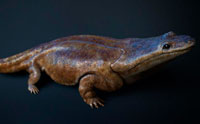
Scientists in Portugal unearthed a “super salamander” which, although “weird compared to anything today,” is still very much a salamander. The fossilized bones of the six-foot animal were discovered on a hillside dig “chock-full” of bones and declared to originate from the “Upper Triassic” period, some 200 million years ago according to evolutionary dating. But creationists see this as yet another discovery of a created animal that grew to large dimensions in the fertile world before the Flood, and was subsequently buried during the Flood itself. More… …read more Read more here: icr.org

As the genomes of many new creatures rapidly fill the public DNA sequence databases, the problems for the grand evolutionary story are becoming overwhelming. One issue is the fact that different creatures have unique sets of genes specific to their kind with no apparent evolutionary history. To explain this glaring problem, evolutionists have resorted to the myth of pervasive horizontal gene transfer. More… …read more Read more here: icr.org
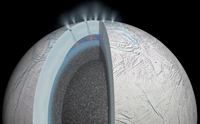
The more we learn about Enceladus, the younger it looks. Stated another way, the more that our space probes discover about this fascinating little moon that inhabits Saturn’s tenuous E ring, the more challenging it becomes for conventional origins to explain. A new discovery adds to the list of young-looking Enceladus features. More… …read more Read more here: icr.org

By Dr. Elizabeth Mitchell Does the “world’s oldest sponge” confirm evolutionary beginnings of multicellular animal life at least 600 million years ago? …read more Read more here: AIG Daily

The humble fingernail turns out to have intricate design. The middle layer has fibres aligned to prevent tearing down to the nail beds, and the two outer layers make nails as strong as hooves. …read more Read more here: creation.com

By Tom Hennigan This paper is meant to lay creation groundwork for lizard systematics with the goal of estimating the number of baramins brought on the Ark. …read more Read more here: AIG Daily

Do raindrop imprints help identify the pre-Flood/Flood boundary? …read more Read more here: creation.com
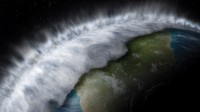
By Dr. Danny Faulkner Dr. Danny Faulkner analyzes Dr. Walt Brown’s determination of the date of the Flood within his hydroplate model using the orbits of two comets. …read more Read more here: AIG Daily

By Dr. Elizabeth Mitchell From almost the same genetic building blocks, DNA, very different results are achieved! But is that the result of evolution, or God’s design? …read more Read more here: AIG Daily

Despite no verifiable evidence in support of dark matter, its existence is being presented to the public as established fact. …read more Read more here: creation.com

Research indicates that many outward characteristics of organisms may be the result of ‘switching on’ of existing genes in response to the environment. …read more Read more here: creation.com

The bombardier beetle’s explosive secrets are inspiring engineers to design better aircraft engines. …read more Read more here: creation.com

Response to Reasonable Faith lecture shows radiometric dating is not as objective as claimed to be. …read more Read more here: creation.com

The evolutionary tree of life popularized by Charles Darwin has been shaken to its roots by the molecular genetics revolution. …read more Read more here: creation.com
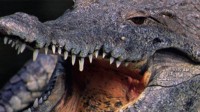
By Dr. Elizabeth Mitchell To evolutionists, the “butcher” crocodile demonstrates crocodiles had evolved to be major Triassic predators millions of years before dinosaurs ruled the world. …read more Read more here: AIG Daily

Essential to understand chemical evolution, and all other processes we take for granted. …read more Read more here: creation.com

By Jeffrey P. Tomkins Based on differences in gene sets and molecular machines between bacteria and eukarya, we continue to demonstrate that unbridgeable evolutionary chasms exist. …read more Read more here: AIG Daily

Wrong evolutionary assumptions about the thymus gland and cot deaths led to the unnecessary demise of many more children. …read more Read more here: creation.com

By Dr. Andrew Snelling Evolutionists say the oldest human fossil, the Ledi jaw (LD 350-1), shows humans had evolved from ancestors like Lucy in East Africa 2.8 million years ago. …read more Read more here: AIG Daily
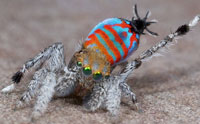
A University of California Berkley graduate student has discovered two beautiful new species of peacock spiders in southeast Queensland, Australia. The student, Madeline Girard, named the two colorful creatures “Sparklemuffin” and “Skeletorus,” both of the genus Maratus. Are these splendid specimens highly evolved species or have spiders always been spiders? More… …read more Read more here: icr.org

By Jeffrey P. Tomkins In the grand evolutionary paradigm, the origin of the eukaryotic cell represents one of the great mysteries and key hypothetical transitions of life. …read more Read more here: AIG Daily

Geological features that scientists struggle to explain likely of impact origin. …read more Read more here: creation.com

New claims about this ‘classic’ origin-of-life experiment, but it remains inadequate-and evidence shows the earth always had an oxidizing atmosphere. …read more Read more here: creation.com
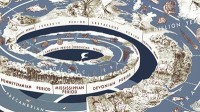
By Dr. Elizabeth Mitchell Does the Cambrian explosion mark the beginning of the catastrophic global Flood or the beginning of vertebrate evolution? …read more Read more here: AIG Daily

By Ken Ham Headlines are buzzing with news about the oldest known human in the fossil record. The specimen—half a lower jawbone with five teeth—was found in the […] …read more Read more here: Ken Ham AIG

A recent discovery indicates our eyelashes must measure at just the right length to function properly. Scientists at the Georgia Institute of Technology studied 22 mammal lash lengths and reported that, from giraffes to hedgehogs, lash length was of “optimum” length—about one-third of the width of the given mammal’s eye. More… …read more Read more here: icr.org