Highest Rated Videos
 8,517 views
12,751 views
8,517 views
12,751 views 13,226 views
11,876 views
13,226 views
11,876 views
 503,506 views
 16,405 views
 19,291 views
 13,638 views
Related Videos
1,106 views
1,231 views
1,006 views
1,034 views










Researchers in the field of astronomy have recently announced what is described to be a ‘truly monstrous’ structure, consisting of a ring of galaxies around 5 billion light-years across. Reported findings show that the seemingly unprecedented galactic ring, which was revealed by nine Gamma-Ray Bursts (GRBs), is located 7 billion light-years away. GRBs are thought to be the result of massive stars collapsing into black holes, ostensibly at the end of the stars’ lives. Because black holes are typically found inside galaxies, astronomers say the ring of GRBs is evidence of a gigantic galaxy ring. Beacons can be used to [More]
‘If Noahs Flood really happened, then why don’t we see any evidence for it?’ a skeptic might ask. In today’s era of mass-media disinformation, this type of question is hurled at Bible-believers daily. The answer is quite simply this: evidence for Noah’s Flood is everywhere, but it is not reported as such by mainstream secular sources. A recent Associated Press article posted on the Guardian website provides us yet another perfect example of how evidence can be hidden in plain sight and presented in a completely dishonest way. Read More: Unpermineralized hadrosaur bones Alaska – creation.com
By Dr. Andrew A. Snelling The biblical worldview changes how you see everything, even a “paradise” like Hawaii. …read more Read more here: AIG Daily
By Dr. Alan Gillen Is Community-associated (CA)-MRSA “evolution in action”? Microbiology research based on creation provides some answers to its emerging dominance in the USA. …read more Read more here: AIG Daily
As noted previously,1 there is a subtle connection between the creation-evolution issue and anxiety over ‘global warming’ or ‘climate change’. Thus a biblical worldview helps to guard against alarmism in this area. Another reason for taking a judicious approach toward this issue are ‘gaps’ in our understanding of meteorology: There is a very real possibility that current meteorological and climatological models are not taking into account all the relevant physics. In particular, there is a possibility that cosmic rays could be influencing weather and climate Read More: Cosmic ray weather climate link – creation.com
When describing so-called ‘transitional’ fossils, we often call such fossils ‘mosaic fossils’. What do we mean? Read More: Mosaic fossils – creation.com
By Dr. David Menton A bird’s-eye view involves much more than the panoramic view we see from an airplane. …read more Read more here: AIG Daily
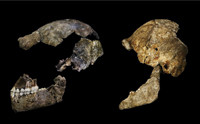
In the first of our three articles on this news-grabbing subject, we pointed out some strange circumstances surrounding the geology of the cave systems in which Homo naledi was discovered, as well as critical mismatches in bony body parts. This second article exposes a strange lack of evolutionary dating methods. Why has lead researcher Lee Berger, who is touring the world touting these fossils, not performed even one of several standard dating methods for fossils? More… …read more Read more here: icr.org
Does saying that God designed creatures mean that they’re nothing more than mere machines? Despite protestations from prominent evolutionists, teleology (purpose) is central to understanding biology. But does this mean that organisms were designed by some external agent? There are evolutionists who agree that life is full of purpose, but that purpose comes from the very fabric of the universe itself, so that there’s no need for an external designer. Eugene Y. from Malaysia writes: Read More: Biology purpose and pantheism – creation.com

By Ken Ham Sometimes I see things in the news that just make me shake my head. I’m often reminded of this verse about those who ignore God’s clear witness in creation: “Professing to be wise, they became fools” (Romans 1:22). Well, I was most recently reminded of this in relation to an article titled, “Fossil could settle the debate over whether early birds really did fly.” This article is reporting on a study published in Scientific Reports that showed that supposed “early” birds flew just like modern ones. Wow! Now that’s a revelation! This study revolved around part of [More]
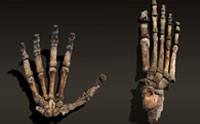
Recent claims of a transitional species named Homo naledi have the anthropologic world in an uproar. The new fossil “species” is said to be a human-like ancestor that neatly fills the gap between the Australopithecus and our own genus Homo. This seemingly fits the human evolution story promulgated since the 19th century, but what are these bones really? More… …read more Read more here: icr.org

By Dr. Elizabeth Mitchell An ape that can learn to walk on its hind legs or has some similarities to humans does not demonstrate that it is an evolutionary cousin of human beings. …read more Read more here: AIG Daily

Why Mt Everest, the Grand Canyon and multiple other significant geological features mark Earth as a special planet. …read more Read more here: creation.com

David Attenborough fails in his attempt to refute the Genesis account of creation with his account of the Darwinian tree of life. …read more Read more here: creation.com

Darwinists hold up gene duplication as evidence for ‘goo-to-you’ evolutionary change but the reality is much different. …read more Read more here: creation.com

By Dr. Alan Gillen We have seen a changing profile from HA-MRSA to CA-MRSA. This is potentially dangerous because the new strains are more virulent and aggressive. …read more Read more here: AIG Daily

How do we explain ‘apeman’ fossils from a biblical perspective? …read more Read more here: creation.com

By Dr. Elizabeth Mitchell The Open Tree of Life represents a rejection of our Creator’s account of our origins in favor of man’s unverifiable belief that random processes produced life. …read more Read more here: AIG Daily

By Frost Smith Scientists were hoping for insight into why so many fossilized dinosaurs are buried in rock appearing to be in what’s been called the “throes of death” posture. …read more Read more here: AIG Daily
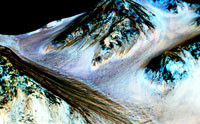
Scientists have announced indirect evidence of liquid water on the surface of Mars, raising hopes among secular scientists that life may be present on the “red planet.” But why do they hope for this—and are such hopes realistic? More… …read more Read more here: icr.org

Along with fudge factors, such as Dark Matter used to explain the big bang, the chameleon particle has been introduced even though there’s no evidence it exists. …read more Read more here: creation.com

By Dr. John Whitmore How is it possible to get such thick ocean reefs, if they had only a few thousand years to grow, after the Flood? …read more Read more here: AIG Daily

Archer fish exploits two independent hydrodynamic properties to shoot down prey with powerful water jet. …read more Read more here: creation.com

The Lake Missoula flood can’t be tamed by spreading it over long periods of time. …read more Read more here: creation.com

A short protein, or peptide, in wasp toxin may one day treat human cancer in a whole new way. Researchers isolated a particular peptide from the venom of Brazilian Polybia paulista wasps and studied how it seeks and destroys cancer cells while leaving normal cells unharmed. They uncovered intriguing details that enable this average-looking peptide to become a cell-destroying weapon. More… …read more Read more here: icr.org

By Jeffrey P. Tomkins Past evolutionary research in comparative DNA analysis between chimps and humans has employed a great deal of preferential and selective data analysis. …read more Read more here: AIG Daily
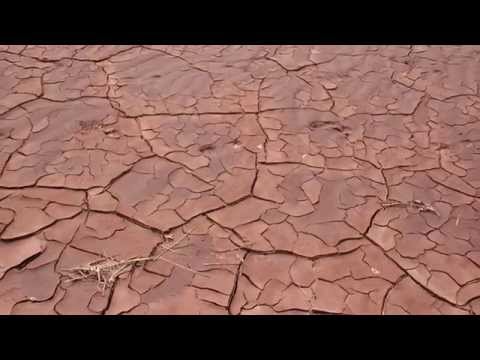
‘Mud cracks’, as they are commonly called, form when muddy sediment is exposed to the air and dries out. This causes the mud to dehydrate, shrink and crack. Some Bible critics claim that mud cracks disprove the global flood, because they are supposedly found throughout the geological record, and therefore imply a series of prolonged periods of drying out, instead of one great watery cataclysm that laid down most sedimentary layers. However, this argument is far from ‘rock solid’, because true mud cracks are easy to confuse with cracks formed by other mechanisms that don’t involve a period of drying [More]