Highest Rated Videos
 8,496 views
12,738 views
8,496 views
12,738 views 13,214 views
11,860 views
13,214 views
11,860 views
 503,481 views
 16,391 views
 19,277 views
 13,624 views
Related Videos
 1,154 views











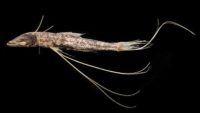
By Harry F. Sanders, III The tripod fish, which is challenging to evolutionists, is a truly unique creature that exhibits remarkable evidence of God’s hand in his creation. …read more Source: AIG Daily

The sea creature that makes so much of an impression, its effects can be seen from outer space. …read more Source: creation.com

By Harry F. Sanders, III 2018 was a busy year for biology. We covered many of these events on Answers News or our website to equip the church to answer the questions of our day. …read more Source: AIG Daily
When investigating true-vs.-false controversies, words are very important. Yet Christians sometimes unintentionally perpetuate false teachings by using misleading terms that accommodate evolutionary assumptions.1,2 This is what law courts call confusion of issues, a truth-interference problem so serious that trial judges, invoking Evidence Rule 403, ban such confusing terminology when admitting trial evidence.3 For example, the origin of species is a confusing topic. What exactly is a species? How can we properly analyze and discuss our origins if the words we use mean different things to different people? Consider this approach by Wikipedia, the multi-anonymous online encyclopedia that institutionally assumes [More]
While I was chatting once with an inmate at a Pennsylvanian prison, he told me that upon his arrival a guard wryly said he was free to do whatever he wanted…so long as it was regulated. Regulations are a method of control using rules in lieu of physical handling. Since regulatory control over systems, processes, and behaviors is often essential, regulations are pervasive in organizations—and also in biology. If engineered control systems and biological regulatory systems are both based on rules, how similar are they? Read More: Engineered Adaptability: Biological Networks Feature Finest Engineering Principles | The Institute for [More]

Time to clear up the confusion caused by misleading use of the term ‘fitness’. …read more Source: creation.com
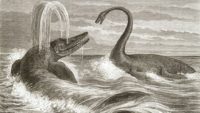
By Ken Ham New research reveals ichthyosaurs, extinct marine creatures, likely had blubber, smooth skin, countershading, and were warm-blooded. Now that’s interesting and will certainly prompt scientists to take another look at this fascinating creature. But the real story here is one you have to read between the lines to get. Johan Lindgren, the lead researcher on this study published in Nature, states of the find: This animal’s preservation is unusual, especially for a marine environment . . . This specimen has given us more evidence that these tissues and molecules can preserve for extremely long periods, and that soft [More]

The lovable, designed gecko makes the news again this year.1 In 2009, it was discovered the gecko had amazing nocturnal vision.2 Even their sophisticated feet that secrete phospholipids, complex membrane molecules, are a wonder of creation.3 The impediment of directional hearing in small animals, such as the gecko, is cleverly solved by the Creator’s design. In larger creatures, … More… …read more Source: icr.org

It does not add up for the evolutionary story. …read more Source: creation.com

A research team described a form of fossilization that it thinks can explain how original proteins have lasted for millions of years in Earth’s crust. It does match certain fossil features, but leaves two key questions unanswered. And that leaves soft tissue fossils still looking quite young. Publishing in Nature Communications, Yale University scientist Jasmina Wiemann and colleagues drew two parallels… More… …read more Source: icr.org

By Dr. Joe Francis The narwhal’s unusual tusk clearly didn’t grow by accident—but what is it there for? …read more Source: AIG Daily
Experimenting on humans, especially at the earliest stages of life, raises all sorts of ethical problems. From IVF to human cloning, people have debated the morality of tampering with people, who might then suffer consequences from the experimentation throughout their lives. CRISPR (clustered regularly interspaced short palindromic repeats), a gene-editing technology that has made genetic manipulation easier and less expensive than ever before, holds both the promise of a cure for diseases that are currently fatal, and the threat of opening a Pandora’s box of unintended consequences. Source: Genetically modified babies – creation.com

Plankton is a generic term for small marine creatures such as algae, bacteria, and protozoa. Although tiny, they are packed with incredibly intricate submicroscopic structures. This complexity isn’t surprising since many of these entities are photosynthetic, able to turn light energy into sugars needed for life’s energy. This process of photosynthesis is surprisingly complex. Bacteria and single-celled alg… More… …read more Source: icr.org
Contrary to the well-known intelligent-design claim that some biological systems are so complex that they must have been designed, botanist and environmental scientist Alexander Williams has now described a new concept that shows all aspects of life point to intelligent design. ‘This concept is simpler, and broader in its application, than Behe’s concept of irreducible complexity’, Williams says, ‘and it applies to all of life, not just to some of it.’ Writing in the latest issue of the Journal of Creation, Williams outlines the biological concept of autopoiesis, a term that literally means ‘self-making’. Autopoiesis refers to the [More]

By Harry F. Sanders, III It’s commonly assumed that mutations associated with genetic diseases and cancers occur because they disrupted otherwise ordered proteins, but is this the case? …read more Source: AIG Daily

Evolutionists stopped in their tracks as amber find has them scratching their heads. …read more Source: creation.com

What’s an ‘animal-only’ pigment doing in plants? …read more Source: creation.com
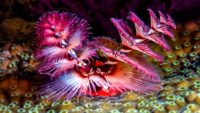
This miniature underwater Christmas tree shows how wonderfully God blends the beautiful with the practical. …read more Source: AIG Daily

Evidence for creation is seen in both the sudden origin1 of spiders, as demonstrated in the fossil record, and their amazing design.2 All spiders are created with four pairs of walking legs. Spider fossils are rare. Only about a thousand fossil species have been described worldwide. But they always display their iconic eight legs, remarkably complex eyesight organs and are, as creationists predict, 100% spiders. The Ju… More… …read more Source: icr.org
By Dr. Jason Lisle Randy Guliuzza has made some controversial claims regarding the cause and nature of adaptation of organisms to their environment. We examine his claims. …read more Source: AIG Daily
The evolution of the eye has always been a dilemma for evolutionists from Darwin’s time to the present. Although Darwin, Richard Dawkins and other evolutionists have tried to explain how an eye could evolve, their solutions are clearly unsatisfactory. Many kinds of eyes exist, but no progression of eye designs from simple to complex can be produced in the natural or fossil world. Furthermore, the simplest ‘eye’, the eyespot, is not an eye but pigmented cells used for phototaxis; yet even it requires an enormously complex mechanism in order to function as a vision system. Read More: Did eyes [More]
The following brief web article was adapted from the section on alleged ‘bad designs’ in Dr Sarfati’s new book By Design, which is subtitled, Evidence for nature’s Intelligent Designer—the God of the Bible. The prostate is a walnut-sized gland in male mammals that secretes a clear, slightly alkaline liquid that comprises about 10–30% of the volume of semen. Thus it is a vital musculoglandular organ for reproduction. Some critics of creation/intelligent design complain that it is badly designed because the urethra (the tube through which urine flows out) passes through it, so if the prostate enlarges, it restricts urine [More]
Francis Crick and James Watson have used the occasion of the 50th anniversary of their discovery of the DNA double helix as an excuse to attack belief in a Creator.1 wikimedia commons Francis Crick and James Watson. Together with Maurice Wilkins they received the Noble Prize in 1962 for their discovery of the double helix structure of DNA back in 1953. A recent UK news article about the Nobel-Prize–winning pair claimed ‘scientific discoveries have a habit of offending religious susceptibilities’, and pointed out, ‘Watson and Crick are both outspoken atheists.’1 These comments attempt to reinforce the old canard [More]

By Dr. Andrew Fabich References to Noah’s Ark abound in the culture and even have been used to describe recent efforts to store strains of microbes (instead of animals). …read more Source: AIG Daily
Is the ribosome designed? Are there differences between the ribosomes in the different domains of life? Read More at Creation.com

Humans mostly find rodents repulsive, but lots of creatures love this one. …read more Source: creation.com

A pristine Mesozoic bird fossil showed impressions of feathers and even some organs, including what appear to be lungs. The technical article published in the leading journal PNAS did not report any original body tissue, nor any substance that literally felt soft.1 Instead, the now-decomposed lungs left such detailed impressions that researchers saw lung microstructures. Two aspects of this set of probable lungs confirm … More… …read more Source: icr.org