Highest Rated Videos
 7,977 views
12,195 views
7,977 views
12,195 views 12,783 views
11,757 views
11,561 views
12,783 views
11,757 views
11,561 views
 502,889 views
 15,961 views
 18,701 views
 13,103 views
Related Videos
255 views![Where Could I Go? [Live]](http://img.youtube.com/vi/_aeECPiZpWY/0.jpg "Where Could I Go? [Live]") 11,646 views
11,646 views 1,839 views
374 views
1,839 views
374 views












By Dr. Marcus Ross Winged reptiles were primitive, clumsy, “prehistoric” beasts, barely able to get off the ground, right? Take a closer look and see. …read more Read more here: AIG Daily
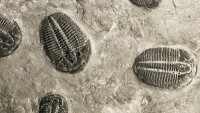
By Avery Foley Geologists claim their work with the fossil Dicynodon shows that the supposed terrestrial mass extinction happened before the marine extinction. …read more Read more here: AIG Daily
A team of French and Canadian scientists have identified preserved embryos within the eggs of a tiny shrimp-like creature believed to have lived over 500 million years ago, raising questions about both the development of the creatures’ brooding abilities and the likelihood of such delicate materials surviving for thousands of millennia. Waptia fieldensis is a tiny, shrimp-like arthropod whose fossilized remains were first found 100 years ago in Cambrian layers of fossils in Canada. Now extinct, Waptia was a frail creature that carried the eggs of its young within its own body. Canadian researchers studying Waptia specimens recently made a [More]

The distribution of the galaxies appears anything but random and stands in stark contrast to the model promoted by big bang cosmologists. …read more Read more here: creation.com

Might it actually be evidence for design? …read more Read more here: creation.com
By Dr. Elizabeth Mitchell Evolutionists claim human intelligence, culture, and society evolved because an ape-like ancestor’s brain evolved the need to be shaped by the environment. …read more Read more here: AIG Daily

Plenty of 2015 discoveries clashed with the largely fictional portrayal of dinosaurs in this year’s blockbuster movie Jurassic World. They even confront basic theories, like that dinosaurs evolved into birds or died off tens of millions of years ago. More… …read more Read more here: icr.org

The question of Ice Ages proves more of a problem for secular scientists to answer than it does for creationists. …read more Read more here: creation.com
By Dr. Andrew A. Snelling This contribution is designed to document the radioisotope dating data for groups of chondrites, stony achondrites, pallasites and mesosiderites, and irons. …read more Read more here: AIG Daily
By Dr. Andrew Fabich ERVs are found in the same location in the genome across species, so evolutionists apply their ideas of common ancestry and say ERVs demonstrate evolution. …read more Read more here: AIG Daily

The discovery of planets around distant stars isn’t new. Roughly 2,000 exoplanets are confirmed to exist. But astronomers claim to have direct evidence that a giant planet is in the process of forming. How strong is this claim? More… …read more Read more here: icr.org

Could an anomaly found in the map of the cosmic microwave background be from one universe bumping up against another? …read more Read more here: creation.com
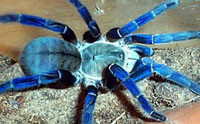
The BBC recently reported a group of tarantulas possessing a beautiful blue color that apparently has an important signaling function. Evolutionary researchers maintain this shade of cobalt evolved at least eight separate times. But what’s the evidence? More… …read more Read more here: icr.org

Designers of flying robotic drones have tried and failed to make autonomous landing systems, despite using lasers, radars, sonars and GPS technology. So how do bees do it so easily? …read more Read more here: creation.com

Evolutionists once thought that jumping genes were ‘selfish’ DNA, but Australian wallabies show they were jumping to the wrong conclusions. …read more Read more here: creation.com

Newfound “feathered dinosaurs” continue to garner fossil headlines. What’s the big deal? Peter Larson, part of a team that described an eight-foot tall supposedly feathered raptor fossil, explained its significance to the Rapid City Journal. The paper wrote, “He said this discovery is so important because this group of dinosaurs is ‘very, very closely related to birds.'” Did they find actual feathers? Does this fossil really confirm that dinosaurs evolved into birds? More… …read more Read more here: icr.org

By Michael J. Oard Both the Ice Age and the many millions of woolly mammoths buried in Siberian permafrost have been major mysteries for about years despite numerous theories. …read more Read more here: AIG Daily
By Dr. David Menton Perhaps more than any other fossil, Lucy is presented as “exhibit A” for evolutionists in their attempt to show that humans evolved from an ape-like ancestor. …read more Read more here: AIG Daily

The largest volcano on Earth erupted catastrophically …read more Read more here: creation.com

Evolutionary claims of a new species of yeast simply fall flat. …read more Read more here: creation.com

Earlier this year, New Horizons flew past dwarf planet Pluto and its sister Charon, rapidly capturing data. That information continues to trickle in, revealing a surprisingly smooth heart-shaped plain called “Tombaugh Regio.” The countless craters expected from billions of years’ worth of impacts are nowhere to be found. More… …read more Read more here: icr.org

Jim Stump at BioLogos recently posted an article claiming to resolve 10 ‘common misconceptions’ about evolution which attacks biblical creation. Does it stack up? …read more Read more here: creation.com

Does a Y chromosome and estrogen in men make them confused about their sexual identity? …read more Read more here: creation.com

Ice core discovery supports the creationist model of the post-Flood ice age. …read more Read more here: creation.com

Following the discovery of remains that have been named Homo naledi, more questions than answers emerge when the facts are examined. …read more Read more here: creation.com
By Dr. Andrew A. Snelling For decades, dinosaurs have troubled Christians who didn’t know how to explain them from the Bible. …read more Read more here: AIG Daily
By Dr. Elizabeth Mitchell Some believe the Gibbon-like fossil Pliobates cataloniae sheds light on the common ancestor supposedly shared by monkeys, apes, and humans. …read more Read more here: AIG Daily