Highest Rated Videos
 7,974 views
12,193 views
7,974 views
12,193 views 12,782 views
11,756 views
11,558 views
12,782 views
11,756 views
11,558 views
 502,888 views
 15,959 views
 18,700 views
 13,101 views
 2,898 views
Related Videos
258 views 442 views
476 views
442 views
476 views












Scientists velcroed wood-‘n’-clay tails onto chickens to reverse-engineer dinosaur-to-bird evolution. Really. …read more Read more here: AIG Daily

In this 2-part BBC TV program,1 Sir David Attenborough tells us he is going to look at the rise of vertebrate animals, because, he says, “The story of the rise of animals is also the story of why you and I came to be as we are.” As he presents this specious evolutionary fish story, we shall compare it with the biblical record, and seek to ascertain which is correct, as each contradicts the other. He begins in China, which he says is “the new frontier for fossil discoveries”. Unfortunately it is also the new frontier for fossil forgeries. …read [More]

The molecular mechanism at the root of cavefish blindness is unmasked. …read more Read more here: AIG Daily

Physicists in California and Hawaii found evidence that solar wind performs curious chemistry on space dust, and they suggested that this will help support a naturalistic origin of life on Earth. But how much help will it really bring? More… …read more Read more here: icr.org

Mirror, mirror, on the wall, what’s the fishiest fable of them all? …read more Read more here: AIG Daily
“One more marvel of design in nature.” Admin Certain gecko lizards can see color in dim light. That means these geckos’ eyes are about 350 times more sensitive than human eyes, which see only black and white in the same conditions. Can evolution account for the origin of the remarkable machinery that enables these nocturnal creatures to see so well? Scientists studying the helmet gecko’s eyes found distinct concentric zones, each with a different refractive power. Geckos also have a much higher density of oversized cone cells in their retinas that are responsible for detecting specific light wavelengths. In their [More]
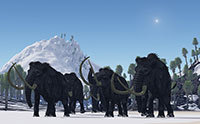
Researchers claim to potentially have solved the mystery of the wooly mammoth’s mass extinction—the creatures went extinct when grasses began “crowding out” other edible plants these massive animals needed to subsist. More… …read more Read more here: icr.org

Coral reefs are masses of limestone created as the polyps build their skeletons-an amazing symbiosis between an animal and algae. They grow quickly. Bye-bye millions of years. …read more Read more here: creation.com

The dog’s shoulder is a brilliant design, in spite of evolutionary teaching to the contrary. …read more Read more here: creation.com
“I’ve posted a number of these articles about marvels of design which occur throughout nature yet no matter how many examples are given evolutionists still insist they are just products of blind random chance … how foolish can you get.” Admin For decades, human design engineers have been laboring to make more efficient machines, like propeller blades that produce steady airflow patterns. Our thinking has been fixed on the idea that smooth surfaces are the best basic form, but studies on whales and dolphins are changing that. A whale flipper has a bumpy edge. After incorporating some bumpy, irregular features into [More]

A research team recently characterized a group of genes in humans and other mammals that not only defies evolutionary models but vindicates the Bible’s prediction of the uniqueness of created kinds with distinct genetic features. More… …read more Read more here: icr.org
Sep 8, 2008 … A gecko foot encased in amber has been dubbed the oldest gecko fossil ever discovered, according to researchers from Oregon State University and the Natural History Museum in London.1 The amber deposits containing the remarkably well-preserved fossil, discovered in Myanmar, are said to be around 100 million years old, which would double the “date” of the earliest-known gecko, making it “43 to 56 million years older” than the prior record holder.2 The discovery has been given the customary evolutionary interpretation, but the evidence presented by this gecko foot actually fits much better within a biblical creation [More]

Molecular clock dates were too old to suit the evolutionary story. …read more Read more here: AIG Daily
Creation scientists say new genetic findings challenge the evolutionary model and show that humans and chimps did not evolve from a common ancestor. Scientists from MIT and the University of Massachusetts Medical School recently published a report in the journal Genome Research entitled “Evolutionary dynamics and tissue specificity of human long noncoding RNAs in six mammals.” The article compares human long intergenic noncoding RNAs (lincRNAs) with lincRNAs of several mammals—including chimps and rhesus monkeys. According to experts, lincRNAs are critically important to cells’ existence and serve many different roles. Not only are lincRNAs found within cells’ nuclei and cytoplasm, but [More]

Do monitor lizards and crocodiles really breathe the same way birds do? …read more Read more here: AIG Daily

Is there genetic evidence of the Nephilim? And does the genetic diversity of animals today match what we would expect from the biblical account? …read more Read more here: creation.com

The study of ancient DNA is currently all the rage in the field of genomics. Despite the fact that many problems still plague the field, several new research papers are claiming that scientists can now detect and study Neandertal genome sequence in modern human DNA databases using only electronic tools. More… …read more Read more here: icr.org
“Another incredible marvel of design that only an intelligence far greater than ours could have produced.” Admin Human eyes are well-designed to see objects using light transmitted through air, but not through water, because light travels at a different speed through the two media. However, intertidal-dwelling marine mollusks called chitons can see equally well in both environments. How did they acquire this unusual ability? Chitons scour intertidal rocks for algae meals. Eight integrated shell-plates cover their backs, and a muscular foot allows them to cling with surprising strength to the rocks they traverse. A recent study explored their unique dual-mode [More]

Complex biomolecules such as proteins are increasingly being found in fossils supposedly ‘millions of years old’. …read more Read more here: creation.com

“The biological classification of Dugongs demonstrate the fanciful leaps of logic evolutionists like to indulge in when trying to present a supposed evolutionary order of various creatures even if there’s zero fossil evidence to support it.” Admin Sightings of dugongs by early seafarers possibly gave rise to the mythology of mermaids and sirens. Given that a dugong has a wrinkly face and bristly nose, those sailors must have been at sea for a very long time! But, while dugongs may not be as lovely as the imaginary beautiful creatures their sightings inspired, they nevertheless possess a wondrous beauty in their [More]

Do ‘ancient’ corals show that days were shorter than now? …read more Read more here: creation.com

We widely believe that some core in each person will somehow live forever, but where does this idea come from? A new research tactic reveals that belief in eternal life is hardwired into each of us, inadvertently confirming the Bible’s message. More… …read more Read more here: icr.org
The human hand is undeniably a work of wonder. Its layout and suite of design features enable mankind,the only possessors of this particular arrangement of bones, tendons, muscles, and nerves,to type faster than 60 words per minute or swing a heavy hammer while holding a delicate potato chip. What would it take to duplicate a human hand? A series of robotic facsimiles of human hands have been developed, but none have approached the range of functions of the original. The latest and most advanced robot hand was recently described in the journal Smart Materials and Structures by two Virginia Polytechnic [More]
“Another marvel of design that confounds evolutionists.” Admin Animal and human life depends, either directly or indirectly, on plant life. And all plant life depends on extraordinarily precise biochemical machines that capture and convert light energy into energy that living cells can use. Researchers at the Argonne National Laboratory in Illinois have been using ultrafast spectroscopy to discover just how these systems work. Their most recent discovery has them baffled over the newfound complexity of photosynthesis in purple bacteria. It turns out that their photosynthetic machinery is such advanced technology that it takes advantage of the quantum nature of light. [More]

A parasitic fly has silenced the crickets on this Hawaian island. But crickets remain there yet. …read more Read more here: creation.com

Bright baboons know nutritional needs of “Nutcracker Man” were no problem. …read more Read more here: AIG Daily

Evolutionists proclaim discovery of the ancestral anatomy for air-breathing terrestrials in an African fish. …read more Read more here: AIG Daily