Highest Rated Videos
 7,977 views
12,195 views
7,977 views
12,195 views 12,783 views
11,758 views
11,561 views
12,783 views
11,758 views
11,561 views
 502,890 views
 15,961 views
 18,701 views
 13,103 views
 1,884 views
Related Videos
893 views 2,139 views







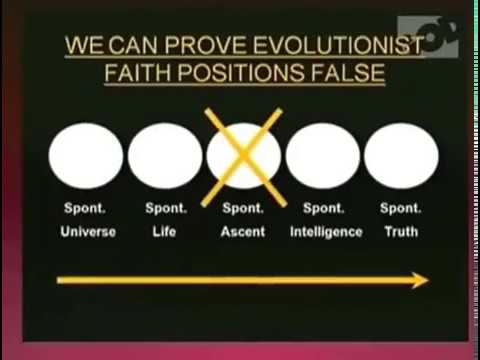


Before uniformitarian geology derailed biblical history, the rails were greased by an unwarranted confidence in scientific history. What is the relationship between science, history, and truth? Carol Cleland, a leading philosopher of science, attempts an answer. Reacting to critics who claim historical science is less valid than experimental science, she defends their epistemic equality with both negative and positive arguments. Her negative argument highlights flaws in both the theory and practice of experimental science. Although her arguments ably undermine some modern distortions, her case against experimental science in this paper relies on the straw man of positivism—the idea that science [More]
By Dr. Nathaniel T. Jeanson Frello’s recent critique is helpful progress in our discussion, and it argues for the strength of the science in Replacing Darwin. …read more Source: AIG Daily

By Avery Foley Matt Walsh misses the heart of the issue in his rebuttal of Ken Ham and young-earth creation. …read more Source: AIG Daily
D.M. from the UK wrote in, sarcastically asking: “Which of the physical sciences do you believe in?” Dr Robert Carter, CMI-US, responds: Fantastic question! The short answer is, “All of them.” In fact just looking at a list of the people who work for CMI, I see PhDs in physics, nuclear physics, engineering, radiotelescopes and antenna design, geomorphology, molecular biology, plant science, plant nutrition, forestry, physical chemistry, zoology, and marine biology. We also have a medical doctor or two. This does not include the many other highly qualified people at CMI with up to master’s-level degrees. In short, we love science! We also have several theologians and educators on staff, to make for a very [More]
After speaking at a church recently, a young man approached me. I thought he might have a question. Instead, he handed me a 6-page essay he had written. It was a defence of a form of Day-Age creationism, the belief that the days of Genesis were actually long periods of time. Normally, I would not spend too much time on such a thing, but the young man impressed me as humble and studious. He also reminded me of myself at that age, when I was trying to defend that very same position. But when I read his paper, I saw [More]
The remarkable fossils found in the Cambrian rocks provide devastating evidence against Darwin’s theory. …read more Source: creation.com

By Ken Ham A short article appeared recently in an “Ask a Scientist” column in response to the question, “How did the Big Bang begin?” The scientist explains, “The Big Bang Theory is a timeline of the history of the universe. It says nothing about how the universe was created. As such, there is no beginning to the Big Bang, since it is a theory that merely describes the universe’s history.” He goes on to explain that in the Big Bang model (which he wrongly refers to as a theory, as there’s no observational evidence to support it), the entire [More]

What evidence do we see that a global Flood devastated the earth’s surface during Noah’s day—on a scale unlike anything we see today? …read more Source: AIG Daily
A scientific study aligns with the biblical account of the ancient cities of Sodom and Gomorrah being destroyed by fire and brimstone from the heavens. The book of Genesis tells the story of God sending two angels to save Lot and his family from a city where men demanded to “be intimate” with visiting men, one of the clearest biblical condemnations of homosexuality. In response, God “rained upon Sodom and Gomorrah sulfurous fire … out of heaven.” It would be hundreds of years before life returned to the region. And now scientists have found evidence of a cataclysmic event in that area, [More]
In 1994, Bolivian workers quarrying high-grade limestone for cement reached a layer with too much quartz, a hard mineral, so they left it alone.1 As quarrying continued, more and more of the unwanted layer was exposed, forming a huge cliff and revealing hundreds of dinosaur trackways. The tracks are of at least eight different kinds of dinosaurs, including a pair of titanosaurs and a herd of 16 ankylosaurs. The layer also contains the longest dinosaur trackway in the world, over 500 m (1,640 ft), by a small theropod,1 possibly a juvenile Tyrannosaurus rex.2 Read More: The Cal Orcko (‘Lime [More]

By Harry F. Sanders, III Evolutionists have serious problems with interspecific animal adoptions, while creationists are in a much better position when it comes to discussing the topic. …read more Source: AIG Daily

By Dr. Georgia Purdom Just because a family member looks a little different doesn’t make her a different race—even if she’s adopted. …read more Source: AIG Daily

Atheist pastor keeps pulpit; star has origins “close to Big Bang”; acoustic camouflage fur helps moths escape bats; most kiwis support euthanasia; and more in this week’s episode of Answers News hosted at the Creation Museum in front of a live audience. Get more answers here: https://AnswersinGenesis.org
By Kurt P. Wise Fossil Grove offers multiple evidences in support of a huge forest biome floating atop the world’s pre-Flood oceans. …read more Source: AIG Daily

By Troy Lacey A recent Pew Research poll asked several interesting and introspective questions about potential or real genetic engineering experiments on animals. …read more Source: AIG Daily
Why did God make Noah’s Flood so destructive? Why put animals on the Ark God knew would go extinct after the Flood? Read More

By Dr. Andrew A. Snelling Most people, including Christians, would still claim dogmatically that the earth looks old. But why does the earth supposedly look old? …read more Source: AIG Daily

With a new addition to the category of “uniquely human features,” MIT neuroscientists discovered a feature of human—not animal—brain cells. Certain human brain cells have much longer extensions called dendrites, and this research team found a uniquely human reason for it. The cerebrum lies just beneath the skull. It has folds and bends. This largest part of the brain manages all kinds … More… …read more Source: icr.org

Since the 1990s, cross-section images of mantle tomography have shown visible slabs of oceanic lithosphere (which includes oceanic crust) descending hundreds of miles beneath ocean trenches into subduction zones.1 These descending plates have been imaged all the way down to the top of the earth’s outer core2 and are composed of cold, brittle, dense rock about 62 miles thick. Researchers from the Univ… More… …read more Source: icr.org

By Ken Ham A recent study of the tiger genome confirmed that there are six extant (still in existence) subspecies of tigers; Bengal tiger, Amur tiger, South China tiger, Sumatran tiger, Indochinese tiger, and Malayan tiger. This new knowledge will aid in conservation efforts. But it also has an interesting creation connection, confirming exactly what we would expect starting with God’s Word. AiG’s Dr. Nathaniel Jeanson, who holds a PhD in cell and developmental biology from Harvard University, wrote these comments about the study: Evolutionists have long thought that species take hundreds of thousands to millions of years to form. [More]

Do ‘laterite’ soils take a million years to form? …read more Source: creation.com
By Harry F. Sanders, III What many people may not know is how the cleaning relationship exhibited by the cleaner wrasses demonstrates God’s design, even in the post-fall world. …read more Source: AIG Daily

By Dr. Kevin Anderson Since evolutionists view mutations as the genetic engine driving dramatic transformations, dark DNA could be a source of rapid, extensive evolutionary change. …read more Source: AIG Daily

Archaeologists discover a spear point “9000 years old”? But it’s far older than either the biblical date for the Flood or Creation. What is the answer to this? …read more Source: creation.com

Our scientific forefathers thought of germs as simple living things. They were oh, so wrong. Apparently, when it comes to living things, small does not mean simple. Two new discoveries about germs that live in or on human bodies take microbe ingenuity to a new level. In one report published in PLOS Pathogens, researchers under the direction of Luisa Hiller at Carnegie Mellon University decoded a germ’s … More… …read more Source: icr.org
Scientific experiments confirm that dead crocodiles need to be buried quickly in sediment to fossilize. Read More
In a universe allegedly billions of years old, some clearly visible star features should not exist. Read More