Highest Rated Videos
 7,975 views
12,194 views
7,975 views
12,194 views 12,782 views
11,756 views
11,558 views
12,782 views
11,756 views
11,558 views
 502,888 views
 15,959 views
 18,700 views
 13,101 views
 1,751 views
Related Videos
384 views












Is it a bird? A bat? No, it’s Ambopteryx! Multiple characteristics show that new fossil is likely a bird. …read more Source: creation.com

By Ken Ham The more scientists dig into the fossil record, the more exciting and surprising fossils they discover. Recently, scientists announced the discovery of a new species of lizard inside the stomach of a microraptor, what they call a type of supposed “gliding dinosaur” (really, it’s a bird) from northeastern China. It’s so well-preserved, they can tell the bird swallowed the lizard head first! The researchers believe these fossils were exquisitely buried during a series of volcanic explosions some 130 million years ago. But there’s a better explanation! We find fossils that are incredibly preserved all around …read more [More]

The dynamic process of fish schooling is amazingly preserved in a ‘Fossilized freeze frame’ recording their coordinated collective motion. …read more Source: creation.com

Creation-based thinking made a testable prediction. If Noah’s Flood formed dinosaur and other fossils only 4,500 or so years ago, then they may still contain measurable amounts of the short-lived radioactive isotope carbon-14—also called radiocarbon. On the other hand, any fossil deposited before the limit of carbon-14 longevity (around 100,000 theoretical years ago) would have no carbon-14 left. Now, a team of secular scientist… More… …read more Source: icr.org

By Ken Ham Creationists were shocked to read a news article about the evolution of lilies—astonishingly, a fossilized lily, the supposed oldest ever discovered (115 million years), looked just like. . . a lily! The evolution is incredible! Actually, it forgot to evolve! Okay, so that was very tongue-in-cheek—we weren’t surprised to see that lilies have always been lilies. That’s exactly what we’d expect based on God’s Word. This particular specimen was “extraordinarily well preserved,” including roots, flower, and even the individual cells. And it has all the features of that specific class of plant (monocotyledonous): “parallel-veined, …read more Source: [More]

How does Noah’s Flood provide a better framework for understanding unconformities? …read more Source: creation.com

“I can’t picture a three-dimensional school of fish sinking to the bottom and maintaining all their relative positions,” said Dr. Plotnick, paleontologist at the University of Illinois at Chicago. “That makes no sense to me.”1 Dr. Plotnick was talking about a recent fascinating discovery of a fossilized school of extinct fish (an entire school—259 of them) discovered in Fukui P… More… …read more Source: icr.org

Old World monkey and ape fossils both appear suddenly in the fossil record. (Note: “Old World” refers to countries known to Europeans before they discovered the Americas.) In 2013, the fossils were discovered together in an alleged 25 million-year-old Oligocene rock unit in Tanzania.1 Now a new alleged 22 million-year-old monkey fossil found in Kenya2 increases the known diversity for the sudden appearance … More… …read more Source: icr.org

How did they form? …read more Source: creation.com

Long-age thinking held back scientific explanations of a major South African geological feature. …read more Source: creation.com

By Ken Ham A slab of limey shale features something incredible—259 fish, with scales, eyes, and fins—frozen as if in mid-swim. But how on earth is this possible? …read more Source: AIG Daily

Answering a challenge to biblical geology: do pre-Ice Age ’tillites’ require glacial processes to form? …read more Source: creation.com

Have you ever seen a dinosaur running in the rain? No, but a stunning new fossil find is the next best thing. …read more Source: creation.com
When were these geomorphological features carved? Read More

One of the more compelling evidences for the creation model is found in the Cambrian sedimentary layers dated by evolutionists to have formed 500 to 541 million years ago. Almost all the major groups of sea life, including fish (vertebrates) and the most complex invertebrates, the nautiloids, suddenly appeared in a most undarwinian manner—hence the term “Cambrian Explosion.” For centuries secular scientists, including Darwin him… More… …read more Source: icr.org

Or do planation surfaces require a more catastrophic mechanism? …read more Source: creation.com

When were these geomorphological features carved? …read more Source: creation.com

Sneak peek of latest Creation magazine. Can fossils form quickly under the right conditions? …read more Source: creation.com

Rapidly carved by channelized Flood runoff …read more Source: creation.com

The past is the key to the present understanding of these geological features. …read more Source: creation.com

Fleeing the rising waters of Noah’s Flood …read more Source: creation.com

By Ken Ham Headlines around the world are announcing the discovery of a new species of “bat-wing dinosaur” uncovered in China. Researchers are dating this find at 163 million years old. They claim this new species, Ambopteryx longibrachium, had a membranous wing, similar to bats, and that it was a non-avian theropod (read: dinosaur) that represents a dead-end in the evolution of flight. But what was this creature? Be Careful When Reading Popular News Reports! Dr. Gabriela Haynes, a paleontologist who works with our research department, analyzed the scientific paper, published in the journal Nature. Dr. Haynes said when she [More]
Does lengthening the ‘time frame’ of the Cambrian explosion make it easier for evolutionists to explain? Read More
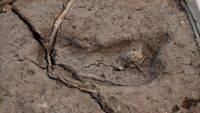
By Ken Ham Researchers in the South American nation of Chile have announced the discovery of a human footprint they’ve dated at 15,600 years. This makes it the oldest evidence of humans in the Americas by over 3,000 years, according to the evolutionary timeline. How should Christians understand finds such as these? Well, first we compare what the study says against the absolute authority of the Word of God. Starting with God’s Word (using the six days of creation and the genealogies), we know the earth is only around 6,000 years old, and the world was destroyed at the time [More]

Paleontologists just discovered a fossil of a new type of extinct ferocious-looking mammal that’s bigger than any lion or tiger living today.1 This bizarre creature highlights the amazing diversity of lost mammal species that were preserved as fossils in sedimentary rocks deposited during Noah’s Flood. Discoveries like this continue to debunk the evolutionary myth of “simple to complex” that we should find… More… …read more Source: icr.org

By Brian Thomas and Jeffrey Tomkins The story of whale evolution is one of the most ridiculous fables of scientifically unsupported speculation ever perpetrated on the public. And now, with the recent discovery of a Peruvian fossil of a clearly four-legged land animal named Peregocetus being called “An Amphibious Whale,” the evolutionary myth has just di… More… …read more Source: icr.org