Highest Rated Videos
 7,974 views
12,192 views
7,974 views
12,192 views 12,780 views
11,755 views
11,557 views
12,780 views
11,755 views
11,557 views
 502,888 views
 15,957 views
 18,699 views
 13,100 views
 1,881 views
Related Videos
 2,419 views
380 views
498 views
2,419 views
380 views
498 views









Researchers discovered eight well-manufactured throwing spears in an Ice Age coal deposit near Schöningen, Germany. They are calling these the oldest human tools. What can forensic science reveal about the people who made them? Portions of the Schöningen open pit coal mine were set aside for archaeological work decades ago. In 1997, Hartmut Thieme of the Lower Saxony State Office for Heritage described three spears that he found in the Helmstedt lignite coal mine.1 They were constructed to such exacting specifications that replicas of them performed as well as modern javelins in throwing tests. The site also contained [More]

By Bodie Hodge Evolutionists are digging in the wrong place. When you don’t have the correct information, you can miss the mark significantly. …read more Source: AIG Daily
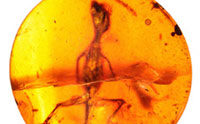
In a culture virtually convinced that the world is billions of years old, few people listen to evidence that clearly supports a young Earth. But that’s what the Bible teaches. And plenty of science, including four finds from 2016, backs up the Bible’s version of Earth history. More… …read more Read more here: icr.org

By Callie Joubert The recent claim that “conflicting networks” in the brain that explain belief and unbelief in God cannot be true. …read more Read more here: AIG Daily

Secular speculations insist Earth coalesced into its current state over four billion years ago, leaving one huge problem: the young sun would have been so dim that Earth would have frozen. Secular astronomers have long invoked methane gas to defray this dilemma, called the “faint young sun paradox.” A recent study revealed two new reasons to totally reject methane as a rescuing device, leaving this paradox stronger than ever. More… …read more Read more here: icr.org

Air pressure is the clue to answering this question. …read more Read more here: creation.com

By Callie Joubert Is it possible that we are facing a situation where there is a massive production of wrong information or distortion of information? …read more Read more here: AIG Daily

By Callie Joubert Researchers using neuroimaging technology claim to have found the cause for the conflict between science and religion (evolution and creationism) in the brain. …read more Read more here: AIG Daily

By Dr. Nathaniel T. Jeanson Today’s species are the link between the past and the present. The genetics of the species around us today contain the echo of the Ark. …read more Read more here: AIG Daily

Author dismisses creationist concepts but raises interesting questions about the inadequacies of materialistic evolutionary theory. …read more Read more here: creation.com
A New Scientist article1 ponders a baffling enigma to evolutionists—‘living fossils’. These are creatures alive today which are identical to fossilised forms, believed to have lived ‘millions of years ago.’ Examples include the coelacanth fish (fossil coelacanths are believed by evolutionists to be 340 million years old2), Gingko trees (125 million years), crocodiles (140 million years), horseshoe crabs (200 million years), the Lingula lamp shell (450 million years), Neopilina molluscs (500 million years), and the tuatara lizard (200 million years). This poses a conundrum for evolution: ‘Why have these life-forms stayed the same for all that time?’This poses a conundrum [More]

An increasing number of evangelical Christian leaders have publicly stated that combatting ‘global warming’ or ‘climate change’ is a moral imperative.1 Likewise, Pope Francis recently called for action on this issue in a recent encyclical letter.2 However, at the same time, some scientists and environmental activists have become quite skeptical of alarmism on this issue, including former president of Greenpeace Canada Patrick Moore, physicist Freeman Dyson, and emeritus MIT professor of meteorology Richard Lindzen.3,4,5 Read more here: creation.com

By Jake Hebert Part I of this series presented a number of serious problems with the Pacemaker paper. It is necessary to also understand the Blackman-Tukey (B-T) method. …read more Read more here: AIG Daily
By Ken Ham Well, despite years of research, scientists still haven’t found any evidence of life on other planets. And they’ve found very few earth-like planets that they claim have even a slight chance of hosting life. The more they study earth and our solar system, the more they realize that earth is uniquely suited for life. We don’t live on a random chunk of rock—we live on a privileged planet with just the right characteristics for life to survive and thrive. But because of the sin nature of humans, most would rather consider any possibility, except that …read more [More]
By Dr. Terry Mortenson There is an intensifying controversy in the church all over the world regarding the age of the earth. …read more Read more here: AIG Daily

The earth is a ‘privileged planet’ and was specially created to support life. …read more Read more here: creation.com

Some have minds like concrete: thoroughly mixed up and permanently set! Open minds prefer to engage with facts instead of toeing the party-line of prevailing dogma. …read more Read more here: creation.com
By Ken Ham Well, our newest research associate, Dr. Nathaniel Jeanson, a graduate of Harvard University, explained in a recent discussion with some AiG staff how the creation model can be used to make testable predictions that are far more accurate than evolutionary predictions: Because we start from the right foundation, we’re going to get the right answer. Now, one of the things evolutionists commonly challenge us with is, “Well, you’re not scientists. You don’t make testable predictions. You just say ‘God did it, that’s the end of it.” This is a stereotype, a straw man, and it’s not true. [More]
By Ken Ham This study really highlights how, when you ignore the history revealed in God’s Word, you come to all kinds of silly conclusions. These conclusions are based on ice core records (that are based on many fallible assumptions) and lots of imagination. Since evolutionists assume that the ice has been slowly building up for tens of thousands of years, they believe ice cores capture climate and atmospheric history for some of Earth’s history. But the ice cores don’t show tens of thousands of years of winters and the slow accumulation of snowfall each year. Instead, they are …read [More]

Can the problems of ordered complexity be solved by using the tools of randomness? …read more Read more here: creation.com

A 21 year old mystery has been solved! But kayak accident victim reveals problems with anthropologist’s expert identification. …read more Read more here: creation.com

Scientists exhibiting at London’s Natural History Museum are unable to identify an evolutionary progression from apes to men. …read more Read more here: creation.com

In 1975, ICR’s founder and hydrological engineer Dr. Henry Morris made some interesting human population calculations. He demonstrated the feasibility of obtaining today’s world population in only about 6,000 years. A new study presents a very different version of human history—one in which the population grew very slowly for 200,000 years. Does the science in this new report debunk Dr. Morris’ 40-year-old biblical argument? More… …read more Read more here: icr.org

By Dr. Don DeYoung Can you imagine a plant that is nutritious, grows rapidly without special care, has medicinal value, and provides chemicals to purify water in remote places? …read more Read more here: AIG Daily

Did mankind come from Adam? Did nations arise from families dispersed from Babel, found in modern-day Iraq? According to the most popular versions of human evolution, mankind came from an ape-kind. Animals supposedly evolved without supernatural tinkering, and the world’s nations emerged from Africa. But discoveries from archaeology, linguistics, and genetics during 2015 confirm the Genesis account. More… …read more Read more here: icr.org

Plenty of 2015 discoveries clashed with the largely fictional portrayal of dinosaurs in this year’s blockbuster movie Jurassic World. They even confront basic theories, like that dinosaurs evolved into birds or died off tens of millions of years ago. More… …read more Read more here: icr.org

Jim Stump at BioLogos recently posted an article claiming to resolve 10 ‘common misconceptions’ about evolution which attacks biblical creation. Does it stack up? …read more Read more here: creation.com