Highest Rated Videos
 7,974 views
12,193 views
7,974 views
12,193 views 12,782 views
11,756 views
11,558 views
12,782 views
11,756 views
11,558 views
 502,888 views
 15,959 views
 18,700 views
 13,101 views
 1,751 views
Related Videos
 2,414 views











A genetically engineered toxin is said to show how scorpions evolved. …read more Read more here: AIG Daily

Birds flying in V formation take aeronautical engineering to new heights. …read more Read more here: AIG Daily

The lowly, ‘basal’ box jellyfish has astonished scientists with its capacity to see things above the water. …read more Read more here: creation.com

For the amazing echolocation ability of bats to function properly, both emitting and receiving organs must be present, and cooperate. (There are other problems too, to drive evolutionists ‘batty’.) …read more Read more here: creation.com
“One of the scientists quoted in the article states “We’ve got some catching up to do.….The nature-produced tiny structures are far beyond any human designs.” yet evolutionists want us to believe this marvel of design happened by chance … ridiculous.” Admin The diamond weevil, which makes its home in the Brazilian tropics, has a body studded with tiny, brilliant reflectors. Each one is like a diamond, reflecting different-colored light in shiny arrays. New research has probed the microstructure of these brilliant facets and discovered that the way they work is familiar—but the way they are made is not. These insect [More]

Does common anatomy necessarily point to common ancestry? …read more Read more here: creation.com

Evolution textbooks have said for years that placental mammals didn’t appear until after dinosaurs went extinct. But now many are saying that’s wrong. …read more Read more here: creation.com

Fish fingers were never on the evolutionary menu. …read more Read more here: AIG Daily

With green blood, three hearts, and able to change colour in a flash, the cuttlefish sounds like a ‘weird aliens’ movie creature. …read more Read more here: creation.com
“Once again man is copying one of the marvels of design in Gods creation.” Admin Harvard’s Wyss Institute specializes in designing new materials and devices that mimic patterns found in living things. Their latest contribution was inspired by the versatile material found in insect cuticle, which is strong and flexible, yet remarkably lightweight. The result was “shrilk,” a moldable, biodegradable substance derived from shrimp shells and silk that is as strong as some aluminum alloys but only half their weight. “Shrilk could be used to make trash bags, packaging, and diapers that degrade quickly,” according to a Wyss Institute press [More]

“The honeybee’s guidance system and waggle dance it does to communicate to other bees how to get to the nectar are complex marvels of design. Another testimony to God’s handiwork.” Admin Polarized light imprints GPS directions on the honeybee brain’s genes. The uncanny ability of honeybees to remember and communicate the location of sweet nectar has been the subject of ongoing investigations—both navigational and genetic. “The more we find out how honeybees make their way around the landscape, the more awed we feel at the elegant way they solve very complicated problems of navigation that would floor most people—and then [More]
100 Years of Fruit Fly Tests Show No Evolution http://www.icr.org/article/5532/ July 22, 2010, marked the 100th anniversary of genetic investigations using fruit flies. The first such study appeared in Science in 1910 and described the unexpected appearance of a male fruit fly with white eyes after generations of flies with pigmented eyes.1 This began a century of focused studies on fruit fly mutations, but what has really been learned by all this tinkering? For most of the past century–and especially since the discovery of DNA as a physical molecule carrying heritable information–the prevailing concept of neo-Darwinian evolution has held mutations [More]
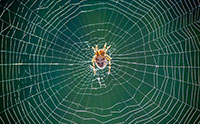
No, it’s not science fiction—it’s real. Spider webs use electricity to snare prey, and researchers recently discovered an added environmental benefit from these arachnids’ masterful constructions. More… …read more Read more here: icr.org
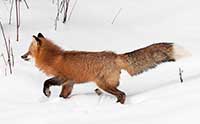
During winter, red foxes hunt snow-covered mice without even seeing their prey—but how? Foxes may see more than what visible light reveals. More… …read more Read more here: icr.org
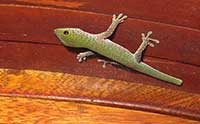
Abigaille the robot can climb up smooth walls, but she leaves behind no residue as her feet mimic gecko traction and locomotion. How close did the engineers come to matching the precision capabilities of real gecko feet? More… …read more Read more here: icr.org

Are there any limits to the production of hybrid animals? …read more Read more here: creation.com

A huge collaborative study finds that most, and probably all, human DNA is functional (contrary to evolutionist predictions) …read more Read more here: creation.com
“If man with all his ingenuity can only create a much inferior fake Jellyfish then what is the probability that blind random chance could create the much superior real one, I think we know the answer to that.” Admin Many jellyfish are transparent, and they have seemingly simple movements and few visible interacting parts. They should, therefore, be easy to synthesize with man-made parts, but that’s not what bioengineers discovered when they recently built a jellyfish mimic from rat heart cells attached to a silicone frame. Read More Here
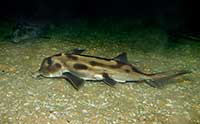
Scientists recently studied the genome of a “living fossil” called the elephant shark. Their report refers to “unique insights” into evolution, but the facts actually reveal something else—clues to creation these researchers overlooked. More… …read more Read more here: icr.org

Highly specialized for living in eucalypt trees, the koala is something of an evolutionary mystery, with its marsupial pouch opening backwards (unlike the kangaroo’s, and possum’s, which open forwards). …read more Read more here: creation.com

God said that all He had made was very good. There were no pathogens, parasites, or disease prior the Fall and subsequent Curse, so the immune system may have functioned differently in that world. …read more Read more here: AIG Daily
“One more example of a marvel of design in nature. Such precision could hardly be the product of random chance.” Admin Computerized tomography (CT) scans use computing power to compile two-dimensional X-ray images into a three-dimensional view, and researchers are optimistic that a new form of high-resolution CT scanning at the molecular level will give “scientists precious new information about how Mother Nature forms shells, bones, and other hard structures.”1 They hope to learn how to mimic the strength of these natural structures in the manufacture of similar man-made materials. Like the metal rods (rebar) that are embedded in a [More]
“More marvels of design in nature. How anyone could think such sophistication in design could happen by chance is beyond me. It almost shouts it was a product of intelligence and one far beyond ours.” Admin Many clams glue themselves onto a solid surface like a rock or coral reef to keep from being tossed about by the surf. The “glue” sets when wet and is extremely strong, partly because tiny fibers enable the glue to self-heal. Similarly, scientists have discovered that a form of bacteria produces an amazingly water-repellent substance called biofilm that “greatly surpass[es] the repellency of Teflon.”1 [More]
Encyclopædia Britannica claims the earliest known rodents come from the upper Paleocene (supposedly about 57 million years ago) of North America, yet it admits these animals ‘had already acquired all of the diagnostic features of the order.’ In other words, these ‘early’ animals were easily recognizable as rodents. Comprising 50% of all mammal species, rodents should be prolific in the fossil record, and evolutionists should expect to find numerous examples of transitional species. However, Britannica states: ‘Rodents are relatively poorly represented in collections of fossils, in spite of their great abundance at the present time.’2 This situation is clarified with [More]

It was once believed that the regions in between the protein-coding genes of the genome were wastelands of alleged nonfunctional “junk DNA.” However, we now know that these previously misunderstood regions are teeming with functional activity—and a new study shows they are actually required for life. More… …read more Read more here: icr.org

Flowers deep in the fossil record are just as advanced as flowers today. …read more Read more here: AIG Daily

Are inherited fears mere fodder for novels, or is there some basis for them in science? …read more Read more here: AIG Daily