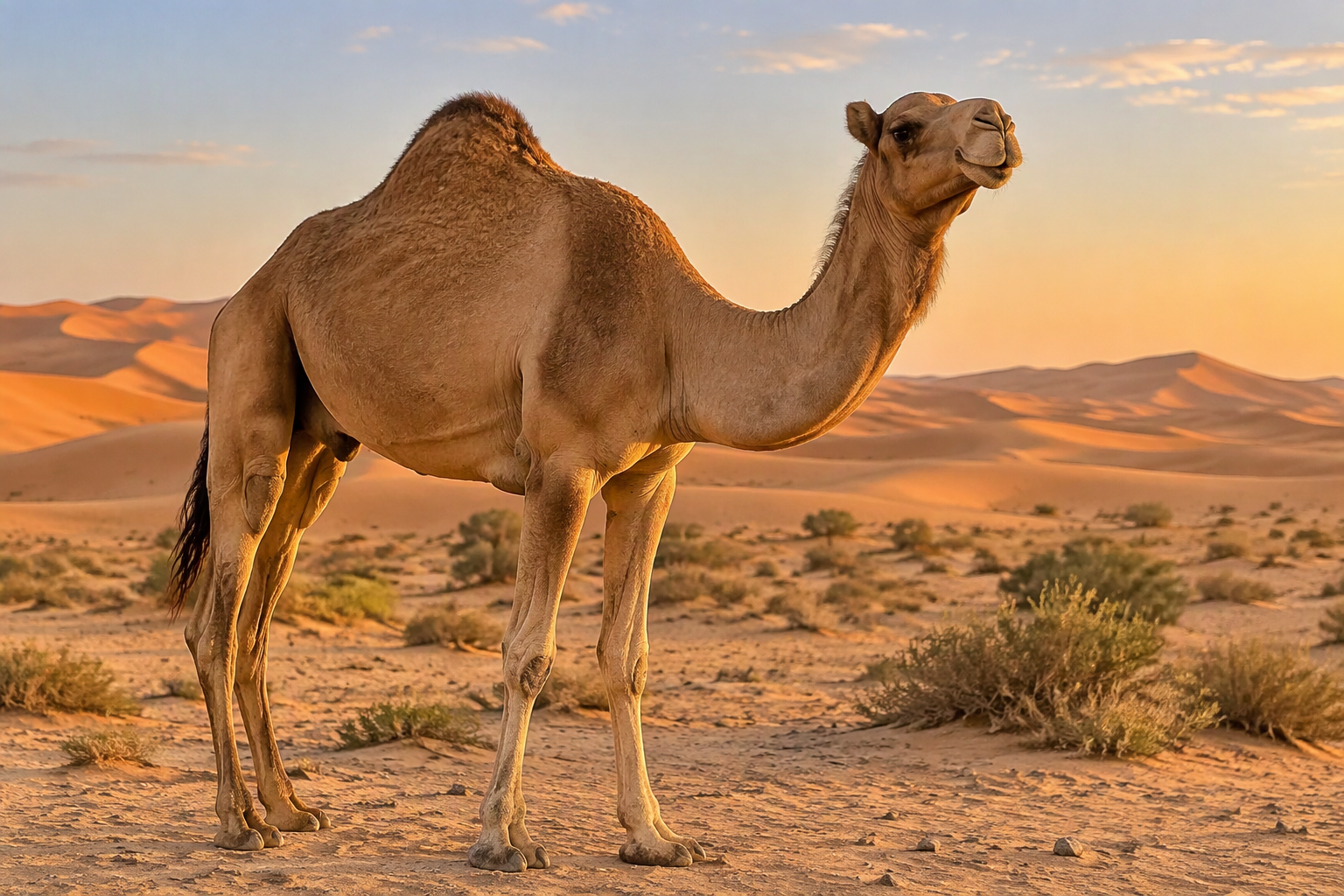
James: Imagine traveling across a vast desert. The sun is beating down, the sand stretches as far as the eye can see, and there’s no lake, river, or water supply anywhere in sight. The temperature is climbing, the wind is blowing sand across the ground, and you have no idea when you’ll find your next drink of water.
Christopher: Now imagine being able to travel through this environment for days, sometimes under extremely harsh conditions, without suffering the way most animals would. There is an animal that can do just that. It has long legs, broad padded feet, a remarkable ability to conserve water, and a hump on its back that has been the subject of many misconceptions.
James: We’re talking about the camel. And as we’ll discover, this animal has some remarkable features that make life in the desert possible. When most people picture a camel, they probably imagine a large animal walking across the sand dunes of the Sahara Desert, perhaps carrying a rider or a load of supplies. But there are actually different kinds of camels, and they don’t all look exactly alike.
Christopher: The dromedary camel has one hump and is found mainly in northern Africa and the Middle East. The Bactrian camel has two humps and is native to the colder desert regions of Central Asia. Its thick coat helps it survive temperatures that can become extremely cold during winter.
James: So whether we’re talking about a one-humped or two-humped camel, we’re looking at an animal equipped for some pretty demanding environments. Let’s begin with the feature everyone notices first: the hump. There’s an old misconception that camels store water in their humps. It sounds reasonable, doesn’t it? An animal that can go a long time without drinking must have some kind of built-in water tank.
Christopher: But that’s not what the hump does. It’s actually a storage area for fat. And that fat serves an important purpose. When food becomes scarce, the camel can break down the stored fat and use it as an energy supply. The hump is essentially a reserve fuel tank carried right along with the animal.
James: There’s another advantage to storing much of the body’s fat in one location. It leaves less fat spread over the rest of the body, helping the camel release heat more effectively. In a hot desert, that can be a valuable advantage. And here’s something interesting. When a camel uses up much of the fat stored in its hump, the hump can shrink and even lean to one side. After the animal has access to food again, it can gradually rebuild that reserve.
Christopher: Now let’s get to the camel’s most famous ability: conserving water. Water is one of the greatest challenges for animals living in arid regions. A human being can become seriously ill from dehydration, and many animals cannot tolerate losing a large percentage of their body water.
James: Camels, however, can tolerate an extraordinary amount of water loss. Under severe conditions, they can survive losing a much larger proportion of their body weight in water than most mammals could withstand. But they don’t accomplish this by simply toughing it out. Their bodies have several systems working together to reduce water loss.
Christopher: For example, their kidneys are very efficient at conserving water. They produce highly concentrated urine, which means less water leaves the body when waste is removed. Their intestines also recover water very efficiently, and their droppings can become so dry that they contain very little moisture. In other words, the camel doesn’t waste much of the water it has.
James: And there’s another fascinating feature involving the camel’s nose. When most mammals breathe out, they lose some water as moisture in their breath. Camels have a special arrangement inside their nasal passages that helps recover some of that moisture.
Christopher: As warm, moist air leaves the lungs and passes through the cooler nasal passages, water vapor can condense on the membranes and be reabsorbed. Think of it as a tiny built-in moisture recovery system. Even the air leaving the camel’s body gets another opportunity to contribute to its water supply.
James: And those nostrils have another trick. They can close down into narrow slits, helping keep blowing sand out when desert winds pick up. That is certainly better than trying to sneeze your way through a sandstorm!
Christopher: The camel also has an unusual way of dealing with extreme temperatures. Most mammals work hard to keep their internal temperature within a fairly narrow range. When they become overheated, they sweat, and the evaporation of sweat helps cool their bodies. But sweating uses water, and water is precious in the desert.
James: Camels have a clever alternative. Their body temperature is allowed to change more than ours does over the course of a day. During the cooler nighttime hours, their body temperature can fall. As the desert heats up during the day, their temperature gradually rises.
Christopher: By allowing the body to absorb more heat before sweating heavily, the camel can reduce the amount of water it loses through evaporation. This is a remarkable way of adjusting to the daily temperature changes of the desert.
James: And what about those long legs? They aren’t just there to give the camel its unusual appearance. They help lift its body higher above the hot ground. The desert floor can become extremely hot under direct sunlight. Keeping the body farther away from that surface helps reduce the amount of heat it receives from the ground.
Christopher: Then we come to the feet. Just look at them. They are broad, soft, and padded, rather than narrow and hard like the hooves of a horse. When the camel places its foot on loose sand, the toes spread out and the wide padded surface distributes its weight. This helps keep the animal from sinking deeply into the sand.
James: Imagine trying to walk across a sandy beach wearing high-heeled shoes. You would sink with every step. Now imagine wearing broad, cushioned shoes that spread your weight across a much larger area. That’s roughly the advantage the camel has built into its feet.
Christopher: The feet also provide cushioning and support when walking over rough desert terrain. And the camel has more protection against the desert than just its feet.
James: Those long eyelashes help shield its eyes from blowing sand. It also has an additional transparent inner eyelid that can help protect the eye while still allowing the animal to see. Its ears have hair that helps keep dust and sand out, and its nostrils can close during a sandstorm.
Christopher: So when desert conditions become unpleasant, the camel has several built-in protective features working together.
James: Now let’s look at what the camel eats. You might think an animal living in the desert would have a difficult time finding enough food. There’s no lush green pasture stretching across the landscape. Much of the vegetation consists of tough, dry plants, thorny bushes, and vegetation that other animals might find difficult to eat.
Christopher: But the camel has a mouth equipped to handle some of these challenging foods. Its lips are tough and flexible, allowing it to pick through thorny plants and shrubs. It can eat vegetation that would discourage many other animals.
James: Camels also have a digestive system that helps them get nutrition from rough plant material. They chew their food, swallow it, and later bring some of it back up to chew again. This process helps break down tough plant fibers so the animal can make better use of the food.
Christopher: Its digestive system works with microorganisms that help process the plant material. So the camel isn’t particularly fussy about its menu. When other animals might turn their noses up at some desert vegetation, the camel may see a perfectly acceptable meal.
James: And what happens when a camel finally reaches a water supply after a long period without drinking? It can drink a tremendous amount of water in a relatively short time.
Christopher: Its blood cells have an unusual oval shape. This helps them continue moving through the circulation when the animal is dehydrated, and they can expand considerably as water is taken in without bursting as easily as ordinary red blood cells would. That is especially useful when the camel drinks a large quantity of water after being deprived of it.
James: It’s an impressive example of how the different parts of an animal’s body work together to meet the demands of its environment.
Christopher: There’s another side of camel anatomy that is worth mentioning: its ability to kneel. When a camel rests or receives a load, it often folds its legs beneath its body and lowers itself onto the ground. It has thickened, toughened patches of skin on areas such as its knees and chest. These protective pads help cushion the body when it kneels on hot or rough surfaces.
James: And when it gets back up, it does so in a distinctive sequence, lifting its hindquarters and front end in stages. Anyone who has watched a camel rise from the ground knows that it is quite a performance!
Christopher: Camels have also played an important part in human history. For centuries, people living in desert regions have depended on them for transportation, carrying supplies, providing milk, and helping move goods across long distances. Their ability to travel through dry environments made them especially valuable for trade routes that would have been difficult for many other animals.
James: That’s why the camel is often called the ship of the desert. A camel can carry a substantial load, travel steadily over long distances, and manage conditions that would be extremely difficult for many other working animals.
Christopher: Of course, camels are not machines. They need food, water, rest, and proper care. They cannot survive indefinitely without water, and even their remarkable adaptations have limits.
James: But when we step back and consider everything that has to work together, the camel becomes an even more interesting animal. Its hump stores energy. Its kidneys conserve water. Its digestive system makes use of tough vegetation. Its nose recovers moisture from exhaled air.
Christopher: Its body temperature can fluctuate to reduce water loss. Its feet spread across soft sand, while its eyes and nostrils have protection against blowing dust. These features aren’t isolated conveniences. They function as a coordinated collection of systems that allow the camel to live and travel in an environment where survival can be a challenge every single day.
James: And that’s what makes the camel such an interesting subject when we look at the design found throughout nature. From the perspective of intelligent design, we can look at these interconnected features and ask an important question: How do so many different systems work together so effectively to meet the challenges of a very demanding environment?
Christopher: The camel is just one example of the remarkable variety of living things and the specialized features that make each one suited to its surroundings.
James: The next time you see a camel walking across a desert, remember that you’re looking at much more than an animal with a funny-looking hump. You’re looking at a remarkable collection of biological features that allow it to survive in one of the most challenging environments on Earth.
Christopher: And perhaps that’s a good reminder that sometimes the most extraordinary examples of design are found in animals we might otherwise take for granted.
James: Thanks for joining us for another exploration of the wonders of design in nature. We hope you’ve enjoyed learning a little more about the remarkable camel.
Christopher: Until next time, keep looking closely at the world around you. You may be surprised by what you see.















Thanks! Share it with your friends!
Tweet
Share
Pin It
LinkedIn
Google+
Reddit
Tumblr