Highest Rated Videos
 8,517 views
12,752 views
8,517 views
12,752 views 13,226 views
11,876 views
13,226 views
11,876 views
 503,508 views
 16,405 views
 19,291 views
 13,638 views
Related Videos
352 views 44,504 views
 1,996 views









![Point of Grace – Jesus Will Still Be There [with lyrics]](http://img.youtube.com/vi/XFqjq_LsZVg/0.jpg "Point of Grace – Jesus Will Still Be There [with lyrics]")


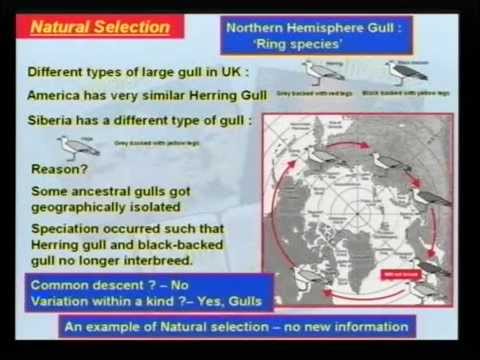
By Dr. David Menton Evolutionists seek to explain the origin of species from a single, hypothetical, primordial life-form by means of progressive change and natural selection. …read more Source: AIG Daily

Recently, secular scientists revealed their speculation of alternate evolutionary histories by studying a protein they supposed existed half a billion years ago. Using a large “set of genetic variants” from “a resurrected version of an ancient protein” they theoretically discovered “a myriad of other ways that evolution could have” occurred. Are they on to something valid or is this another unsupported speculation? More… …read more Source: icr.org

By Dr. Andrew Fabich Viruses are amazingly complex and beautiful machines. They exhibit all the hallmarks of being designed, though we often fail to recognize them as such. …read more Source: AIG Daily

Human designers of TV screen copy one of the ways cuttlefish change colour. …read more Source: creation.com

When it’s a gigantic underwater landslide formed during Noah’s Flood. …read more Source: creation.com

By Dr. Danny R. Faulkner With yet another set of failed predictions, shouldn’t all this nonsense about Nibiru finally go away? It should, but it probably won’t. …read more Source: AIG Daily
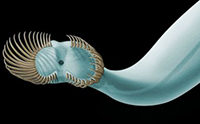
Paleontologists have unearthed yet another bizarre creature, this time in British Columbia, Canada, from sediments alleged to be 541 million years old. Evolutionists feel this new genus of animal is an evolutionary ancestor that led to modern arrow worms that currently inhabit the world’s oceans. But is it? More… …read more Source: icr.org

By Ken Ham Last month, AiG’s Director of Research Dr. Andrew Snelling launched a momentous raft trip on the Colorado River through the Grand Canyon to collect rock samples from four specific sites. This trip came on the heels of an almost four-year battle with the National Park Service, which included a lawsuit filed with the help of Alliance Defending Freedom (ADF). The team of seven, including Dr. John Whitmore, senior professor of geology at Cedarville University, spent a week inside this magnificent Arizona canyon collecting samples. <img src="https://assets.answersingenesis.org/img/blogs/ken-ham/2017/09/andrew-snelling-and-john-whitmore.jpg" alt="Drs. Andrew Snelling and John …read more Source: Ken Ham AIG [More]

By Harry Dickens North America’s Proterozoic geology provides evidence for enormous erosion and the formation of extensive water flow systems, even spanning the continent. …read more Source: AIG Daily

The recent publication of a research paper evoked such headlines as “Massive genetic study shows how humans are evolving.” Despite the improvement of health-care technology, many other studies indicate that chronic human disease is increasing worldwide—and that mutations are commonly associated with disease, not upward evolutionary improvement. More… …read more Source: icr.org

The controversial theory with a long history of competing concepts that is no closer to being resolved than it was in Darwin’s day. …read more Source: creation.com

Does the reverse ontological argument show that God can’t exist? …read more Source: creation.com

It’s claimed to be ‘evolutionary art’, but evolution has no plausible explanation for incredible images on the wings of a remarkable fly. …read more Source: creation.com

Recent studies describing sophisticated plant traits, and some of the insects that feed on those plants, highlight how biology may be interpreted very differently. But usually, these interpretations are largely dependent on a researcher’s preexisting beliefs about the origins of living things. More… …read more Source: icr.org

When the numbers don’t add up, it’s time to examine the methods and the philosophy behind them. …read more Source: creation.com

By Dr. Danny R. Faulkner The best stellar evolution models fix HD 140283’s age to slightly older than the big bang model age for the universe. …read more Source: AIG Daily

Evolutionists try to define homology by how it is explained, not by how it is observed. …read more Source: creation.com

By Dr. Danny R. Faulkner The winter solstice has a special effect at Ireland’s most famous megalith. …read more Source: AIG Daily

By Dr. David Menton Selected data and unprovable assumptions are a problem with all methods for determining the age of the earth, as well as for dating its fossils and rocks. …read more Source: AIG Daily

By Jonathan Bartlett After examining the present and future state of cosmology, Krauss and Scherrer conclude that we live in a very special time in the universe. …read more Source: AIG Daily

Everyone knows that spiders spin webs but did you know they also use their silk to move through the air? …read more Source: creation.com

By Ken Ham Evolutionist Dr. Mary Schweitzer shocked the world in 2005 when she discovered Did dinosaurs roam the earth 65 million years ago? This Echoes Of The Jurassic book and DVD pack shows new discoveries with evidence for creation and biblical accuracy of Genesis. Shop Now You can learn more about these remarkable finds in the brand-new DVD Echoes of the Jurassic. This eye-opening DVD, hosted by David Rives, features over a dozen Bible-believing scientists, including some of AiG’s own, who give a clear and concise understanding of both the science and the controversy surrounding the ages of these [More]

Corals are thought to be one of the earliest forms of multicellular life to have evolved. Today, corals are foundational to ocean life, but are they primitive? A new study shows that a highly complex system of genetic recoding called RNA editing is active in today’s corals. Does this fit the evolution model or the creation model? More… …read more Source: icr.org

By Ken Ham Do “molecules of ancient organisms” from Australian rocks answer the question of man’s origin? Well, this recent article suggests that we humans owe our existence to . . . algae. Supposedly, it’s only because algae formed that life was able to evolve and diversify so, they say, “algae . . . are the ancestors of us all.” After all, evolutionists believe humans are related to all animals and plants in their so-called evolutionary tree of life. According to this new story about the origin of life, bacteria dominated the planet in the supposed Snowball Earth period, a [More]

By Dr. Andrew A. Snelling Minerals display not only God’s incredible creativity and His care for our needs, but also His unbounded love of variety and beauty. …read more Source: AIG Daily

Secular geologists hypothesize five major mass extinctions in Earth history and maintain the most catastrophic of these happened nearly 252 million years ago. This Permian extinction, or Great Dying, supposedly resulted in the loss of 70 percent of land species and 95 percent of marine species. What really happened? More… …read more Source: icr.org

The discovery in a seaweed of a complex molecule thought (and taught!) to be only in land plants astonishes evolutionists, forcing a billion-year rewrite of textbooks. …read more Source: creation.com