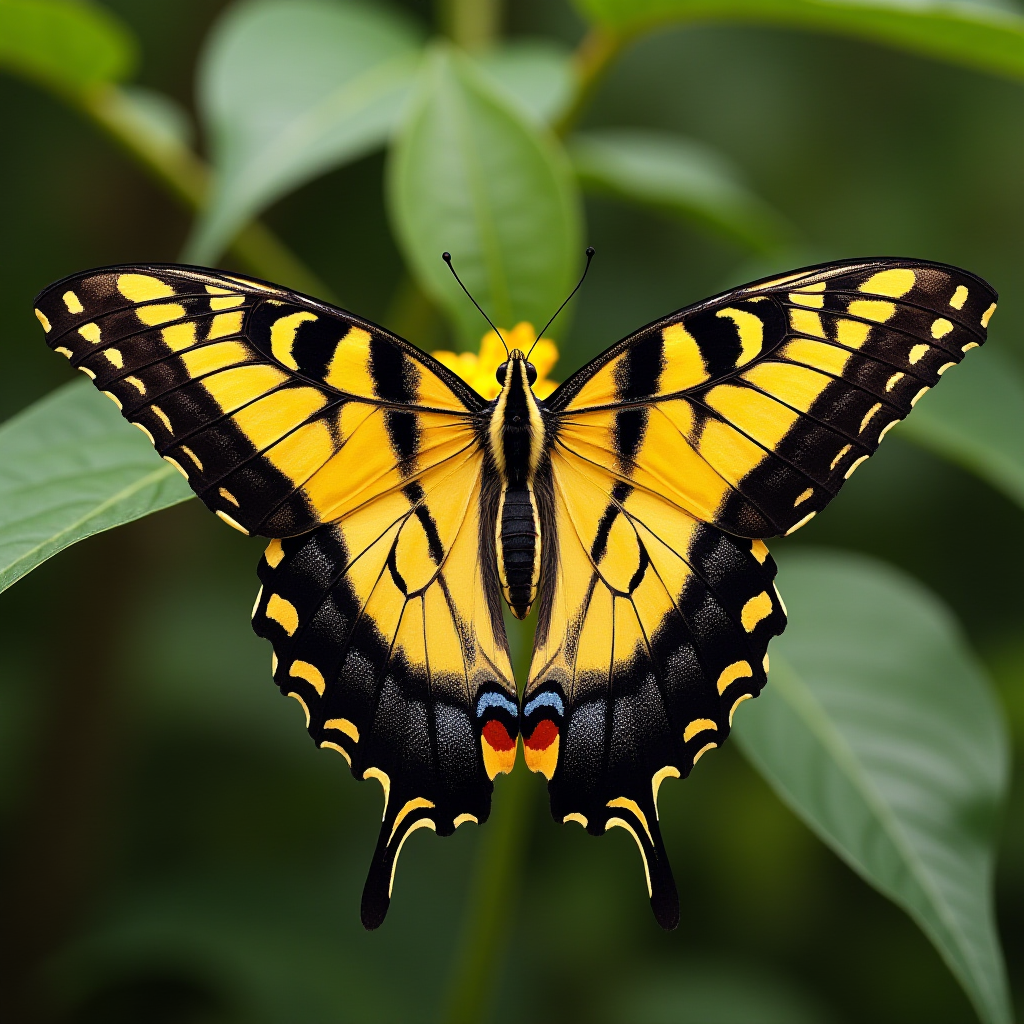
John: Welcome back, everyone, to a segment where we peel back the layers of nature’s most astonishing creations. Today, Nigel, we’re diving into the world of an absolute master illusionist, a creature that has perfected the art of disguise at every single stage of its life: the tiger swallowtail butterfly.
Nigel: John, it’s truly a marvel. When you look at the tiger swallowtail, it’s not just a pretty butterfly; it’s a living testament to an incredible strategy. From the moment it’s an egg, right through to its final winged form, it seems to have a bespoke defense mechanism, almost tailor-made for each threat it might face. It’s just… incredible forethought, isn’t it?
John: Absolutely, Nigel. And what’s so fascinating is how these disguises aren’t just generic camouflage. They’re specific, highly effective deceptions that seem perfectly suited to fool the very predators looking for a meal. It’s almost like a carefully orchestrated play, with each act having a different costume.
Nigel: That’s a fantastic analogy, John. Let’s start right at the very beginning, with the egg. You’d think an egg would be a prime target, right? But the tiger swallowtail’s eggs are often laid singly, a very deliberate choice, and they’re typically a light green or yellow color. Now, why is that significant?
John: Well, precisely because they blend so perfectly with the tender young leaves and stems where they’re laid. It’s not just a random color; it’s a hue that melts into the background. A bird or an insect predator scanning a leaf for a meal would likely just overlook it, seeing only a continuation of the plant, not a future snack. It’s simplicity, yet utterly effective.
Nigel: Exactly. It’s an initial layer of protection, designed to get it past that extremely vulnerable first stage. But then, it hatches, and this is where the truly mind-bending deception begins. The first instance of the caterpillar, the young larvae, what do they look like, John?
John: Oh, this is my favorite part! They look, unbelievably, like bird droppings! I mean, you look at them, and your brain just screams ‘poop!’ They’re dark, mottled with white, often shiny in places. It’s not just a passing resemblance; it’s an uncanny, almost perfect mimicry. Who in their right mind would want to eat bird droppings?
Nigel: Precisely! And that’s the genius of it. Imagine you’re a hungry bird, looking for a plump green caterpillar. You scan the leaves, and you see this little dark, irregular blob. Your instinct says, ‘Nope, not food, just waste.’ It’s a complete turn-off. The precision with which this tiny creature is patterned to imitate something so unappetizing is just… it speaks volumes about an intentional, very clever design. It’s a complete psychological trick on the predator.
John: It really is! And it’s not just the color, it’s the shape, the texture, the way it just sits there, often on the top side of a leaf, completely exposed, precisely where a bird dropping might fall. It’s like it knows exactly what to look like and where to position itself to reinforce the illusion. It’s not accidental; it’s too precise for that.
Nigel: And this disguise serves it through its most vulnerable early growth phases. But as it gets larger, as it sheds its skin and enters later stage, it can no longer convincingly look like a bird dropping. A large bird dropping would still be a bird dropping, but also maybe a large enough snack to tempt a very hungry predator. So, it switches its costume, doesn’t it?
John: It undergoes an astounding transformation! From unappetizing droppings to something far more intimidating: a snake! Or at least, the head of a small snake. These larger caterpillars turn green, which already helps them blend with foliage, but then they develop these incredible false eye spots on their thorax. They’re usually yellow with black centers, perfectly placed to look like a pair of large, staring snake eyes.
Nigel: And it’s not just static. When disturbed, it can puff up that anterior segment, making those ‘eyes’ seem even more prominent and menacing. It will even rear up, swaying slightly, completing the illusion of a small serpent ready to strike. A bird or a lizard, expecting a juicy caterpillar, suddenly sees something that looks like a snake, and their immediate response is ‘danger, retreat!’
John: It’s an absolute stroke of genius. Think about the complexity involved there. Not just the visual mimicry, but the behavioral component too – the puffing up, the posture. It’s a multi-layered defense system. It’s designed to not just look like a snake but to act like one just enough to deter a quick attack. What kind of blueprint accounts for that level of integrated deception?
Nigel: Indeed. It’s not just a random mutation that happened to work out; it’s an entire system. The coloration, the placement of the spots, the physical ability to change its form slightly to enhance the illusion, and the instinctive behavior to carry it out. It all works in concert. It’s a complete package for survival. And this takes it through its main feeding stage.
John: Right. So, it’s grown, it’s eaten, it’s successfully fended off predators with its snake routine. Now it’s time to transform into a butterfly. And here, again, it needs to be completely vulnerable as it undergoes this incredible metamorphosis. So it forms a chrysalis. And the chrysalis itself is another masterclass in camouflage.
Nigel: Absolutely. The chrysalis is suspended, often from a twig or a branch, and it has this remarkable ability to blend with its surroundings. They can be either green or brown, depending on the environment where the caterpillar decides to pupate. If it’s on a green stem, it might become green; if it’s on a dry branch, it might become brown. How does it ‘know’ what color to be? It’s almost like it’s making an informed decision.
John: It’s a fascinating question, isn’t it? This isn’t just a fixed color; it’s a responsive adaptation. The chrysalis itself is shaped like a twisted leaf or a broken twig, complete with veins and nodes. So, you have this creature, completely immobile, entirely at the mercy of its environment, and yet it has this incredible, almost active, ability to disappear into the background. It’s not just a fortunate accident; it’s a highly sophisticated mechanism. It’s like a perfectly designed stealth mode.
Nigel: Stealth mode is right, John. It stays hidden for weeks, sometimes months, completely vulnerable, yet completely protected by its disguise. And then, finally, the grand reveal: the adult tiger swallowtail butterfly emerges. And even here, the camouflage and mimicry continue, especially with the females.
John: This is where it gets really clever, for a subset of the females anyway. You see, the male tiger swallowtails are typically bright yellow with those striking black tiger stripes. They’re bold, they’re beautiful. But many females, especially in areas where certain other butterflies exist, come in two forms: the standard yellow-and-black, and a dark, almost black form.
Nigel: And that dark form, John, is where the brilliance shines through. It’s a mimicry of the Pipevine Swallowtail, a butterfly that’s completely unpalatable, even toxic, to predators because of the chemicals it ingests as a caterpillar. So, predators quickly learn to avoid anything that looks like a Pipevine Swallowtail.
John: Exactly! So, this dark morph female tiger swallowtail, which is perfectly edible and delicious to a bird, flies around looking exactly like a butterfly that would make that bird very sick. The bird, having learned its lesson with the real Pipevine, avoids the mimic, granting the tiger swallowtail an undeserved immunity. It’s like a ‘poisonous’ warning label on a harmless snack.
Nigel: It’s a masterstroke of design. Think about the levels of information that must be encoded for this to happen. The female needs to develop the correct coloration and pattern to convincingly imitate the Pipevine Swallowtail. It’s not just a general dark color; it has to be the right dark color, with the right iridescent blue sheens and red spots, to fool a discerning predator. This precision is truly astonishing.
John: And it’s not just a ‘lucky guess.’ This specific mimicry is regional, meaning it’s more prevalent where the Pipevine Swallowtail is common. It’s a localized, highly effective strategy. How does a species ‘decide’ to adopt such a specific and beneficial disguise in precisely the right geographical areas? It’s almost as if there’s a guiding hand, anticipating the needs and challenges.
Nigel: It’s the very definition of intelligent problem-solving, isn’t it? You have an edible species, a highly vulnerable target, and it finds a way to wear a costume that broadcasts ‘stay away, I’m dangerous.’ The Pipevine Swallowtail, in a sense, does the advertising for the tiger swallowtail. It’s an ingenious workaround, a very clever design.
John: It truly is. From the minute egg, hiding as a tiny green bead, to the caterpillar pretending to be a bird dropping, then transforming into a formidable snake head, then pupating as a disguised twig, and finally, emerging as a butterfly that, in some cases, pretends to be poisonous. It’s a continuous, multi-stage narrative of survival through brilliant deception.
Nigel: It makes you wonder, John, at the sheer ingenuity embedded within nature. Each stage presents a new set of challenges, and for each challenge, there appears to be a perfectly crafted, often surprisingly complex, solution. It’s not just chance; it’s a testament to incredible foresight and precision in design.
John: And the tiger swallowtail, with its continuous array of tailored disguises, stands out as one of the finest examples of this profound design. It’s not just pretty; it’s a living puzzle of intricate, purposeful strategies. It really gives you something to ponder the next time you see one flitting by.
Nigel: Indeed. A true masterpiece of natural engineering. Thanks for joining me on this incredible journey through the life of the tiger swallowtail, John.
John: My pleasure, Nigel. And to all our listeners, keep an eye out for these incredible creatures, and perhaps you’ll spot one of their many ingenious disguises yourself. We’ll catch you next time!
















Thanks! Share it with your friends!
Tweet
Share
Pin It
LinkedIn
Google+
Reddit
Tumblr