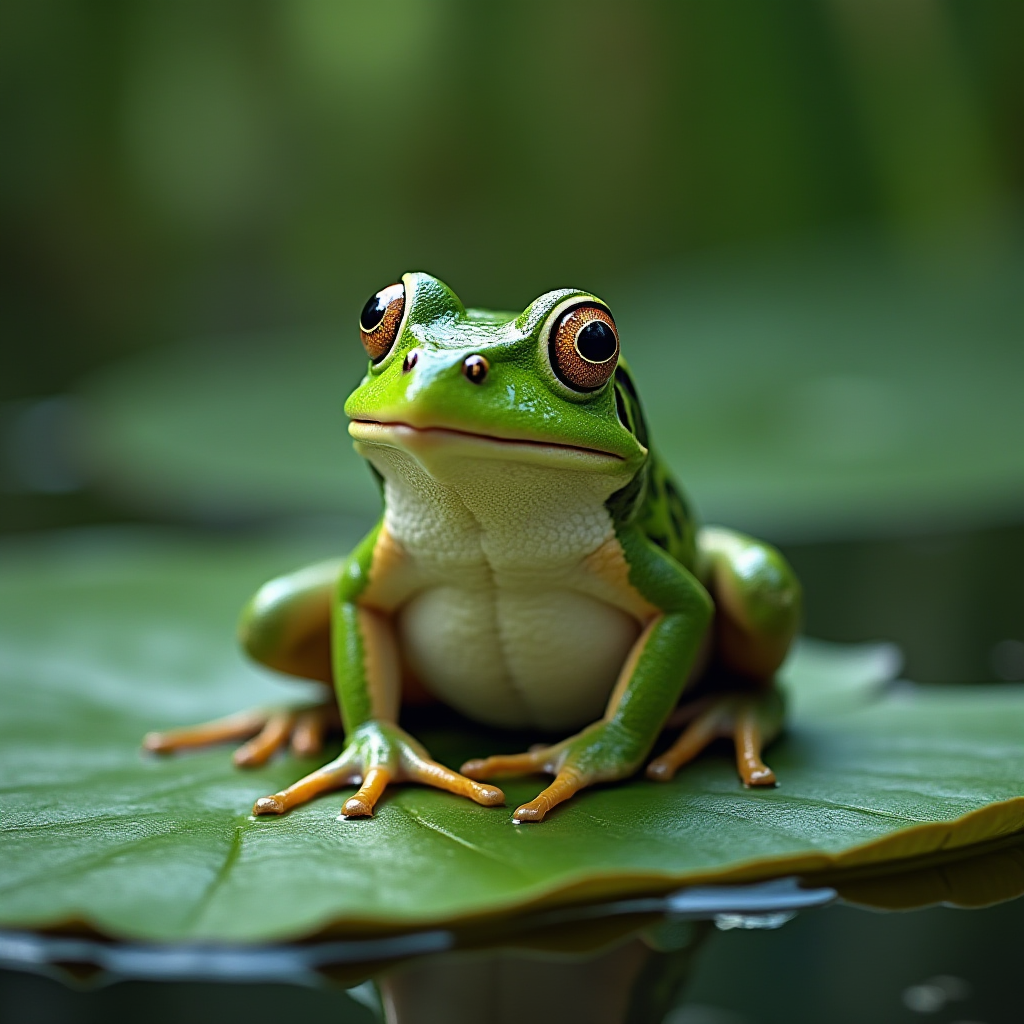
John: Nigel, how often have we seen a common frog hopping by? I mean, we see them, we hear them, but their life cycle… it’s just astounding, isn’t it?
Nigel: John, it absolutely is. It’s one of those everyday miracles that, the more you delve into it, the more you realize the sheer complexity and the incredible foresight involved in every single step. It’s not just a change; it’s a complete redesign.
John: Exactly! You start with this tiny, gelatinous egg, right? And then out pops a creature that’s essentially a miniature fish. A tadpole! It swims around, has gills, a tail… you’d never guess it was destined to become something that hops on land.
Nigel: That’s the beauty of it. The tadpole is perfectly engineered for its initial environment. Those feathery gills, designed to extract oxygen from water, are just incredible. And that long, muscular tail, propelling it through ponds and streams. It’s a masterclass in aquatic locomotion.
John: And the diet too! Most tadpoles are primarily herbivores, right? Scraping algae off rocks and plants. They’re basically tiny aquatic vacuums, cleaning up the pond while they grow. It’s such a specific role.
Nigel: Precisely. Their mouthparts are designed for that. Small, raspy structures perfect for grazing. And their digestive system, long and coiled, optimized for processing plant matter. It’s all so incredibly synchronized for that specific stage of life.
John: But then, the most mind-blowing part starts. This creature, perfectly adapted for water, begins to transform into something completely different. It’s not just growing; it’s rebuilding itself from the inside out.
Nigel: The onset of metamorphosis is truly a marvel of biological programming. It’s not haphazard; it’s a meticulously orchestrated sequence of events. You first see the hind legs beginning to emerge, almost like a preview of what’s to come. They start as tiny buds, almost imperceptible.
John: And it makes sense, doesn’t it? Hind legs first, because those are going to be the powerful propulsion units for hopping on land. It’s like the body knows, “Okay, we need to get these land-ready muscles developed first.”
Nigel: Absolutely. It’s a strategic deployment of resources. While those hind legs are developing, the internal machinery is undergoing a radical overhaul. The gills, which were so vital, begin to regress. They’re no longer needed, because a completely new respiratory system is coming online.
John: The lungs! Imagine having gills, breathing water, and then slowly developing lungs to breathe air. That’s not just an adaptation; that’s a whole new operating system being installed while the old one is still running.
Nigel: It’s an elegant solution, truly. And concurrently, the forelegs begin to emerge. They’re tucked away initially, often beneath a fold of skin called the operculum, only to burst forth at precisely the right moment. It’s as if they’re hidden until the stage is set for their grand reveal.
John: And the tail! Oh, the tail is just incredible. It doesn’t just fall off, does it? It’s reabsorbed. The body literally recycles its own tissue, breaking down the tail and using those nutrients to fuel the growth of the new limbs and organs. It’s the ultimate in efficiency.
Nigel: That process, known as apoptosis or programmed cell death, is profoundly complex and precisely controlled. Cells in the tail are given instructions to dismantle themselves, and specialized cells then consume the remnants, ensuring nothing goes to waste. It’s an internal nutrient buffet for the developing frog.
John: It’s like a perfectly choreographed demolition and construction project happening simultaneously within a single organism. And it’s not just the external features. What about the internal organs? I mean, a herbivore gut to a carnivore gut… that’s a massive change.
Nigel: A complete transformation. The long, coiled intestine of the tadpole begins to shorten dramatically and remodel itself into the much shorter, simpler digestive tract suitable for a carnivorous diet. The enzymes produced also shift. It’s like switching from a vegetarian restaurant menu to a steakhouse, with all the necessary kitchen equipment and staff changes to match.
John: And the mouth! The tadpole’s mouth, with its raspy parts, totally disappears, to be replaced by the wide, gaping mouth of a frog, designed for snapping up insects. And that tongue! The sticky, projectile tongue, perfectly engineered for catching fast-moving prey.
Nigel: The precision of that tongue’s mechanics, the rapid firing, the adhesion, it’s all part of the new predatory toolkit. And don’t forget the sensory organs. The eyes of a tadpole are positioned for an aquatic perspective. A frog’s eyes are larger, often bulging, positioned for a wider field of view to spot predators and prey on land.
John: It’s not just vision either, is it? The ears, or the structures related to hearing, must also adapt. From sensing vibrations in water to detecting airborne sounds. It’s a shift from one sensory world to an entirely different one.
Nigel: Indeed. The entire nervous system undergoes significant rewiring to accommodate the new sensory inputs and motor skills required for living on land. The brain pathways for swimming are replaced by those for jumping, climbing, and sensing air-borne threats. It’s an intelligent system update, if you will, executed flawlessly.
John: And all of this happens within a relatively short period. Sometimes just a few weeks or months, depending on the species and conditions. It’s not a gradual, millions-of-years kind of change; it’s a rapid, complete overhaul within a single individual’s lifetime.
Nigel: The timing is critical. Too slow, and the vulnerable tadpole might not escape its drying pond. Too fast, and the complex changes might not be fully integrated. There’s an internal clock, a master program, that dictates this precise schedule, ensuring each stage transitions seamlessly into the next.
John: It’s like having a detailed architectural blueprint and a perfect construction crew all rolled into one tiny creature. Every step, every molecular change, every reabsorption and growth, it all points to an incredibly sophisticated design.
Nigel: Absolutely. Consider the skin, too. A tadpole’s skin is thin and permeable, ideal for gas exchange in water. The frog’s skin, while still permeable for breathing, also needs to provide more protection against desiccation on land, and some species develop glands that produce toxins for defense. It’s another layer of thoughtful engineering.
John: So, you go from this entirely aquatic, herbivorous, gill-breathing, tail-propelled creature… to a semi-aquatic, carnivorous, lung-and-skin breathing, leg-hopping amphibian. It’s a complete shift in every aspect of its being. It’s not just growing up; it’s becoming a different animal.
Nigel: It truly is. It’s a testament to an underlying plan that anticipates every need for both environments. The tadpole stage isn’t a mistake or a temporary workaround; it’s a perfectly functional, independent organism, a complete being in itself, before being transformed into another complete being.
John: And the energy required for all this! Breaking down its own tail, regrowing limbs, completely changing its digestive system. It’s an immense energetic undertaking, all powered by the food it consumed as a tadpole, stored and strategically utilized.
Nigel: That resource management within the organism is another facet of its ingenious design. The exact hormonal signals that initiate and control this cascade of changes, the precise activation and deactivation of genes—it’s mind-bogglingly intricate. It speaks to a master conductor guiding a symphony of cellular activity.
John: It makes you think, doesn’t it? When you see a pond full of these tiny tadpoles, each one carrying this incredible, pre-programmed journey within it. Each one perfectly equipped for its starting point, and then perfectly re-equipped for its destination.
Nigel: It’s a process that shouts “purpose” from every developing cell. Every part of the tadpole phase serves a function, and every part of the metamorphic transition is directed towards achieving the frog phase. There’s an undeniable coherence to the entire system.
John: And the ultimate outcome, the frog, is just as perfectly designed for its semi-aquatic, land-hopping life. Those powerful hind legs, that camouflage skin, the ability to jump and catch prey. It’s an entirely different creature, but just as functional and specialized.
Nigel: It’s a double mastery of design, really. First, a perfectly formed aquatic creature, then a complete transformation into a perfectly formed terrestrial-aquatic creature. All from the same initial blueprint, but with two entirely distinct operational modes programmed within.
John: It really does make you look at a frog with entirely new eyes, doesn’t it? Not just a common amphibian, but a living testament to an astonishingly complex and elegant design, unfolding right before us, season after season.
Nigel: Absolutely, John. It’s a profound example of intricate biological engineering, a reminder of the extraordinary ingenuity embedded in the natural world. A true spectacle of life’s wonders.
John: Well said, Nigel. It’s been a pleasure diving into this topic with you today. Definitely makes me want to visit a pond soon, just to watch these tiny marvels in action.
Nigel: The pleasure was all mine, John. And perhaps next time, we can explore another one of these amazing natural blueprints. Until then, keep an eye out for those transforming little guys!









![Bill & Gloria Gaither – I’m Free [Live] ft. Vestal Goodman](http://img.youtube.com/vi/p33KNWjxzqg/0.jpg "Bill & Gloria Gaither – I’m Free [Live] ft. Vestal Goodman")


Thanks! Share it with your friends!
Tweet
Share
Pin It
LinkedIn
Google+
Reddit
Tumblr