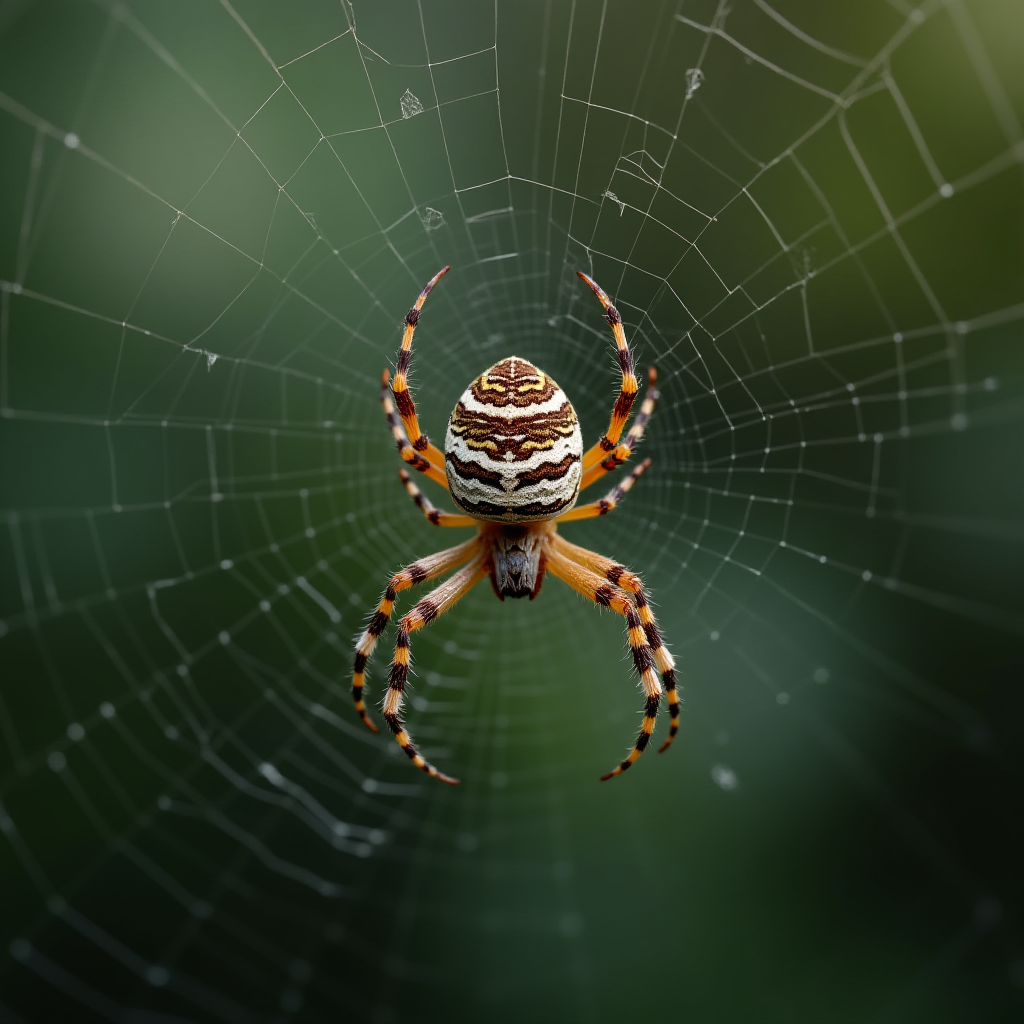
[John]: Welcome everyone. Today, Nigel, we’re diving into a topic that, for many, might trigger a bit of a shiver, but for us, it’s a source of absolute amazement: the common spider. And more specifically, the absolute marvel that is spider silk.
[Nigel]: John, you’ve hit the nail on the head. I mean, people often focus on the eight legs or the eight eyes, but it’s the silk, isn’t it? It’s like a secret superpower that’s just… built into them. We talk about ‘engineering,’ but what a spider does, it feels like it transcends our understanding of the word.
[John]: Absolutely. Think about it. We’ve spent centuries, millennia even, trying to create materials that are strong, flexible, durable. And here, this tiny creature, sometimes no bigger than your thumbnail, produces something that, pound for pound, is stronger than steel, more elastic than nylon, and incredibly tough. It’s truly mind-boggling.
[Nigel]: Stronger than steel, really? That always blows my mind every time I hear it. And it’s not just one type of silk, either, is it? We’re not talking about a single, generic thread. A spider’s ‘tool kit’ is far more sophisticated than that.
[John]: That’s exactly right, Nigel. It’s not just one material; it’s an entire arsenal of specialized fibers, each with a distinct purpose, a unique blend of properties tailored for specific tasks. It’s like having a whole factory on demand, producing different specialized components as needed.
[Nigel]: So, how many different types are we talking about? Because when I think ‘spider silk,’ I generally just picture the sticky stuff in a web, catching flies. But I know it’s so much more.
[John]: Well, most spiders can produce up to seven different types of silk, sometimes even more, each from a different set of glands and spinnerets. It’s an incredibly intricate system. For instance, the dragline silk, what they use as their safety line or the main structural frame of a web – that’s the one that’s tougher than steel. It’s called ‘major ampullate silk,’ and it’s just phenomenal.
[Nigel]: A safety line! So when a spider drops from the ceiling, that’s this ‘major ampullate silk.’ And it’s strong enough to support its entire body weight, even in freefall. That’s some serious tensile strength. It’s almost like it’s been perfectly engineered for that exact purpose.
[John]: Precisely. But then you have the ‘minor ampullate silk’ which is used for temporary scaffolding, or the ‘flagelliform silk’ which is the incredibly stretchy, sticky capture spiral of the web. It’s designed to stretch up to four times its original length without breaking, absorbing the impact of a struggling insect.
[Nigel]: So it’s not just strong, it’s also incredibly elastic. That combination is so rare in man-made materials. Usually, you get one or the other, right? Something super strong is often brittle, and something super stretchy isn’t very strong.
[John]: Exactly. That’s what makes it so bafflingly sophisticated. It’s this perfect balance. And think about the ‘piriform silk,’ which is used as a cement to attach threads to surfaces or to each other. It’s a super-adhesive. Or ‘tubuliform silk’ for the egg sac – that needs to be tough and protective, almost like a miniature fortress for the eggs. Each silk is perfectly suited to its task, a testament to an incredible design.
[Nigel]: It’s like it has a material science department inside its tiny body. But how does it make all these different silks? I mean, it’s not like it has a tiny chemical lab in there, mixing compounds.
[John]: That’s where the ‘intelligent design’ aspect truly shines. Deep inside the spider’s abdomen are these specialized glands. Each type of gland is essentially a miniature factory, custom-built to produce a specific type of silk protein, or ‘spidroin.’ These proteins are stored in a liquid, gel-like form.
[Nigel]: So it’s like a liquid protein concentrate, essentially?
[John]: Precisely. And here’s where it gets really clever. When the spider decides it needs a particular silk, say dragline silk, the liquid spidroin is channeled through a very narrow duct, an extrusion canal, which is lined with special cells. As the liquid moves through this canal, conditions change. The pH might drop, or water might be removed, or specific ions are introduced.
[Nigel]: It’s like a chemical reaction on demand, then.
[John]: Exactly. These changes cause the proteins to rapidly reorient and align themselves, forming highly ordered, crystalline structures within an amorphous matrix. It’s a spontaneous transition from a liquid protein solution to a solid, incredibly strong fiber, all happening in milliseconds as the spider pulls the thread out through its spinnerets.
[Nigel]: So it’s not just extruding a pre-made fiber; it’s actively making the fiber right at the point of use, changing its molecular structure from liquid to solid. And doing it differently for each type of silk? That’s… astounding. Our most advanced manufacturing processes struggle to do anything near that efficiently, let alone at that scale.
[John]: It really is. And the spinnerets themselves are another marvel. These are small, finger-like appendages, typically at the rear of the spider’s abdomen, each containing hundreds of spigots. Each spigot is connected to a specific gland. The spider can control which glands activate and which spigots release silk, allowing it to weave multiple threads simultaneously, often twisting them together to create stronger composite fibers.
[Nigel]: So it’s like having multiple nozzles on a 3D printer, but each nozzle can print a different material with entirely different properties, on the fly, and then twist them together for added strength. It’s a living, self-assembling, multi-material manufacturing plant!
[John]: That’s an excellent analogy, Nigel. And it does all of this with innate, programmed precision. No training manuals, no blueprints, just an inherent ability to produce and utilize these complex materials perfectly from the moment they are able to spin.
[Nigel]: It suggests a very deep, fundamental understanding of material science, doesn’t it? As if the solution for optimal strength, elasticity, and adhesion was pre-programmed into its very existence. And then there’s the web itself. It’s not just a random tangle of threads.
[John]: Not at all. The orb web, for example, is a masterpiece of architectural engineering. It’s a testament to mathematical precision and structural efficiency. The radial threads, typically made of that super-strong dragline silk, provide the structural integrity, like the spokes of a wheel. And then the capture spiral, with its highly elastic and sticky flagelliform silk, is laid down, spiraling inwards.
[Nigel]: And the geometry, the angles between the radial threads, the spacing of the spirals… it’s all so incredibly consistent within a species. It’s not trial and error. It’s a blueprint that’s inherently understood by the spider.
[John]: Exactly. Each part of the web serves a specific function. The non-sticky frame and radial threads allow the spider to move freely without getting stuck, while the sticky capture spiral traps prey. It’s a perfectly optimized hunting machine, created from scratch, often nightly, using materials the spider manufactures itself.
[Nigel]: Wait, they often build them nightly? So all that complex construction, all that material production, all those different silks, just to be done again tomorrow? That’s an incredible energy investment for such a small creature, but it clearly pays off.
[John]: Indeed. And they’re efficient too. Many spiders will consume their old web, recycling the proteins to produce new silk. Nothing goes to waste in this amazing system. It’s a complete, self-sustaining, optimized cycle. It’s a pre-programmed solution to a complex problem.
[Nigel]: This whole discussion really makes you think about the level of intricacy and pre-planning involved. It’s not just a random occurrence. The precise molecular structures, the specialized glands, the behavioral instructions for building perfect webs… it all points to something truly remarkable.
[John]: It does. And beyond webs, silk has so many other uses for the spider. We mentioned the dragline for safety. But it’s also used for locomotion, creating ‘ballooning’ threads to travel long distances on the wind. It’s used to wrap prey, to build retreats, to create nests for their young. It’s their all-purpose tool, their home, their transport, their hunting equipment.
[Nigel]: So, from birth, these tiny creatures have the inherent ‘knowledge’ and the biological ‘machinery’ to create and deploy these astonishing materials for a multitude of purposes. They don’t learn it. It’s just… there.
[John]: Exactly. It’s an inherited trait, an innate capability that’s fully formed and functional from the start. You don’t see juvenile spiders messing up their silk production or building wonky, non-functional webs. They produce perfect silk and perfectly structured webs from day one, proportional to their size.
[Nigel]: And the fact that human engineers and scientists, with all our technology, are still trying to replicate spider silk speaks volumes. We can analyze its structure, we can identify the proteins, but actually producing it with the same efficiency, strength, and elasticity? That’s a challenge that still largely eludes us.
[John]: It’s a huge challenge. We’re getting closer, with things like synthetic spider silk for medical implants or bulletproof vests, but we’re still mimicking, still trying to catch up to what these tiny arachnids have been doing effortlessly, perfectly, since they first appeared. It’s a testament to an incredible original design.
[Nigel]: I mean, imagine if we could mass-produce something like that. Think of the applications: incredibly lightweight, strong materials for aerospace, biodegradable fishing nets, sutures that are stronger than anything we have now. The potential is immense, all inspired by a creature many of us swat away.
[John]: It puts it all into perspective, doesn’t it? The sheer ingenuity displayed in such a small package. Every aspect of the spider’s silk production, from the raw materials it synthesizes to the intricate spinning process and the diverse applications, works together in perfect harmony. It’s a complete, well-orchestrated system.
[Nigel]: It’s almost like observing a finely tuned, miniature biological machine where every component, every protein, every gland, every behavior is perfectly calibrated for survival and success. There’s no waste, no inefficiency, just pure, functional genius.
[John]: Precisely. And that’s what always strikes me. The sheer elegance of it. It’s not clunky or overly complicated; it’s elegant and streamlined, perfectly adapted for its purpose. It’s a natural wonder that continually inspires awe and scientific inquiry. It really makes you appreciate the intricate workings of the world around us, if we just take a moment to look.
[Nigel]: Indeed, John. It just goes to show that some of the greatest wonders are hidden in plain sight, or in this case, spun from the abdomen of a spider. What a truly remarkable creature and material to discuss today.
[John]: Absolutely. And that’s all the time we have. Thank you, Nigel, for another fascinating discussion. And thank you, listeners, for joining us as we explored the incredible, intelligently designed world of spider silk. Join us next time for another journey into the marvels around us.




















Thanks! Share it with your friends!
Tweet
Share
Pin It
LinkedIn
Google+
Reddit
Tumblr