John: Welcome everyone to another fascinating discussion. Today, Nigel and I are diving into something truly foundational, something so ubiquitous we often take it for granted, but it is, without exaggeration, one of the most astonishing processes in the entire natural world: photosynthesis.
Nigel: Absolutely, John. When you start to peel back the layers of how plants actually work, it’s just mind-boggling. We’re talking about the ultimate clean energy factory, happening everywhere, all the time, completely silently, and it underpins almost every single living thing on this planet.
John: That’s it. Think about it: every bite of food we eat, every breath of oxygen we take, almost all of it can be traced back to a tiny green plant, or algae, converting sunlight into chemical energy. It’s an act of profound, elegant engineering.
Nigel: Elegant is the perfect word. It’s not just effective; it’s astonishingly beautiful in its simplicity on the surface, yet unbelievably complex when you get down to the molecular level. It’s like finding a miniature, perfectly optimized power plant in every single leaf.
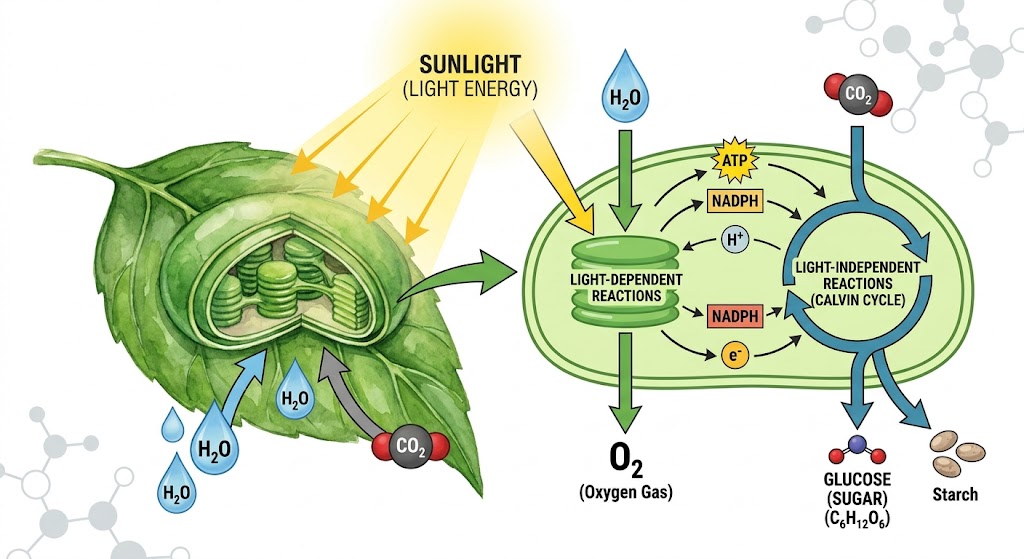
John: Exactly. Let’s break it down for a moment. What are the ‘ingredients’ this incredible system uses? It’s remarkably simple inputs for such a complex output. You have sunlight, water, and carbon dioxide.
Nigel: And the ‘chef’ in this kitchen, the main component that makes it all happen, is chlorophyll, right? Those green pigments that give plants their color. They’re not just for show; they’re the ultimate solar panels.
John: Precisely. These chlorophyll molecules are housed within specialized organelles called chloroplasts inside plant cells. And these chloroplasts, Nigel, are where the magic truly unfolds. They are miniature, purpose-built factories with incredibly sophisticated internal structures.
Nigel: I remember learning about them, those stacked disc-like structures called thylakoids, and then stacks of those are called grana. It’s like a finely organized internal architecture, not just a blob of green stuff.
John: That organization is key. It’s a testament to the incredible design. It maximizes surface area for capturing light and creates distinct compartments where different stages of photosynthesis can occur efficiently, without interfering with each other. It’s compartmentalization at its finest.
Nigel: So, let’s talk about those stages. You mentioned sunlight, water, and CO2. How does the plant actually take these raw materials and turn them into sugar and oxygen?
John: It happens in two main phases, brilliantly separated yet perfectly coordinated. First, we have the light-dependent reactions. This is where the sunlight truly shines, pun intended. Light energy is absorbed by the chlorophyll within those thylakoid membranes.
Nigel: And what happens once the light is captured? It’s not just passive absorption, right?
John: Oh, no, it’s far from passive. When light hits chlorophyll, it excites electrons to a higher energy state. These energized electrons then embark on an incredible journey through a series of protein complexes embedded in the thylakoid membrane, known as the electron transport chain. It’s like a precisely engineered molecular conveyer belt.
Nigel: A molecular conveyer belt! That’s a great analogy. So, these electrons are zipping along, being passed from one protein to another. What’s the purpose of this incredibly specific relay race?
John: The energy from these electrons is used to do two crucial things. First, it powers the pumping of protons across the thylakoid membrane, building up a concentration gradient. This gradient is then used by another amazing molecular machine, ATP synthase, to generate ATP – adenosine triphosphate – which is the primary energy currency of the cell. It’s like a tiny turbine generating electricity from a water flow, but with protons.
Nigel: So, light energy is being converted into chemical energy in the form of ATP. That’s one part. And what’s the other crucial output from this light-dependent stage?
John: The other is NADPH, another energy-carrying molecule. And here’s where the water comes in. As the electrons move along the chain, they need to be replaced. Water molecules are split in a process called photolysis. This releases electrons to replenish the chain, protons which contribute to the gradient, and crucially, oxygen gas as a byproduct. That’s where our breathable air comes from!
Nigel: Wow. So, water is broken down, light energy is captured, electrons are moved, and we get ATP, NADPH, and oxygen. It’s an entire energy conversion system designed with such incredible foresight. I mean, the oxygen being a byproduct – it’s like the system not only sustains itself but also perfectly provides for the needs of other life forms.
John: It truly is a brilliantly integrated system. Now, these ATP and NADPH molecules, brimming with chemical energy, are absolutely essential for the second stage: the light-independent reactions, often called the Calvin cycle.
Nigel: This is where the carbon dioxide comes into play, right? Where the actual sugar is made.
John: Exactly. The Calvin cycle occurs in the stroma, the fluid-filled space within the chloroplast, outside those thylakoids. Here, the plant takes the carbon dioxide from the atmosphere and ‘fixes’ it, meaning it incorporates it into organic molecules. It’s an absolutely pivotal step, transforming inorganic carbon into the building blocks of life.
Nigel: And this cycle, it’s not just a simple one-off reaction. It’s a continuous, self-regenerating process, right?
John: That’s a crucial point. It’s a cycle, meaning the starting molecule is regenerated at the end, allowing it to continue. It involves a specific enzyme called RuBisCO, which, surprisingly, is one of the most abundant enzymes on Earth. It’s responsible for ‘grabbing’ the CO2 molecule and attaching it to an existing five-carbon sugar.
Nigel: RuBisCO… even the name sounds important! So, this enzyme acts like a molecular welder, fusing carbon dioxide into an organic framework. And then, the ATP and NADPH from the light reactions, they come in to power the rest of the process?
John: Precisely. The energy from ATP and the reducing power from NADPH are used to convert these newly formed carbon compounds into glucose – simple sugar. Think of it: a plant takes thin air, water, and sunlight, and through this unbelievably complex, coordinated molecular dance, it literally conjures food out of nothing. It’s pure alchemy, but it’s real, and it’s happening right now.
Nigel: And it’s not just glucose. That glucose then becomes the building block for everything else: starches for energy storage, cellulose for structure, all the complex organic molecules that make up the plant itself. It’s the ultimate base of the food chain.
John: It really is. Without this finely tuned process, life as we know it simply couldn’t exist. There’s an incredible interdependence. The atmosphere provides the CO2, the sun provides the energy, the soil provides the water, and the plant, with its perfectly designed chloroplasts and molecular machinery, takes all of it and produces sustenance for itself and a breathable atmosphere for virtually everything else.
Nigel: And the efficiency! Think about the scale. Billions of plants, billions of chloroplasts within each plant, each one doing this complicated chemical ballet perfectly, day in and day out. It’s not just functional; it’s optimized to an incredible degree.
John: Optimized is a key word there. The light-harvesting complexes, for instance, are designed to capture a wide spectrum of light and funnel that energy to the reaction centers with minimal loss. It’s like an incredibly intelligent network of antennas, each perfectly tuned.
Nigel: And the speed! These reactions are happening at an astonishing rate. I mean, we’re talking about molecules moving, electrons zipping around… It’s all so incredibly precise and fast. You can’t help but be struck by the sheer engineering marvel of it all.
John: It implies such a deep level of foresight and purpose. The system is complete, robust, and elegant. Each component is essential, and they all work together in perfect synchronicity. If you remove any one part, the whole system grinds to a halt.
Nigel: It’s not just a collection of parts; it’s a unified, integrated system. The light reactions produce exactly what the Calvin cycle needs, and the byproducts of one perfectly serve the needs of others in the broader ecosystem. It’s interconnectedness at its finest.
John: Exactly. From the absorption spectrum of chlorophyll, perfectly matched to the sun’s output, to the enzymes that facilitate each specific chemical reaction, to the internal architecture of the chloroplast, everything seems specifically tailored for this grand purpose of sustaining life.
Nigel: It’s almost poetic, really. The sun, which gives us warmth and light, is also the ultimate power source, harnessed by these unbelievably intricate biological machines. And the fact that this has been going on without human intervention… it’s just humbling.
John: Absolutely humbling. It challenges you to look at a simple leaf and see not just a green surface, but a microcosm of intelligent design, a marvel of chemical and physical orchestration that dwarfs even our most sophisticated human technologies.
Nigel: It really does make you appreciate every green thing you see, every tree, every blade of grass. They’re all performing this incredible, life-giving feat right before our eyes.
John: And that, I think, is a wonderful note to end on. The sheer genius inherent in photosynthesis, a process so fundamental, so intricate, yet so perfectly executed. It truly is one of nature’s greatest masterpieces, continuously demonstrating a profound intelligence behind its design.
Nigel: Couldn’t agree more, John. It’s a constant reminder of the incredible, purposeful design that underpins our world. Thank you for another enlightening discussion.
John: My pleasure, Nigel. And thank you all for joining us. We hope you gained a new appreciation for the amazing world of photosynthesis. Until next time, keep exploring the wonders of life.
















Thanks! Share it with your friends!
Tweet
Share
Pin It
LinkedIn
Google+
Reddit
Tumblr