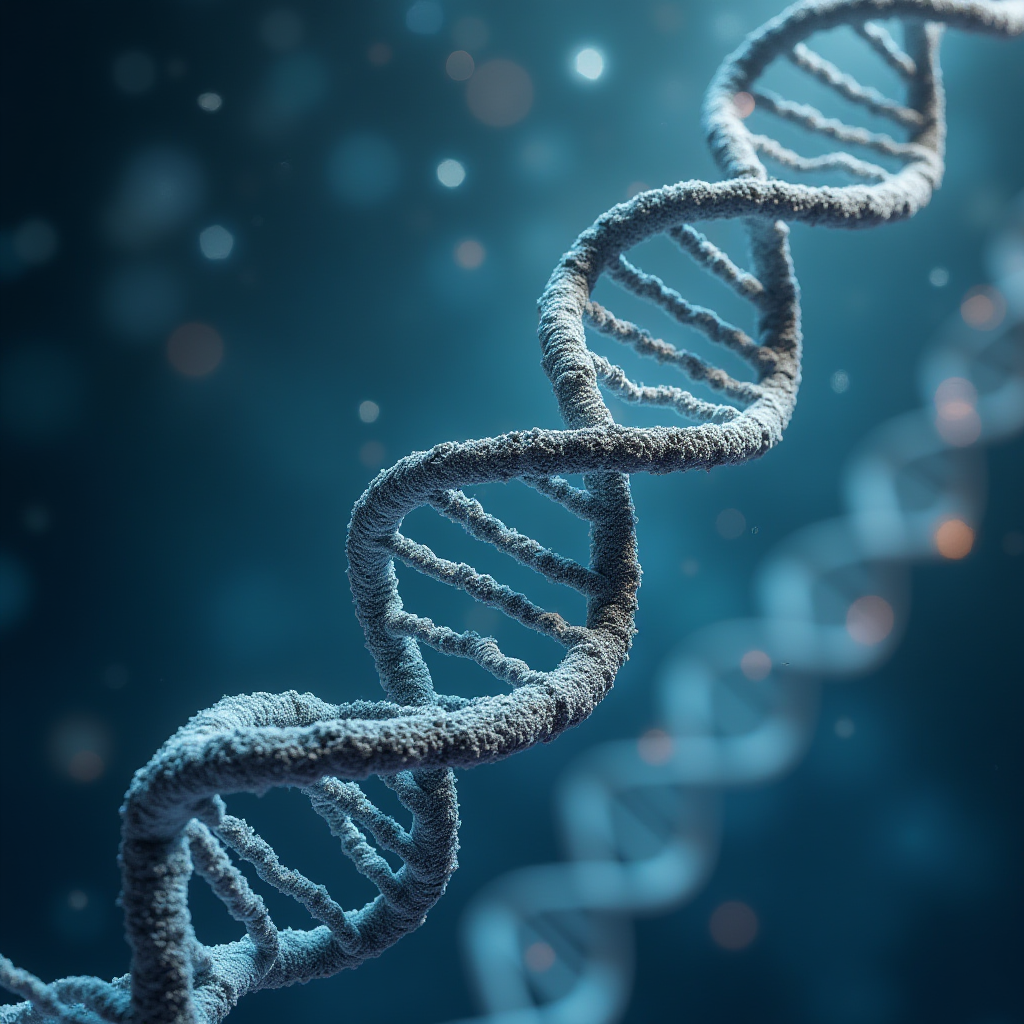
John: Nigel, have you ever just stopped to truly think about the sheer, mind-boggling complexity of something like DNA? I mean, we hear about it all the time, right? It’s the blueprint of life, the code, the instruction manual. But do we really grasp what that means?
Nigel: Honestly, John, I think most of us barely scratch the surface. We know it’s important, we know it’s in our cells, but the ‘how’ and ‘why’ often get lost in the scientific jargon. But when you start to consider it, it’s almost overwhelming, isn’t it? Like trying to comprehend the size of the universe in a tiny grain of sand.
John: Exactly! It’s like trying to imagine an entire library, full of incredibly detailed instruction manuals, all condensed into a microscopic package that fits inside every single cell in your body. We’re talking about something so small, you can’t see it without powerful microscopes, yet it contains more information than you could ever fit into thousands of hard drives.
Nigel: That’s a fantastic analogy, actually. A library in every cell. It makes you think about not just the information, but the way it’s stored. It’s not just a jumbled mess of letters, is it? It’s ordered, structured, incredibly precise. It has to be, otherwise, well, we wouldn’t be here, would we?
John: Absolutely not. And that structure is key. Most people know it as the double helix, right? Like a twisted ladder. But imagine each rung of that ladder is made up of two chemical ‘letters’ that pair up in a very specific way: A always with T, C always with G. This pairing is critical. It’s not random. It’s like a built-in error-checking system, a quality control measure that ensures the information is copied accurately.
Nigel: So, it’s not just the information itself, but the way it’s physically arranged that’s so clever. It’s like having a book where every page is exactly where it needs to be, and the binding is so strong it never falls apart, even when it’s being copied millions of times.
John: Precisely. And think about the scale here. If you were to uncoil all the DNA from a single human cell and stretch it out, it would be about two meters long. Two meters! From one microscopic cell! And if you did that for all the cells in your body, you could reach the moon and back several thousand times. That’s an astonishing amount of highly organized data packed into an impossibly small space.
Nigel: Wow. That’s a visual I’m going to struggle to get out of my head. It really puts into perspective the sheer density of information. And it’s not just storage, is it? That information has to be used. It’s not just a static archive. It’s constantly being read, interpreted, and acted upon to build and maintain everything in our bodies.
John: You’ve hit on a crucial point there, Nigel. It’s not just information; it’s functional information. It’s not just a random sequence of ‘letters’ – it’s a specific instruction set, a program, if you will, that tells cells exactly how to build proteins, how to repair themselves, how to grow, how to divide. Every single process in every single living thing is orchestrated by this code.
Nigel: So, like an incredibly sophisticated computer program running billions of operations simultaneously, all within the microscopic confines of a cell? That comparison really makes sense. You wouldn’t expect a complex piece of software to just appear out of nowhere, without a programmer, right?
John: Exactly. And the ‘language’ it uses is fascinating. There are only four ‘letters’ or bases – Adenine, Thymine, Guanine, Cytosine. But these four letters are arranged in sequences of three, called codons. Each codon acts like a single word, instructing the cell to add a specific amino acid to a growing protein chain. It’s a tri-letter code, highly efficient, highly robust.
Nigel: So it’s not just a series of random combinations. It’s a meaningful language with grammar and syntax, where every ‘word’ has a specific job. And these ‘words’ combine to form ‘sentences’ which are the genes, right? And those ‘sentences’ are the instructions for building all the amazing components that make life possible.
John: Spot on. Think of a human gene as a very long, very precise sentence or paragraph. And each of those genes codes for a specific protein, which are the workhorses of the cell. They do everything from building structures to carrying oxygen to fighting off invaders. And the accuracy required to build just one of these proteins is staggering.
Nigel: And the cell knows which parts of the DNA to read, and when, and how to put it all together? It’s not just a blueprint lying there; there’s an entire manufacturing plant that reads the blueprint, sources the materials, and assembles the product perfectly. It’s a whole system, not just a single component.
John: You’ve hit another crucial aspect: the machinery that reads and uses the DNA. It’s not enough to have the instruction manual; you need a system to interpret it. The cell has molecular machines, like RNA polymerase, that zip along the DNA, making copies of specific genes. Then other machines, called ribosomes, take those copies and translate them into proteins.
Nigel: So, you’re describing an integrated system. It’s not just the DNA, but the DNA plus the reading mechanism plus the manufacturing mechanism plus the transportation system for the final product, all working in perfect harmony. If any one of those pieces is missing or flawed, the whole thing grinds to a halt.
John: Precisely! It’s what some call ‘irreducible complexity.’ You can’t remove a single component without rendering the whole system non-functional. Imagine a highly complex watch. You can’t take away the mainspring, or a gear, or the hands, and expect it to tell time. Every piece is essential. DNA is like that, but on an infinitely more intricate scale. The information itself, the storage mechanism, the replication machinery, the transcription, the translation – it all has to be present and functional from the start.
Nigel: That’s a powerful point. It challenges the idea that something so perfectly interdependent could have just assembled itself incrementally. Each part seems to presuppose the existence of the others. It’s almost like a ‘chicken and egg’ situation, but with dozens of ‘chickens’ and ‘eggs’ all needing to exist simultaneously for any of it to work.
John: Exactly. And let’s not forget about the repair mechanisms. DNA is constantly exposed to damage from UV light, chemicals, and even just normal cellular processes. If these damages weren’t repaired, the integrity of the genetic code would quickly degrade. But cells have an army of molecular machines dedicated to scanning, detecting, and fixing these errors with incredible accuracy.
Nigel: So, it’s not just a beautifully written instruction manual, but it also comes with its own team of highly skilled technicians for maintenance and repair. That’s next-level engineering, honestly. It’s not just designed to work, but designed to endure and self-correct.
John: Absolutely. It really highlights the depth of foresight involved. It’s not just about creating a functional system, but a resilient one. And this resilience is key to life’s continuity. Think about a single fertilized egg cell. It contains all the instructions to build an entire human being, with billions of specialized cells, organs, tissues, all working together perfectly.
Nigel: It goes from one cell to a fully formed individual, all guided by that initial blueprint. It’s like having a master plan that not only builds the initial structure but also oversees its growth, development, and ongoing maintenance throughout its entire lifespan. It’s an ongoing, dynamic process of construction and renewal.
John: And the sheer information density is astonishing. A single gram of DNA, if you could write to it, could store all the data of the world’s most sophisticated data centers. We’re talking exabytes of information in a tiny speck. Our best artificial intelligence and data storage solutions are still playing catch-up to what creation has perfected.
Nigel: That’s a staggering thought. It makes our most advanced technology look almost primitive in comparison. And it’s not just about raw storage; it’s about accessibility and efficiency. This information is readily available for the cell to use whenever and wherever it’s needed, without buffering or lag.
John: Exactly. And the way it’s packaged inside the cell nucleus is another marvel. The DNA is tightly coiled and folded into structures called chromosomes. It’s not just randomly tangled; it’s meticulously organized, making sure the right genes are accessible at the right time. It’s like having a super-efficient filing system within that tiny library.
Nigel: So, not only is the information complex, and the machinery complex, but even the storage and retrieval system is mind-bogglingly intricate. It’s layers upon layers of sophisticated design. It’s not just one smart solution; it’s a whole suite of interconnected brilliant solutions.
John: That’s the beauty of it, isn’t it? When you start to peel back the layers, you find an elegance and efficiency that seems to defy simple explanation. Every component, every process, every interaction seems purposefully arranged to achieve a specific outcome: life itself. And not just simple life, but incredibly diverse and complex forms of life.
Nigel: It really does inspire a sense of wonder. To think that this incredibly detailed, precise, and self-regulating system exists within every single one of us, and in every plant and animal on the planet. It’s a universal language of life, yet uniquely customized for each species. It’s a testament to incredible ingenuity.
John: It truly is. From the way the information is encoded, to its double-helix stability, to the armies of molecular machines that read, replicate, and repair it, DNA is arguably the most sophisticated information system known. It’s the ultimate example of miniaturization and complex engineering operating at an unimaginable scale, underpinning everything that lives.
Nigel: And it makes you realize how much we still have to learn, doesn’t it? We’ve only just begun to truly appreciate the depth of this complexity. But the more we uncover, the more astounding it seems. It’s a humility-inducing field of study, for sure.
John: Absolutely. It’s one of those things where the more you know, the more you realize you don’t know. But what we do know points to something profoundly ordered and purposeful at the very core of biology. It’s not just a molecule; it’s a message, an intricate instruction set for life.
Nigel: Well, John, I think you’ve given us all a lot to ponder about the incredible internal universe within each of our cells. It’s been a truly fascinating dive into the master blueprint of life.
John: Thanks, Nigel. It’s always a pleasure to unpack these marvels with you. Hopefully, it gives our listeners a fresh appreciation for the astonishing design woven into the fabric of life.
Nigel: Indeed. And that’s all for today’s episode. Join us next time for more explorations into the wonders around us.















Thanks! Share it with your friends!
Tweet
Share
Pin It
LinkedIn
Google+
Reddit
Tumblr