John: Welcome back, everyone! Today, Nigel and I are taking a deep dive, quite literally, into one of the ocean’s most incredible, yet often overlooked, feats of biological engineering. We’re talking about ceramics, but not the kind you find in your kitchen.
Nigel: That’s right, John. When you think of ceramics, you probably picture pottery or even high-tech engine parts. But what if I told you that some of the most advanced ceramic manufacturing processes are happening right now, under the waves, inside creatures you might barely notice?
John: It’s truly mind-blowing, isn’t it? We’re going to be focusing on sea urchins and various mollusks today. These aren’t just creatures; they’re living factories, crafting materials with a precision and complexity that human engineers are still striving to replicate.
Nigel: And the beauty of it is, they do it all at ambient temperatures, using readily available materials from seawater. No kilns, no enormous energy expenditure, just incredible biological machinery following an utterly sophisticated instruction set.
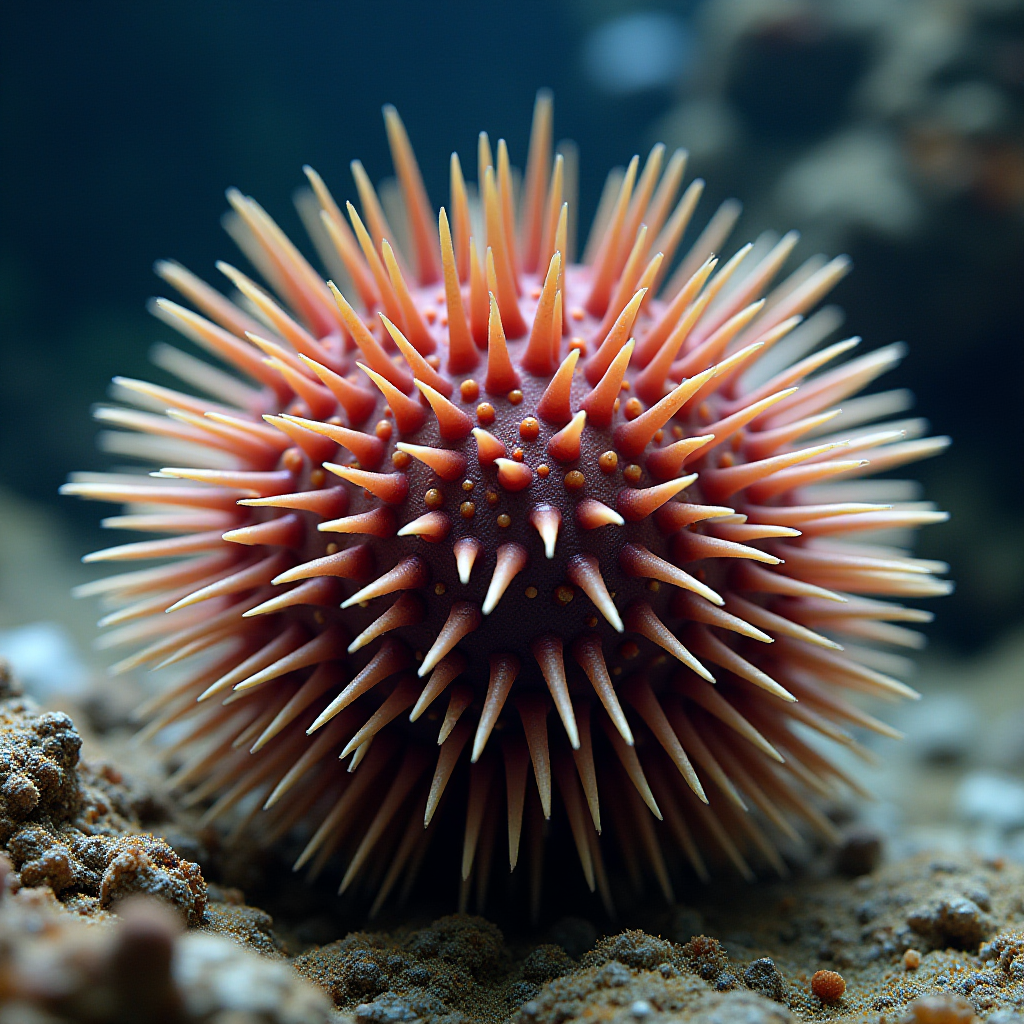
John: Exactly. Let’s start with the sea urchin. These spiky little spherical guys… their entire structure is a testament to ingenious design. Their spines, their ‘test’ or shell – it’s all calcium carbonate, which sounds simple, right? Like chalk.
Nigel: It does, but it’s anything but simple. I mean, if you just crushed chalk into a spine shape, it’d be brittle, easily broken. But sea urchin spines are tough. Really tough.
John: They are. And here’s where the marvel begins. Each spine, each plate of their test, is essentially a single crystal of calcite. A single crystal. But it’s not just a blocky crystal; it’s highly porous, like a sponge, yet incredibly strong.
Nigel: Wait, so it’s porous and strong? That sounds like a contradiction in terms for us, doesn’t it? Usually, adding pores weakens a material.
John: That’s because it’s not random porosity. The sea urchin builds these structures with an absolutely precise, three-dimensional lattice. Imagine a highly intricate scaffold, all made from a single, continuous crystal, but with a network of tiny tunnels and chambers running through it.
Nigel: Like a natural meta-material, before we even coined the term. That’s astonishing. And it’s all done, what, from dissolved calcium and carbonate ions in the water?
John: Precisely. The urchin extracts these basic building blocks and then, through a highly orchestrated biological process, it directs their assembly into these incredibly complex, perfectly ordered single-crystal structures. It’s not just growing a crystal; it’s sculpting it at the atomic level.
Nigel: So, it’s not just about the material, but the architectural design embedded within it. The form is the function, and it’s all pre-programmed. It’s like a blueprint for a miniature, self-assembling skyscraper.
John: Absolutely. And this design gives the spines incredible properties. They’re lightweight for buoyancy, yet robust enough to deter predators and withstand wave action. Some even have a unique ball-and-socket joint that allows them to move and articulate, adding another layer of mechanical genius.
Nigel: And the fact that they can regenerate spines if they lose them… that means the instruction set for building these complex structures isn’t just ‘on’ once, it’s always there, ready to be activated for repair. That’s a powerful testament to the inherent design.
John: It really is. It demonstrates an incredible level of foresight in the underlying biological programming. The information needed to construct and repair such intricate, high-performance ceramics is undeniably present and actively utilized. It’s not something that just ‘happens’.
Nigel: I mean, for us to make a single crystal with that kind of intricate internal architecture? We’re talking advanced labs, incredibly precise control, and even then, we’re mimicking, not creating from scratch with the ease and efficiency of a sea urchin.
John: Exactly. They don’t have an engineering department, yet they’re outperforming our best material scientists in certain areas. It’s truly a masterpiece of engineering, precisely tailored for its environment.
Nigel: Okay, so sea urchins are building these incredible single-crystal nano-scaffolds. What about the mollusks? I know their shells are also calcium carbonate, but they look so different, like abalone shells, with that beautiful iridescent mother-of-pearl.
John: Ah, the mollusks. This is another entirely different, yet equally astounding, ceramic-making strategy. Take abalone, for instance, with its nacre, or mother-of-pearl. It’s famous for its beauty, but its real secret lies in its almost unbelievable strength.
Nigel: I’ve heard it’s incredibly tough. Like, far tougher than the individual components would suggest. How does that work?
John: It’s a prime example of composite material design, light years ahead of what we typically achieve. The shell is made of something called aragonite, which is another crystalline form of calcium carbonate, like calcite. But unlike the urchin’s single crystal, abalone builds in layers.
Nigel: Layers, right. Like bricks in a wall?
John: Precisely, but on a microscopic scale. Imagine millions of tiny, hexagonal aragonite ‘bricks,’ each only about half a micron thick, neatly stacked and arranged.
Nigel: Microscopic bricks. They sound delicate.
John: They would be, if they were just stacked dry. But the ingenious part is the ‘mortar.’ Between each layer of these aragonite bricks, the abalone secretes a thin layer of organic material – a protein-rich polymer. This isn’t just glue; it’s a strategically placed energy-absorbing layer.
Nigel: So, it’s not just a simple adhesive. It’s an active component in the material’s performance. That’s fascinating.
John: Exactly. When stress is applied to the shell – say, a predator tries to bite or crush it – the brittle aragonite plates would normally just crack. But with nacre, instead of a crack propagating straight through, the organic layers act like shock absorbers. They deform and stretch, dissipating the energy.
Nigel: So it’s like a tiny, biological version of bulletproof glass? Where layers of hard and soft materials work together to stop impact?
John: You got it! This ‘brick and mortar’ structure allows nacre to be about 3,000 times tougher than the aragonite mineral itself. It’s incredibly resistant to fracture. The organic matrix doesn’t just hold the bricks together; it allows them to slide past each other a tiny bit, taking the impact without breaking.
Nigel: That’s an unbelievable increase in toughness. Three thousand times! It really highlights how purposeful the architecture is. It’s not just about what materials are used, but precisely how they’re put together. There’s clear intent in that design.
John: Absolutely. It’s a perfect example of how the specific arrangement of components at the nanoscale creates vastly superior macroscopic properties. This is not accidental. This is engineered perfection for a specific purpose – survival.
Nigel: And it’s beautiful too! The iridescence comes from the way light interacts with those perfectly stacked layers, right? Another bonus of this incredible design.
John: Precisely. The spacing of those layers is incredibly precise, reflecting different wavelengths of light to create that shimmering effect. It’s a functional material that also happens to be aesthetically stunning – a hallmark of intelligent craftsmanship.
Nigel: So, we’ve got the sea urchin building single-crystal, porous, lightweight yet strong structures, and the abalone creating incredibly tough, layered composites. Are there other mollusks doing interesting ceramic work?
John: Oh, absolutely. Think about the diversity of mollusk shells – from the elegant spirals of a conch to the robust hinged shells of clams and oysters. Each one represents a unique solution, a specific design tailored to its environment and lifestyle.
Nigel: Like the razor clam, for instance, it’s so streamlined, built for burrowing, yet still strong enough to protect the soft animal inside.
John: Exactly. And even within a single mollusk, you often find different ceramic structures. The outer layer, called the periostracum, might be organic and protective, while underneath, you have different arrangements of calcium carbonate – sometimes fibrous, sometimes prismatic, sometimes nacreous – each optimized for particular stress resistance or growth patterns.
Nigel: So, a single creature can be a multi-material engineer, knowing exactly when and where to deploy different ceramic architectures for optimal performance. That’s astonishing foresight built into their very being.
John: It implies a comprehensive blueprint, doesn’t it? A set of instructions so detailed and sophisticated that it can guide the construction of not just one, but multiple types of advanced ceramic materials within the same organism, adapting as it grows.
Nigel: It’s like having an entire materials science department operating within a tiny, soft-bodied animal. And they’re doing it with raw materials from seawater, without any external energy input beyond their basic metabolism. We use immense heat, pressure, and complex machinery for far less.
John: Indeed. Consider the conch shell, for example. Those striking spirals aren’t just for aesthetics. They’re a structural marvel. The material is arranged in a helical, cross-lamellar structure – like tiny plywood, but with layers rotating, giving it incredible resistance to crushing and bending. It’s designed to withstand impact from crabs and other predators.
Nigel: Plywood on a microscopic scale, engineered for superior strength. This isn’t random. It speaks of a deliberate strategy, a solution crafted to tackle specific challenges in the marine environment.
John: It absolutely does. These are not haphazard agglomerations of minerals. They are exquisitely structured, high-performance materials, each detail contributing to the overall functionality and survival of the organism. Every curve, every layer, every crystal orientation serves a purpose.
Nigel: So, when we look at these shells, we’re not just seeing the byproduct of biological processes. We’re witnessing the manifestation of an incredibly intricate and intelligent design, implemented at a scale and with a precision that still baffles our best scientists.
John: Precisely, Nigel. We’re talking about biological systems that self-assemble complex, multi-functional ceramic composites with unparalleled control over crystal growth, morphology, and orientation. The ability to deposit a material like aragonite or calcite in such precise and varied architectures speaks volumes about the detailed instructions encoded within these creatures.
Nigel: It’s almost humbling, isn’t it? To realize that these ‘simple’ creatures are performing feats of materials science that we’re still scratching our heads over how to fully mimic. It forces you to look beyond mere chance.
John: Completely humbling. When you consider the sheer complexity and optimization, it truly points to a grand, underlying blueprint. These aren’t just efficient; they are elegantly designed, optimized, and robust.
Nigel: And the fact that this ‘manufacturing’ process is so clean and efficient. No waste, no extreme conditions. Just perfectly orchestrated biological assembly. It’s a masterclass in sustainable engineering that we are still trying to learn from.
John: Indeed. From the sea urchin’s single-crystal scaffolding to the mollusk’s layered composites, what we see is not merely survival, but a demonstration of highly advanced, purpose-driven construction. It’s nature’s ultimate material science workshop, openly displaying undeniable evidence of masterful foresight and design.
Nigel: Absolutely. It really puts into perspective the incredible intelligence embedded in the fabric of life around us. Every shell, every spine, a tiny testament to a magnificent architect.
John: Couldn’t agree more, Nigel. It’s a fantastic reminder of the depth and wonder in the natural world, if only we take a moment to truly observe and appreciate the incredible ingenuity at play. What a journey through the ocean’s ceramic factories today.
Nigel: It truly was, John. Thank you for shedding light on these often-unseen marvels. And thank you all for joining us on this fascinating exploration. We hope you’ll look at a seashell or a sea urchin with entirely new eyes next time.
John: Until next time, keep exploring the wonders of design all around us!


















Thanks! Share it with your friends!
Tweet
Share
Pin It
LinkedIn
Google+
Reddit
Tumblr