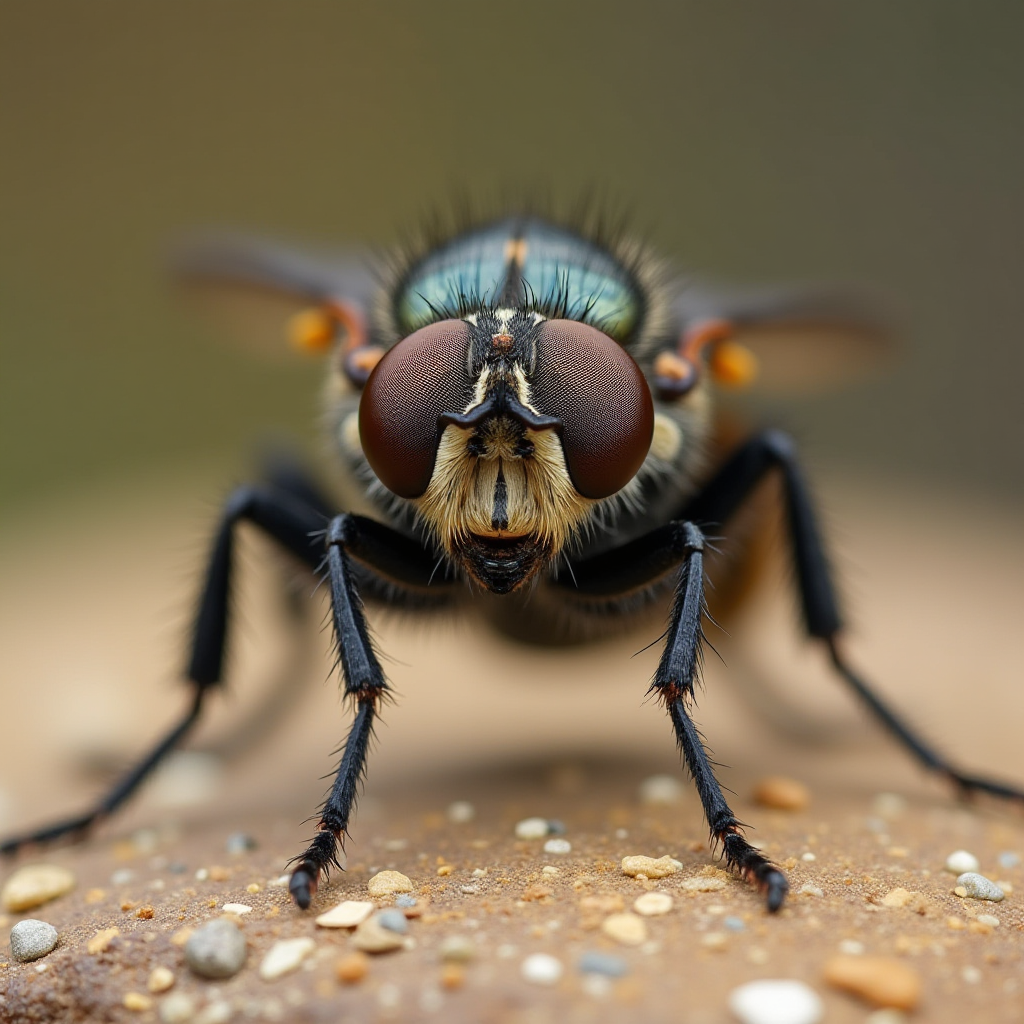
John: Welcome back to the show, everyone! You know, sometimes the most incredible things are hiding in plain sight, or in this case, buzzing annoyingly around your kitchen.
Nigel: Oh, here we go. I knew you were going to bring up the house fly, John. Is this another one of your ‘appreciate the small things’ rants?
John: Hardly a rant, Nigel, more of an appreciation! But honestly, how many times have you been trying to swat one, and it just… vanishes? Like it saw you coming a mile away, even when you were perfectly still?
Nigel: Too many times to count. It’s infuriating, actually. You feel like a clumsy oaf against something so tiny.
John: Exactly! And that’s not just luck, my friend. That’s a tiny, buzzing testament to some of the most sophisticated visual processing in the natural world. We’re talking about the house fly’s eyes.
Nigel: The eyes? I mean, they just look like two big red blobs on the side of its head, don’t they? Not exactly the Mona Lisa of the insect world.
John: Ah, but that’s where the deception lies, Nigel. Those ‘blobs’ are actually compound eyes, and ‘compound’ is the operative word here. They’re not like our single-lens eyes at all. Instead of one lens focusing light onto a retina, the fly’s eye is made up of literally thousands of individual lenses.
Nigel: Thousands? You’re not exaggerating, are you? Like, what, a hundred or two?
John: No exaggeration whatsoever! We’re talking about anywhere from three to six thousand individual optical units, each one called an ommatidium. Think of each ommatidium as a tiny, complete eye in itself, with its own lens, its own light-gathering cone, and its own light-sensitive cells. It’s like having thousands of little cameras all pointing in slightly different directions.
Nigel: Wow. So, it’s not seeing one clear image like us, but more like a mosaic?
John: Precisely! Each ommatidium captures a tiny slice of the world, a single pixel, if you will. And then, the fly’s brain—a brain no bigger than a poppy seed, mind you—instantly stitches all those thousands of pixels together to form a coherent, incredibly detailed, and highly dynamic image of its surroundings.
Nigel: That’s mind-boggling. So, what’s the advantage of seeing the world in a mosaic rather than a sharp, focused image like ours?
John: The biggest advantage, and the reason you can never swat one, is motion detection. With thousands of fixed-focus lenses covering almost a 360-degree field of view, the slightest movement registers instantly. Imagine having eyes on the back of your head, sides of your head, all at once. Any shift in light, any shadow, any approaching object from almost any direction, and the fly knows about it. It‘s unparalleled in its ability to detect movement.
Nigel: So, when I raise my hand, it’s not just seeing my hand, it’s seeing a massive disturbance across thousands of its visual sensors at once.
John: Exactly. And not only does it see it, but its brain processes that information at an astonishing rate. This is where the concept of ‘flicker fusion frequency’ comes in. For us humans, if a light flickers faster than about 60 times a second, our brain smooths it out, and we just see a continuous light, like a fluorescent bulb.
Nigel: Right, like how old movies look like they’re flickering when you see them projected, but modern digital cameras record at a higher rate so it looks smooth.
John: Precisely. Now, for a house fly, that flicker fusion frequency can be as high as 250 frames per second. Think about that for a second. What we perceive as smooth, continuous motion, a fly sees as incredibly slow, almost stop-motion. When you swing your arm to swat it, to the fly, it’s like watching you move in slow motion.
Nigel: Hold on. So, my quick, sudden swat is like a slow-motion ballet for the fly? No wonder they always escape! It’s not just seeing me, it’s seeing me in super slow-mo, giving it ample time to react and fly away.
John: Absolutely. It has an eternity, relatively speaking, to decide its escape route and execute it. It’s a truly spectacular piece of biological engineering, tailor-made for survival against predators and quick navigation through its environment.
Nigel: And you mentioned almost 360-degree vision? So it’s not just seeing what’s in front of it like we are?
John: That’s right. Their eyes bulge out, giving them an incredibly wide field of vision. They’re constantly scanning, constantly processing, taking in information from almost every angle simultaneously. It’s like having a built-in surveillance system, always on, always alert.
Nigel: It makes you wonder, doesn’t it? How such a complex, integrated system, where every part relies on every other part, could just… come about. Thousands of individual lenses, each with its own light-gathering system, all wired to a tiny brain that processes information at speeds we can barely comprehend.
John: It certainly does. I mean, think about the precision required. Each ommatidium has to be perfectly aligned to contribute its ‘pixel’ to the overall image. And the wiring to the brain has to be flawless, connecting thousands of individual data streams into a usable picture, in real-time. It’s a marvel of sophisticated biological engineering.
Nigel: So, it’s not just a collection of random parts; it’s a perfectly integrated machine where the sum is far greater than its individual parts. If one piece isn’t working perfectly, the whole system would be compromised.
John: Precisely. It’s what makes you look at something as common as a house fly and think, ‘There’s something truly special, something incredibly well-designed, going on here.’ It’s not just seeing, it’s super-seeing, optimized for its life, its size, its speed.
Nigel: And the brain’s role in all of this. It’s not just passively receiving light; it’s actively interpreting it, turning those raw inputs into actionable intelligence for the fly to navigate, find food, avoid danger. That processing power in such a small package is astonishing.
John: Absolutely. The brain algorithms, if you want to call them that, for processing that mosaic image into something useful for navigation and escape, must be incredibly sophisticated. It’s detecting edges, contrasts, patterns, all in super high-speed.
Nigel: It almost sounds like a tiny, organic supercomputer with built-in visual sensors that put our best cameras to shame in terms of real-time responsiveness and detection.
John: That’s a fantastic analogy, Nigel. And it makes you reconsider your annoyance, doesn’t it? When you’re trying to swat that fly, you’re not just fighting a pest; you’re engaging with a finely tuned biological machine, a masterpiece of natural engineering, perfectly optimized for its existence.
Nigel: It certainly does. I’ll probably still try to swat it, but now with a newfound respect for my adversary. I’ll be thinking, ‘You magnificent, highly designed visual marvel!’
John: Haha, exactly! It’s truly amazing, isn’t it? And it’s not just about the house fly. This kind of intricate, purposeful design is visible everywhere in the natural world if you just take a moment to look closely.
Nigel: It really is. From the smallest organism to the grandest, there’s such an incredible level of detail and ingenuity. It really makes you appreciate the underlying complexity that makes life possible.
John: It sure does. So, next time you see a fly buzzing around, don’t just see a pest. See a marvel of visual engineering, a testament to intricate design, performing feats of perception that would put our best technology to shame in many ways. It’s a tiny, buzzing wonder, right there in your kitchen.
Nigel: I’ll try to remember that, John. Though I still prefer a fly-free kitchen! But seriously, this has been a fascinating deep dive into something I’ve always taken for granted. Thanks for opening my eyes, pun intended.
John: Anytime, Nigel! That’s all the time we have for today. Thank you for joining us on this little exploration of the extraordinary in the ordinary. We’ll catch you next time!
Nigel: Indeed. Until then, keep an eye out for the hidden wonders around you!



















Thanks! Share it with your friends!
Tweet
Share
Pin It
LinkedIn
Google+
Reddit
Tumblr