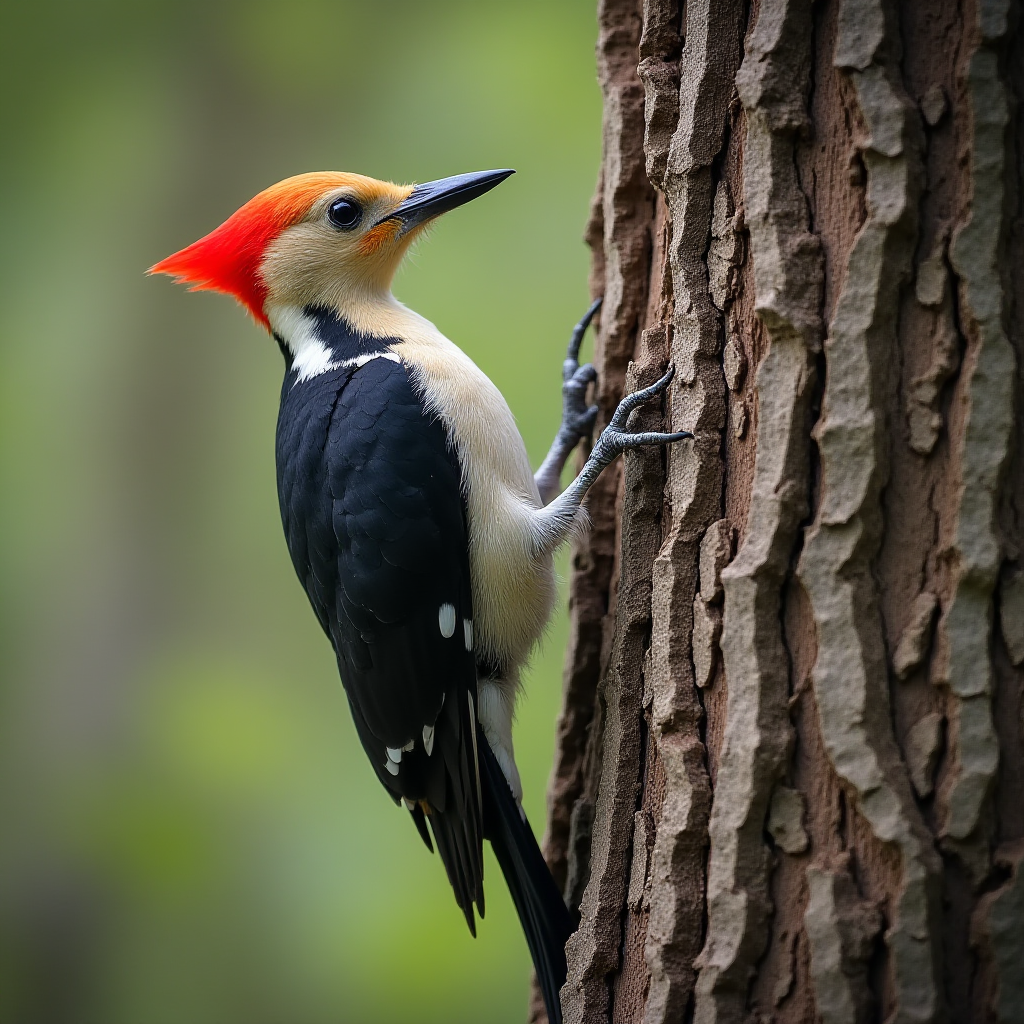
John: Nigel, we often walk right past woodpeckers without a second thought, but if you actually stop to analyze the mechanics involved in a single peck… it’s enough to make your head spin.
Nigel: Oh, absolutely, John. It’s one of those creatures that, the more you learn about it, the more you realize it’s an engineering marvel. I often wonder how it doesn’t just get a massive headache, or worse, brain damage, pecking away like that all day long.
John: Exactly! That’s where I always start. Imagine if you or I tried to bang our heads against a tree trunk even once at that speed and force. We’d be in serious trouble. But these birds? They hit with a force hundreds, sometimes thousands, of times the force of gravity, and they do it twenty times a second! It’s utterly insane.
Nigel: It’s not just the force, it’s the sheer number of impacts. Over and over again. It speaks to a design that anticipates and solves that exact problem in multiple ways, doesn’t it? It’s not just one lucky feature; it’s a whole system working in concert.
John: A whole system, perfectly coordinated. Let’s start with the skull itself. It’s not just a regular bird skull, is it? It’s almost like it’s been specifically engineered for impact absorption. You’ve got this dense, sponge-like bone at the front and back, but then it’s almost like a thin, flexible layer on the sides. It’s like a built-in crash helmet.
Nigel: That’s right. And it’s not just the bone structure. Think about the brain itself. It’s relatively small and fits very tightly within the skull cavity. There’s minimal cerebrospinal fluid around it. That’s crucial because less fluid means less sloshing, less chance for the brain to collide with the inside of the skull during those rapid decelerations.
John: It’s like securing cargo in a box – you don’t want it bouncing around. But it gets even wilder, doesn’t it? We’re not even talking about the hyoid bone yet. That’s a true masterpiece of biological engineering.
Nigel: Ah, the hyoid bone! That’s the real showstopper for me. For those who aren’t familiar, it’s this incredibly long, flexible bone that starts at the base of the woodpecker’s tongue. But instead of just staying in the mouth, it wraps right around the back of the skull, over the top, and then anchors into the nostril cavity.
John: It’s like a natural seatbelt for its brain! Or a suspension system. Every time the bird hits the tree, that hyoid bone acts like a shock absorber, distributing the force around the entire skull, rather than letting it all concentrate on one point. It’s an incredible design feature, utterly unique.
Nigel: And the fact that it attaches near the nostrils? That’s not just a random attachment point. It’s strategically placed to help stabilize the beak and the entire head assembly during those powerful pecking motions. It’s all about managing and dissipating energy.
John: You know, when you think about human engineering, we often use different materials and structures to absorb shock. We use crumple zones in cars, helmets for sports. The woodpecker has all of that built into its very anatomy, in a way that’s totally integrated and functional.
Nigel: Precisely. And let’s not forget the beak itself. It’s not just a blunt instrument. It’s a perfectly sculpted chisel. The upper mandible is slightly shorter than the lower one, which helps to distribute the impact stresses evenly across the beak and prevent it from getting stuck in the wood.
John: And it’s self-sharpening, isn’t it? The way they peck, the tips naturally wear down in a way that keeps them sharp and effective. It’s a tool designed for continuous, high-performance use without needing maintenance. Just imagine the forethought that goes into designing something that can maintain itself like that.
Nigel: It’s not just the head, though, is it? The neck muscles are incredibly strong. They’re what generate that immense power for pecking, but they also play a vital role in decelerating the head after impact. It’s like a finely tuned piston engine, both generating thrust and managing recoil.
John: It truly is. But all this pecking isn’t just for show, is it? It’s how they get their food. And that brings us to another astonishing feature: the tongue. I mean, we’ve talked about the hyoid bone, which is part of the tongue’s support system, but the tongue itself is a whole other level of specialized equipment.
Nigel: Oh, the tongue! If you think the hyoid wrapping around the skull is wild, consider the tongue itself. It’s incredibly long, sometimes three or four times the length of the beak. It’s not just long; it’s armed for the hunt.
John: It’s like a built-in harpoon and sticky trap all in one. The tip often has these tiny, backward-pointing barbs, perfect for impaling grubs and insects deep within the wood. And then there’s the saliva, isn’t there? Super sticky, so anything it touches just adheres to it.
Nigel: It’s almost like a retractable, multi-purpose tool. They probe into those tiny tunnels they’ve just excavated, spear an insect, and then retract it, bringing the meal directly to their mouth. And the precision! To navigate those complex internal tunnels, often unseen, and find the prey, it takes incredible sensory input and muscular control.
John: Think about the coordination required. First, the incredible head and beak design to make the hole. Then, the hyoid system that lets the tongue extend and retract, and the tongue itself, perfectly equipped to extract the food. It’s a perfect sequence, a perfect solution to a very specific problem: getting food out of wood.
Nigel: It’s a masterclass in specialized adaptation. Every part of that bird seems to be working towards the goal of efficient pecking and feeding. But let’s not forget how they actually cling to the tree while they’re doing all this. Because they’re not just hovering, are they?
John: Right, the stability! You see them perched vertically on the side of a tree, often upside down or at weird angles, just hammering away. Their feet are completely different from most perching birds.
Nigel: They have what’s called zygodactyl feet. Two toes pointing forward and two toes pointing backward. Most birds have three forward and one back. This ‘X’ shape provides an incredibly strong grip, like a climbing harness, giving them maximum stability on the rough bark.
John: And those claws! They’re super sharp and curved, really digging into the crevices of the bark. But that’s not all. They also use their tail, don’t they? It’s not just for steering.
Nigel: Not at all. The tail is practically a third leg. It’s incredibly stiff and rigid, with strong, reinforced feathers. They use it as a prop, bracing themselves against the tree trunk, creating a stable tripod-like stance. This allows them to exert maximum force with their head without toppling over.
John: It’s quite clever, isn’t it? To take a tail, which in many birds is primarily for balance in flight, and redesign it to also function as a supportive brace for an entirely different activity. And the bone structure at the base of the tail, the pygostyle, is much stronger and larger in woodpeckers to support this function.
Nigel: Exactly. It’s a multi-functional appendage, perfectly optimized for its role in tree climbing and pecking. So you’ve got the specialized feet for grip, the strong tail for support, the incredible head protection system, the harpoon-like tongue… it’s just feature after feature, all working together.
John: It feels like an ultimate design brief was given: ‘Create a bird that can extract insects from deep within wood, without damaging itself.’ And then every single component was meticulously thought out and integrated to achieve that goal. It’s not just a collection of cool parts; it’s a seamlessly integrated system.
Nigel: It’s the synergy of all these features that truly makes it astonishing. If any one of these elements were missing or poorly executed, the whole system would fail. If the skull wasn’t strong enough, if the hyoid didn’t wrap, if the tongue wasn’t long enough or sticky, if the feet couldn’t grip… the bird couldn’t survive doing what it does.
John: Think about the drumming too. It’s not just random pecking for food. They drum on resonant parts of trees for communication, for attracting mates, for establishing territory. It’s a whole different application of the same high-impact tool.
Nigel: It’s like a built-in messaging system. And to think, they have the precision to find the parts of the tree that will resonate best. It’s an understanding of acoustics and mechanics that’s just inherent to their design.
John: It points to such foresight, doesn’t it? That a creature would be equipped with a mechanism for incredibly forceful, repetitive action, and that mechanism would also be perfect for communication. It’s efficient, elegant design.
Nigel: When you put it all together, John, it paints a picture of intricate, purposeful construction. It’s not just a bird with some interesting features; it’s a testament to incredibly sophisticated planning and execution in the natural world. Every detail, every component, working in perfect harmony, perfectly suited for its environment and purpose. –
John: It really does, Nigel. It’s like looking at a finely crafted machine, where every gear and lever has a specific, critical role to play, and the whole thing functions flawlessly.
Nigel: The woodpecker is a living example of that principle. It really makes you appreciate the incredible intelligence behind nature’s designs.
John: Couldn’t agree more, Nigel. It just reminds you to look a little closer at the world around you, because there’s so much more going on beneath the surface than we often realize. And these ‘everyday’ creatures are often the most astonishing, when you stop to truly consider them. It’s truly amazing.
Nigel: Absolutely. It’s a true wonder.
John: And on that note, I think we’ll wrap up our deep dive into the incredible woodpecker for today. Hopefully, next time you hear that drumming in the woods, you’ll have a new appreciation for the engineering marvel behind it.
Nigel: Indeed. Thanks for joining us, everyone, and keep an eye out for those forest engineers!


















Thanks! Share it with your friends!
Tweet
Share
Pin It
LinkedIn
Google+
Reddit
Tumblr