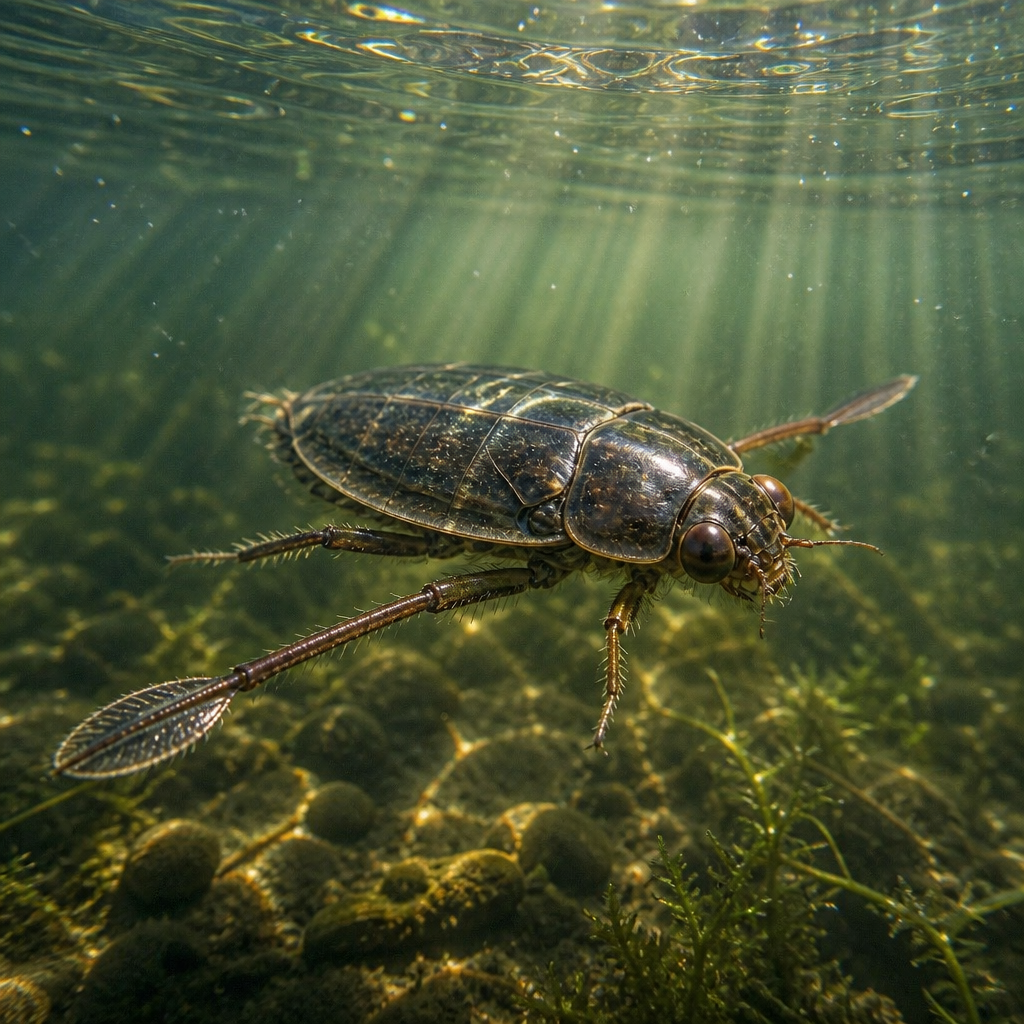
John: Nigel, have you ever really stopped to consider some of the more… well, astonishing inhabitants of our waterways? I was thinking recently about the water boatman.
Nigel: The water boatman? That tiny creature often skittering about just beneath the surface? I’ve seen them, of course, but I can’t say I’ve given them much thought beyond a passing glance. What about them, John?
John: Well, that’s just it. They’re so common, so seemingly unassuming, yet when you dig into their operational mechanics, they’re just… mind-bogglingly sophisticated. It’s like looking at a miniature submersible, perfectly engineered.
Nigel: A miniature submersible? That’s quite a description for an insect. What makes you say that?
John: Think about it. Here’s a creature designed to live underwater, but it’s an air-breather. How does it manage that? It’s not like a fish with gills. It has to carry its own air supply. And it does so with such ingenious simplicity, yet astounding effectiveness.
Nigel: I suppose I’ve always just assumed it held its breath, or something equally simple. But you’re suggesting something more complex?
John: Far more. It uses its body, specifically a unique ‘keel’ structure on its underside, to trap a bubble of air. This isn’t just for breathing; it’s a fully integrated system for buoyancy control and respiration. The air bubble acts like a portable lung, allowing gas exchange directly through its body wall.
Nigel: So, it effectively carries its own personal oxygen tank, sustained by a clever physical structure. That’s already more sophisticated than I would have imagined. How long can it stay submerged with this system?
John: For extended periods. The system is so effective that the oxygen from the water diffuses into the bubble as the boatman uses up the air, replenishing its supply to a certain extent. It’s a remarkable piece of biochemical engineering, truly. A self-sustaining mini-atmosphere, constantly being refreshed.
Nigel: That’s incredible. It’s not just a trapped bubble; it’s an active, dynamic respiratory interface. The sheer precision required for such a system to operate flawlessly, consistently, throughout its existence… it’s astounding.
John: Exactly. And consider its propulsion system. Those specialized hind legs, flattened and fringed with hairs, are perfectly shaped like oars. They’re not just any legs; they’re purpose-built for paddling through water with maximum efficiency. Each stroke is powerful and precise, allowing it to move with incredible speed and agility.
Nigel: So, we’re talking about dedicated aquatic appendages, not just modified walking legs. The shape, the hairs, the muscular control… it all has to be perfectly coordinated for that efficient movement. It’s like a finely tuned rowing machine.
John: Precisely. And consider the entire body shape – hydrodynamic, minimizing drag. Every aspect of its physical structure seems to contribute to its specific lifestyle. It’s not a collection of random features; it’s an integrated, cohesive functional unit. You can’t separate the air bubble system from the legs, or the body shape, without compromising the whole operation.
Nigel: It implies a complete, pre-planned blueprint, doesn’t it? As if someone thought through every challenge of living underwater for an air-breather and meticulously crafted solutions into its very being. The entire apparatus has to function synergistically from the start.
John: Absolutely. How could such a complex, interdependent system, where each part is utterly critical to the function of the others, simply come into being piecemeal? If one component, say the air-trapping keel, wasn’t there, or wasn’t shaped precisely, the whole breathing mechanism would fail.
Nigel: And if the legs weren’t perfectly oar-like, it wouldn’t be able to effectively navigate its watery domain to find food or avoid danger. Each feature is essential. It’s not like you can have half an oar or a partially functional air-trapping system and expect it to survive. It speaks to a profound level of integrated engineering.
John: That’s the point. It’s what some call irreducible complexity. You remove one part, and the whole system collapses. This isn’t just a simple adaptation; it’s a sophisticated, multi-component biological machine that requires all its parts to be present and properly working from the outset.
Nigel: So, for example, the digestive system. How does it even feed underwater? Is that another marvel of precision engineering?
John: Oh, absolutely. Some water boatmen are predatory, equipped with specialized mouthparts to capture and consume other tiny aquatic organisms. Others are more herbivorous, scraping algae from submerged surfaces. But in either case, the mouthparts are perfectly suited for their specific dietary needs, allowing them to operate effectively in a challenging underwater environment.
Nigel: Even down to the feeding mechanisms! It’s not just surviving underwater, it’s thriving. It’s almost as if every aspect of its existence was considered and accounted for by a masterful hand.
John: Indeed. And let’s not forget the sensory apparatus. How does it navigate, find food, or detect threats in a murky pond? It has to have highly tuned sensory organs to process information in an entirely different medium than an air-dwelling creature. Its vision, for instance, must be calibrated for underwater light refraction.
Nigel: Which implies a precise optical system, perfectly tuned for that specific environment, right from the beginning. No blurry, half-functional vision that gradually sharpens. It needs to see clearly from day one to survive.
John: Exactly. And some species even possess the ability to ‘sing’ underwater – they stridulate, producing sounds by rubbing parts of their body together, potentially for communication or attracting mates. Imagine the intricate internal mechanisms required for sound production and, equally important, sound reception underwater. It’s not just a simple squeak; it’s a coded signal.
Nigel: Underwater acoustics for an insect! That’s just another layer of specialized function. We’re talking about a full suite of sophisticated tools: respiration, propulsion, feeding, sensory perception, and even communication, all integrated into a tiny package.
John: It’s truly a marvel. When you observe a water boatman, you’re not just seeing a simple insect; you’re witnessing a triumph of functional design, a creature whose very existence is predicated on a complex arrangement of perfectly complementary features. Each piece fits, each system works in harmony.
Nigel: And the sheer audacity of this design, to take an air-breathing body plan and equip it so perfectly for an aquatic existence. It’s like designing a car that can also fly, but doing so flawlessly, without compromise in either mode.
John: A very apt analogy. Consider the sheer number of coordinated modifications necessary. It’s not just one lucky break; it’s a whole symphony of precise adjustments that allow it to operate as it does. From the exact curvature of its body to the precise length and hairiness of its legs, to the specific chemistry that allows the air bubble to function as a gill.
Nigel: So, when we look at the water boatman, we’re really looking at a creature that seems to defy simple, undirected explanations for its remarkable operational capabilities. The odds of all those interconnected systems emerging without foresight seem… astronomically low.
John: Precisely. The idea that such a creature, with its comprehensive suite of highly specialized, interdependent functions, could just assemble itself without an underlying intelligent blueprint, seems to strain credulity. The complexity points to purpose, to intent.
Nigel: It certainly gives one pause. You see these tiny creatures, zipping around, living their lives, and you realize there’s so much more going on than meets the eye. It’s a testament to incredible foresight and planning, perfectly executed on a miniature scale.
John: It makes you wonder, doesn’t it? How many other ‘simple’ things around us are actually astonishing feats of engineering, just waiting for us to truly observe them and appreciate the intricate systems at play? The water boatman is certainly a prime example.
Nigel: Absolutely. It really changes your perspective. Next time I see one, I won’t just see a bug in the water; I’ll see a perfectly designed, self-contained aquatic system. A truly inspiring piece of biological machinery.
John: That’s exactly the takeaway. There’s so much more to discover and appreciate in the precise construction of even the smallest organisms. It’s a reminder of the incredible depth of intelligent planning present in the world around us. Thank you for this conversation, Nigel.
Nigel: My pleasure, John. It’s always a treat to delve into these fascinating topics with you. The water boatman certainly left an impression!
John: Indeed! And perhaps next time, we’ll pick another unassuming creature and uncover its hidden complexities. Until then, keep an eye out for those miniature submersibles!
Nigel: Will do! Thanks again, John. And to all our listeners, thank you for joining us today for this exploration of the water boatman’s remarkable design. We hope you’ll look at the world a little differently.

















Thanks! Share it with your friends!
Tweet
Share
Pin It
LinkedIn
Google+
Reddit
Tumblr