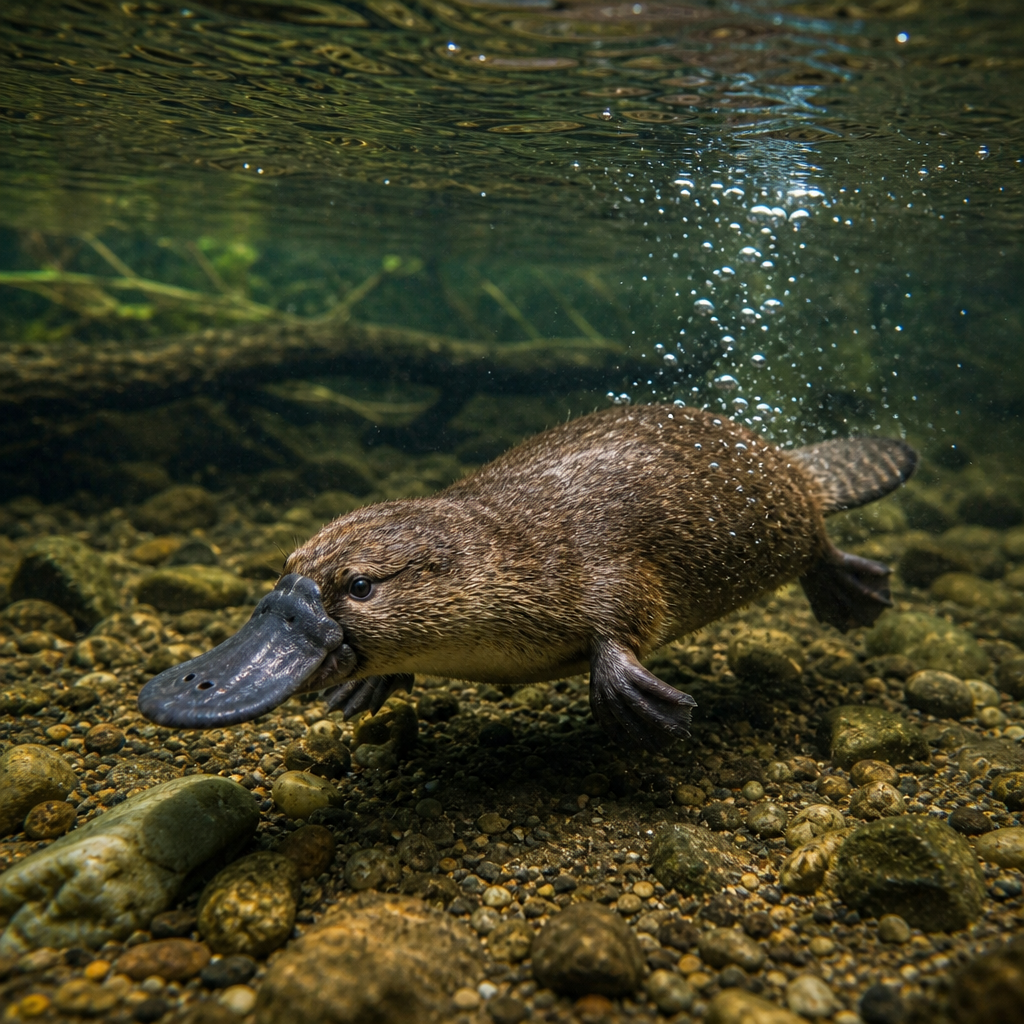
John: Welcome back to the show, everyone! Today, Nigel and I are diving into one of the most utterly bizarre and absolutely fascinating creatures on the planet. I’m talking about an animal that genuinely seems like it was pieced together from a committee meeting where everyone brought their wildest ideas. Nigel, what are we talking about?
Nigel: Oh, John, you’ve set it up perfectly! We’re talking about the platypus. The duck-billed platypus! Seriously, if you tried to invent an animal and gave it a duck’s bill, otter’s fur, beaver’s tail, and then said, ‘Oh, by the way, it lays eggs like a bird or a reptile,’ people would laugh you out of the room. But it exists! It thrives!
John: I mean, where do we even begin with its uniqueness? Let’s start with the most obvious and, frankly, astonishing feature: it’s a mammal that lays eggs. A mammal! How does that even make sense?
Nigel: It’s truly mind-boggling, isn’t it? For centuries, when people first encountered specimens, they thought it was a hoax. The idea of a mammal laying eggs just didn’t compute. Yet, there it is, a monotreme, one of only a handful of mammals that defies the live-birth norm. The female lays typically one to three soft-shelled eggs, almost like reptile eggs, and then incubates them, often curling around them in a burrow for about ten days.
John: And it gets even stranger once the young hatch, right? Because they’re still mammals in the sense that they drink milk. But not in the way you’d expect. There are no nipples!
Nigel: Exactly! It’s another ‘hold on’ moment from the platypus. The mother literally secretes milk through pores on her abdomen. The young just lap it up from a milk patch in the fur. Imagine designing that system! It’s so utterly unique. It’s a beautifully simple, yet incredibly effective way to feed the young, especially when you consider they’re in a burrow and probably not ideal for traditional suckling.
John: It really makes you wonder about the intricate design behind such a creature. Each of these features, in isolation, is remarkable. But putting them all together in one animal? It just works seamlessly. Let’s talk about that iconic bill, the duck’s bill. It’s not just for show, is it? It’s a sensory powerhouse.
Nigel: Oh, it’s incredible. It’s not hard like a duck’s bill at all; it’s soft, leathery, and incredibly sensitive. It’s packed with thousands upon thousands of electrosensors and mechanoreceptors. When the platypus dives underwater, it closes its eyes, ears, and nostrils, becoming completely reliant on this bill to find its prey. It uses electroreception, detecting the tiny electrical impulses generated by the muscle contractions of its prey, like shrimp, worms, and insect larvae.
John: So, it’s basically swimming around with a built-in sonar system, but for electrical fields? That’s next-level hunting technology. How precisely does that work?
Nigel: Precisely! It sweeps its head from side to side, much like a metal detector, and these electrosensors pick up the faint bioelectric fields. Combined with the mechanoreceptors that detect pressure changes and movement, it can create a ‘map’ of its underwater environment and precisely locate prey, even in murky water or complete darkness. It’s an astounding adaptation for a creature that spends so much of its active time foraging on the riverbed.
John: It’s almost like the designer thought, ‘How can we make this creature incredibly efficient at finding food in its specific niche?’ and came up with a solution that’s almost futuristic. And speaking of unique adaptations, we can’t ignore the venom. A venomous mammal! That’s another curveball, isn’t it?
Nigel: Absolutely! It’s one of those features that just makes you scratch your head. Male platypuses have a sharp, hollow spur on each hind leg, connected to a venom gland. They use this spur, primarily during breeding season, to compete with other males. While it’s not typically lethal to humans, it can cause excruciating pain, swelling, and even temporary disability. For a small dog, it could be fatal. It’s a defense mechanism, a territorial tool, and it’s completely unexpected in a mammal.
John: So, we have an egg-laying mammal that secretes milk through its skin, hunts with an electrical sixth sense, and the males have venomous spurs. It’s like a biological mashup of entirely different animal classes. If you were trying to piece together how such a creature could even come into existence through gradual processes, it almost seems impossible to account for.
Nigel: That’s exactly it, John! Each feature feels so distinct and specialized, yet they all integrate perfectly to create a highly successful, resilient animal. Consider its semi-aquatic lifestyle. It’s a master swimmer, thanks to its webbed feet, and its dense, waterproof fur keeps it insulated even in cold water. But those webs aren’t just for swimming.
John: Ah, yes, the retractable webs. Another ingenious piece of engineering.
Nigel: Indeed! When it’s on land, or digging its burrows, it can retract the webbing on its front feet, exposing strong claws for digging. So, it’s got these perfectly designed paddles for propulsion in water, and then those same appendages transform into efficient digging tools on land. It’s an elegant, multi-purpose design for its dual habitat.
John: It’s not just a collection of oddities; it’s a testament to incredible functionality. Every single one of these seemingly disparate features serves a crucial purpose and works in concert with the others. What about its fur? It seems pretty ordinary for an animal that spends so much time in water, but it’s far from it, right?
Nigel: You’re spot on. Its fur is dense, short, and incredibly soft, almost velocities. But crucially, it’s also highly waterproof. It traps a layer of air next to the platypus’s skin, which acts as insulation, keeping it warm in chilly Australian waterways. If that fur didn’t have those specific qualities, it would get waterlogged and hypothermic very quickly. It’s perfectly suited for its environment, a natural drysuit.
John: So, from its unique reproductive method, to its advanced sensory capabilities, its defense mechanisms, and its specialized fur and feet, the platypus is a mosaic of what seem like impossible combinations. It challenges so many of our preconceived notions about what a mammal should be.
Nigel: It absolutely does. It truly feels like a creature designed for its very specific niche, perfectly equipped for its environment. Think about the internal testes in males, another unusual mammalian trait. Or its relatively low body temperature compared to most other mammals, sitting somewhere between mammals and birds. Each aspect is finely tuned.
John: It’s almost as if someone took the blueprint for a bird, a reptile, and a mammal, and then skillfully combined the most effective elements to create this one-of-a-kind creature. The level of integration, where all these complex systems not only coexist but function flawlessly together, is truly astounding.
Nigel: That’s the wonder of it, isn’t it? It’s not just a random collection of parts; it’s a fully coherent, functional, and successful organism. Every aspect, from its bill to its milk pores, serves a vital, interconnected role.
John: You know, when you really delve into the details of the platypus, it pushes you to marvel at the intricate workings of life. It’s not just a quirky animal; it’s a profound statement about the complexity and intelligent engineering that must be behind such a living wonder.
Nigel: I couldn’t agree more, John. The platypus truly stands alone as a masterpiece of design, defying easy categorization and continually fascinating us with its unique charm and incredible capabilities.
John: Indeed. A truly magnificent creature. Thank you, Nigel, for shedding light on the wonders of the platypus today. And thank you, listeners, for joining us on this fascinating journey into the incredible world of nature’s most enigmatic mammal. Until next time, keep exploring the wonders around you!
















Thanks! Share it with your friends!
Tweet
Share
Pin It
LinkedIn
Google+
Reddit
Tumblr