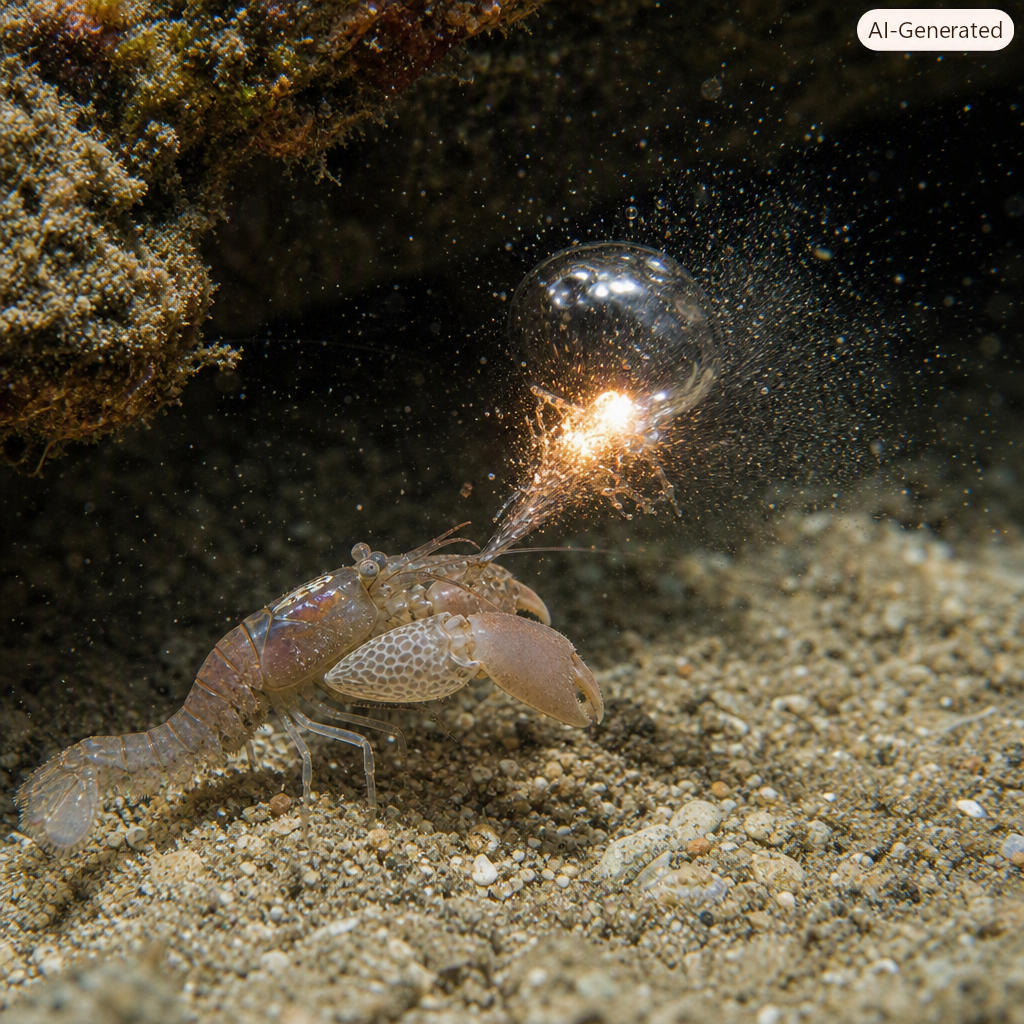
[John] Welcome back, everyone, to a truly fascinating dive into the intricate workings of the world around us. Today, Nigel and I are going to talk about a creature that, honestly, just blows my mind with its precision and its power. We’re talking about the Pistol Shrimp.
[Nigel] John, I’m genuinely excited about this one. The Pistol Shrimp, or snapping shrimp, is just an absolute marvel. It’s not just a shrimp; it’s like a tiny, living sonic cannon, isn’t it? The sheer ingenuity packed into such a small package is astounding.
[John] Exactly! When you think about something so small, typically a few centimeters long, having an ability that rivals some sophisticated human-engineered devices, it really makes you pause. It’s got this one oversized claw, right? Not for grasping in the usual way, but for something far more dramatic.
[Nigel] That’s the key. This claw isn’t just big; it’s designed with an incredibly specialized mechanism. It has this plunger and socket arrangement. When the shrimp flexes its muscles, it builds up immense internal pressure, almost like loading a spring. And then, it releases it with astonishing speed.
[John] And that ‘release’ isn’t just a snap, is it? It’s a snap so fast, so powerful, that it actually creates something truly remarkable in the water. We’re talking about a phenomenon called ‘cavitation.’ It’s not just moving water; it’s literally tearing a hole in the water itself.
[Nigel] That’s right. The speed at which that claw closes – it’s faster than a blink, faster than almost anything we can consciously perceive. This rapid movement creates an area of extremely low pressure, so low that the water molecules themselves can’t hold together. They vaporize, forming a tiny, superheated bubble.
[John] A bubble of nothing, essentially, in the blink of an eye. But here’s where it gets even more incredible. This bubble isn’t stable. It instantly collapses under the surrounding water pressure, but not silently or harmlessly. Oh no, that collapse is where the real show begins.
[Nigel] Absolutely. That implosion is unbelievably violent. It generates a shockwave so potent it can stun or even kill small prey like fish or other crustaceans. Imagine, a creature creating a localized, miniature underwater explosion just by snapping its claw! It’s an entire system working in perfect concert.
[John] And it’s not just a shockwave, Nigel. The physics involved are mind-bending. When that bubble collapses, it actually generates light – sonoluminescence – and temperatures that can briefly reach thousands of degrees Celsius. It’s hotter than the surface of the sun for a fleeting moment, right there in the water!
[Nigel] It’s truly extraordinary. You’ve got mechanical action leading to a pressure differential, leading to a phase change in water, leading to a violent implosion, generating sound, heat, and light. All of this, precisely controlled by a creature that’s, again, just a few centimeters long. It begs the question: how could all these perfectly synchronized components come to be?
[John] That’s exactly what I find so compelling. Think about it: for this system to work, you need the specialized claw structure, capable of building and releasing pressure at that specific velocity. You need the physiological ability to generate that kind of force. Then you need the precise geometry of the claw to form the bubble in the right way, and the bubble itself needs to collapse with these specific effects.
[Nigel] And if any one of those pieces were missing, or improperly formed, the whole ‘weapon’ would be completely useless. A claw that snaps fast but doesn’t create the cavitation bubble? Useless. A bubble that forms but doesn’t collapse with enough force? Also useless. Each component is utterly dependent on the others for the overall function to exist at all.
[John] It’s not like you can have half a cavitation bubble. Or a claw that’s only ‘sort of’ good at generating extreme pressure. It’s an all-or-nothing system. It’s fully functional or it’s not functional at all. The entire integrated assembly must be present and optimized from the get-go for it to provide any benefit to the creature.
[Nigel] It’s like building a high-performance engine. You can’t just have a cylinder head without the pistons, or a crankshaft without the connecting rods. Each part is intricately designed to work with every other part to create the final, powerful output. And the Pistol Shrimp’s claw is far more complex than a simple engine, in many ways.
[John] It truly is. And this isn’t just some random effect. The shrimp uses this ability with incredible precision. It can aim this sonic blast to stun prey hidden in crevices, or to excavate burrows, or even to deter larger predators. It’s a targeted, multi-purpose tool.] Which implies an understanding, or rather, an embedded program, of how to deploy this powerful ability. It’s not just a random discharge. It’s controlled. The shrimp knows when and how to use its incredibly complex apparatus. The sensory systems to detect prey, the neural pathways to activate the claw, the muscular system to deliver the force – it’s all integrated.
[John] The coordination is staggering. And let’s not forget the sheer resilience of the shrimp itself. It’s performing this incredibly violent action, generating immense forces right next to its own body, and yet it’s built to withstand that stress. The materials science, if you will, of its own exoskeleton must be perfectly suited to absorbing those micro-shocks.
[Nigel] Exactly! It’s not just a weapon; it’s a weapon system that includes its own built-in dampening and structural reinforcement. You can’t have a cannon that destroys itself every time it fires. So, the design includes the firing mechanism and the protection for the firing mechanism, all at once.
[John] It’s a complete package. And when you look at it through that lens, it just screams ‘purpose-built.’ There’s no awkward intermediate stage where parts are half-formed and somewhat useful. It either works brilliantly, or it doesn’t work at all.
[Nigel] It does. I mean, think about the probability of all these incredibly specific, interdependent elements arising coincidentally, or in a series of disconnected steps. Each step would need to provide a significant advantage, but what advantage is a half-formed cavitation claw? None.
[John] A half-formed claw would be a hindrance, honestly. It would be an inefficient, oversized appendage that costs energy and offers no benefit. It suggests that the whole, intricate system had to be present, fully functional, and perfectly integrated from its very inception. It’s a masterstroke of engineering.
[Nigel] And not just the physical mechanism, but the behavioral programming too. This tiny shrimp has to ‘know’ how to use this complex tool. It’s not just a hammer; it’s an entire integrated system with the ‘user manual’ embedded within the creature itself. The software and the hardware are inseparable.
[John] That’s a fantastic point, Nigel. We’re not just talking about anatomy; we’re talking about instinct, behavior, the ability to learn and adapt. The shrimp’s entire existence is interwoven with this incredible capability. It defines how it hunts, how it defends itself, how it interacts with its environment.
[Nigel] It even extends to how it lives with other creatures. Some Pistol Shrimp form partnerships with goby fish, where the fish acts as a lookout and the shrimp provides the burrow. Again, another layer of complex, coordinated behavior. It’s not just a singular design marvel; it’s a marvel that participates in a wider, interconnected set of designs.
[John] It truly adds another dimension to the discussion. You have the shrimp with its incredibly sophisticated weapon system, and then it’s engaging in a symbiotic relationship that requires mutual benefit and trust, and specific behaviors from both parties. It’s not a simple one-off interaction; it’s a choreographed dance of two different organisms.
[Nigel] Think about it, John. The goby needs a secure burrow, and the shrimp needs an early warning system. Their individual designs complement each other perfectly to create a stronger, more resilient unit. It’s a testament to how different elements can be perfectly arranged to create an optimal outcome.
[John] It just underscores the immense foresight involved. Not just in the intricate mechanics of the claw, but in how that creature is equipped to thrive within its world, even forming complex partnerships. It paints a picture of comprehensive, meticulous planning.
[Nigel] Indeed. The entire system of the Pistol Shrimp, from the physics of its cavitation bubble to its very existence within its community, speaks to a level of integrated design that is truly beyond our full comprehension. It’s a profound example of precision engineering and functional elegance.
[John] It really does. Every time I think about the Pistol Shrimp, I’m reminded that sometimes, the smallest creatures hold the biggest lessons about sophisticated systems and integrated functionality. It’s not just a shrimp; it’s a living, breathing testament to astonishing design. Nigel, it’s been an absolute pleasure discussing this marvel with you today.
[Nigel] Likewise, John. The Pistol Shrimp truly is a wonder. And it certainly gives us much to ponder about the incredible ingenuity woven into the fabric of the world around us. Thank you for joining me, and thank you, everyone, for listening.
[John] Indeed. We’ll catch you next time for another look at the wonders that surround us. Until then, keep observing, keep questioning, and keep being amazed.


















Thanks! Share it with your friends!
Tweet
Share
Pin It
LinkedIn
Google+
Reddit
Tumblr