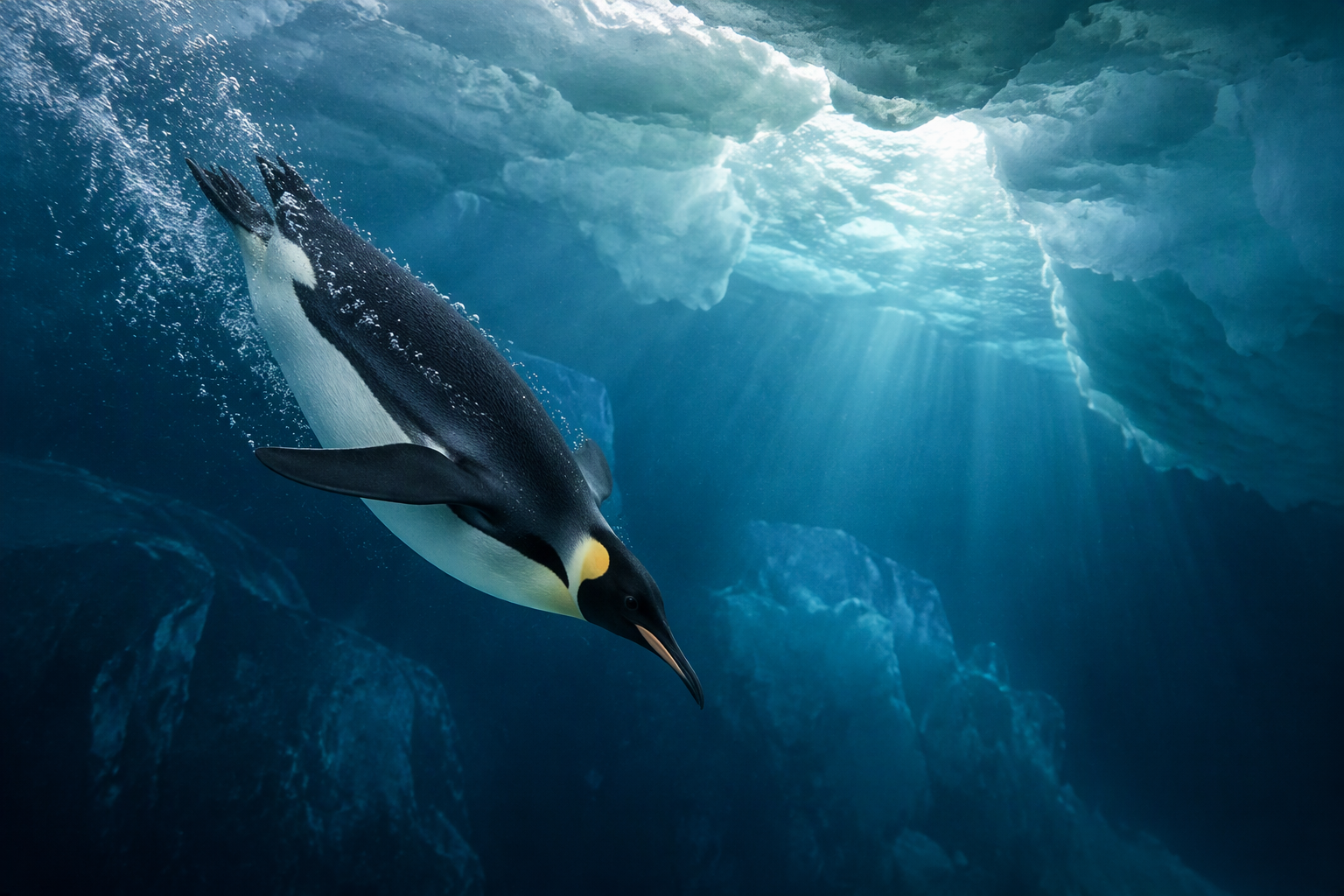
James: Let’s begin with a question. What kind of bird wears a tuxedo every day, can’t fly through the air, spends much of its life swimming in freezing water, and somehow manages to raise its young in some of the harshest conditions on Earth? The answer, of course, is the penguin! Penguins may look like they’re dressed for a formal dinner, but their real specialty is underwater performance. And when we take a closer look at how they’re built, we discover an extraordinary collection of features that work together to make their unusual lifestyle possible.
Christopher: That’s right. At first glance, a penguin might seem like a rather awkward bird. It waddles when walking, has wings that are useless for ordinary flight, and spends a considerable amount of time standing around on ice. But put that same bird into the water and everything changes. It becomes fast, graceful, and remarkably agile. What looks like an awkward design on land turns out to be an exceptionally effective design for life in the water.
James: Let’s start with those wings. Most birds use their wings to fly through the air, but penguins use theirs to fly through the water. Their wings have become stiff, flattened flippers that push against the water with powerful strokes. Instead of bending and spreading like the wings of an eagle or a hawk, penguin flippers act more like underwater paddles. They provide the power needed to accelerate, turn, and maneuver while pursuing fish and other prey.
Christopher: And there’s a wonderful connection between the shape of the penguin and the way it moves. Its body is streamlined, somewhat like a torpedo. This shape helps reduce resistance as it travels through the water. Think about trying to swim through a swimming pool while holding a large flat board in front of you. The water would push against it and slow you down. Now imagine swimming with your arms held close and your body streamlined. It’s much easier to move forward. Penguins have a body shape suited to moving efficiently through their underwater environment.
James: Their flippers are also specially structured for this job. They are relatively narrow and stiff, with strong muscles that provide powerful movement. The shoulder and wing structure allows the penguin to produce repeated strokes as it swims. It’s not simply waving its wings around. Each movement contributes to controlled propulsion, helping the bird move forward with impressive speed and accuracy.
Christopher: The feet have an important job too. While the flippers provide most of the swimming power, the webbed feet help with steering and maneuvering. The penguin can adjust its direction, make quick turns, and maintain control as it chases moving prey. So the wings, body shape, and feet all contribute to the same purpose. The penguin is essentially equipped with an underwater flight system.
James: Now let’s consider something that is absolutely essential for a bird spending so much time in cold water: keeping warm. Water removes body heat much more rapidly than air does. A human jumping into very cold water can lose heat quickly, even when the surrounding air temperature is considerably warmer. Penguins face this challenge routinely, yet they are able to maintain a stable internal body temperature.
Christopher: One of their most important protections is their feathers. Penguins have an extremely dense covering of short, overlapping feathers. These aren’t like the long, loosely arranged feathers we might see on some other birds. They form a compact covering that helps keep water away from the skin and traps a layer of insulating air close to the body. That trapped air acts much like the insulation inside a winter jacket.
James: And there’s more to the story. Penguins constantly maintain their feathers through a behavior called preening. They use their beaks to arrange and clean their plumage, and they spread an oily substance produced by a gland near the base of the tail. This helps their feathers remain water-resistant. It’s rather like regularly treating a waterproof jacket to keep it working properly. If the feathers become damaged or poorly maintained, the penguin can lose some of the protection that makes life in cold water possible.
Christopher: Underneath those feathers, many penguins also have a layer of fat, often called blubber. This provides additional insulation and also serves as an energy reserve. During periods when food is difficult to obtain, stored fat can help support the bird’s energy needs. So the penguin has several protective layers working together: waterproof feathers, trapped insulating air, and a layer of fat beneath the skin.
James: It’s interesting that penguins have to solve two different temperature problems. In the Antarctic, they must avoid losing too much heat, but when they come ashore in warmer weather or are particularly active, they can sometimes overheat. Their bodies have ways of adjusting blood flow and releasing excess heat. This is important because insulation is useful only when the animal can also regulate its temperature when conditions change.
Christopher: There’s another remarkable feature involving the penguin’s feet and legs. You might wonder how a bird can stand on ice for long periods without losing an enormous amount of body heat through its feet. The answer involves a clever arrangement of blood vessels. Warm blood traveling down toward the feet passes close to cooler blood returning toward the body. The warm blood transfers much of its heat to the returning blood before reaching the feet. This helps conserve body heat while allowing the feet to remain cold enough to reduce heat loss to the ice.
James: That is a fascinating arrangement. Instead of sending large amounts of warm blood all the way down to the feet and allowing much of that heat to escape, the penguin recycles much of it. It’s a little like a heat-recovery system in a building, where warmth that would otherwise be lost is captured and reused. Something similar happens in other parts of the bird as well. The circulatory system helps manage heat so the penguin can function in very cold surroundings without wasting valuable energy.
Christopher: Now let’s go underwater again, because this is where penguins really demonstrate their remarkable abilities. Penguins are not simply floating around near the surface looking for an occasional fish. Some species are accomplished deep divers. The emperor penguin, the largest of all penguin species, is particularly impressive. It can dive hundreds of meters below the surface in search of fish, squid, and other food.
James: Think about the challenge involved. As the penguin dives, water pressure increases, sunlight fades, and the bird must continue operating without taking a breath. It needs to carry enough oxygen to support its muscles and other vital organs until it returns to the surface. It accomplishes this through several coordinated features involving its blood, muscles, heart, and circulation.
Christopher: Penguins have a large capacity to store oxygen in their bodies. Their blood contains hemoglobin, which carries oxygen, while their muscles contain a substance called myoglobin that also stores oxygen. You don’t need to remember those names, but the important point is that the penguin has more than one place to store the oxygen needed for a dive. It can draw on these reserves while underwater, allowing it to remain submerged for extended periods.
James: Its heart rate and blood circulation also adjust during a dive. The heart can slow down, and blood flow can be reduced to certain parts of the body while vital organs continue receiving the oxygen they need. This helps conserve the available oxygen and directs it toward the parts of the body where it is most important. It’s an impressive example of a body responding to the demands of a particular activity.
Christopher: And here’s something else worth considering. A penguin doesn’t simply dive straight down and hope to find something to eat. It has excellent underwater vision and uses its senses to locate and pursue prey. Its eyes are adapted for seeing in the aquatic environment, and a transparent protective eyelid helps shield them while swimming. The bird must be able to locate its food, maneuver toward it, catch it, and then return to the surface. That’s quite a list of tasks for an animal that cannot breathe underwater!
James: Food itself presents another interesting challenge. Penguins eat fish, squid, krill, and other marine creatures, depending on the species and where they live. Their beaks are suited to catching and holding slippery prey. The tongue and inside of the mouth also have rough structures that help keep food from escaping. Imagine trying to catch a slippery fish with a smooth spoon. It wouldn’t be easy. Penguins have equipment much better suited to the job.
Christopher: Their coloring is another example of functional design. The familiar black back and white underside aren’t simply a fashionable choice. This pattern provides a form of camouflage called countershading. When a penguin is swimming near the surface, a predator looking down sees its dark back against the darker water below. A predator looking upward sees its white underside against the brighter surface. This difference in coloring makes the penguin harder to spot from either direction.
James: So the famous tuxedo appearance has a practical purpose as well. It helps the penguin blend into its underwater surroundings. It may look like formal evening wear to us, but for the penguin it’s part of the equipment needed to survive.
Christopher: Now we should talk about something that makes the emperor penguin especially remarkable: its parenting. Emperor penguins breed during the Antarctic winter, when temperatures can fall dramatically and winds can be fierce. While many creatures choose to avoid the worst of these conditions, emperor penguins actually raise their young during this difficult season. Their breeding routine is one of the most extraordinary examples of parental care found among birds.
James: The female lays a single egg and carefully transfers it to the male, who balances it on top of his feet and covers it with a warm fold of skin called a brood pouch. The egg must never be allowed to rest directly on the ice. Even brief exposure to the freezing surface could be disastrous for the developing chick. The male protects the egg by keeping it elevated and sheltered against his warm body.
Christopher: And the father has a very demanding job. During much of the incubation period, he remains on the ice while the female returns to the sea to feed. He may go for months without eating. He must protect the egg, maintain its temperature, and survive the extreme Antarctic weather. This is no easy assignment. It requires energy reserves and an extraordinary ability to withstand cold and fasting.
James: The males also gather together in large groups called huddles. By pressing close to one another, they reduce the amount of body surface exposed to the freezing wind. The penguins on the outside gradually move around, allowing others to take their place in the more sheltered interior. This way, the benefits of the huddle are shared. Thousands of birds can participate in these enormous gatherings, creating a remarkable living shelter against the Antarctic winter.
Christopher: Think about the coordination involved. Each bird benefits from the warmth of its neighbors, but the group also depends on individuals moving and adjusting their positions. It’s an extraordinary social behavior that helps these penguins endure conditions that would be extremely dangerous for a single exposed bird.
James: Eventually, the chick hatches. When the female returns with food, the parents can take turns caring for and feeding their young. The chick is covered in soft gray down, which provides insulation while it grows. As it becomes stronger and more independent, it begins spending time with other young penguins in groups called crèches. These groups provide some protection while the parents go out to sea to find food.
Christopher: And the parents recognize and locate their own chick in a colony containing thousands of similar-looking birds. They use distinctive calls to identify one another. In a place where visual identification can be difficult and the colony is noisy, sound becomes an important means of communication. Each family has to find one another among a huge crowd. It’s another remarkable ability that contributes to successful parenting.
James: Of course, not every penguin lives in Antarctica. There are species found in South America, Africa, Australia, New Zealand, and even the Galápagos Islands near the equator. Some live in much warmer climates. Their body sizes, feather arrangements, and heat-management features vary according to the environments in which they live. This is an important reminder that penguins are not all identical. They share a general body design for swimming and hunting at sea, but different species have features suited to their particular surroundings.
Christopher: Some penguins are relatively small, while emperor penguins can stand more than three feet tall. Some hunt close to shore, while others travel considerable distances to find food. Their lifestyles differ, but the basic plan remains remarkably recognizable: streamlined bodies, powerful flippers, dense feathers, specialized feet, and adaptations that allow them to spend much of their lives in the water.
James: When we step back and consider everything we’ve discussed, the penguin is much more than a charming bird in a tuxedo. Its body is a carefully coordinated system. The flippers provide underwater propulsion. The streamlined shape reduces resistance. The feet help steer. The feathers provide protection and insulation. The fat layer supplies additional warmth and energy reserves. The circulatory system conserves heat, while the blood and muscles help store oxygen for diving. And its behavior and parenting abilities contribute to the survival of its young.
Christopher: From the perspective of intelligent design, the penguin offers a wonderful opportunity to appreciate how physical structures, internal processes, and behavior work together. Its features are not isolated curiosities. They form a collection of features that suit the bird to a demanding way of life. The more closely we examine the details, the more there is to admire.
James: Perhaps that’s one of the most interesting lessons from the penguin. An animal that appears almost comical when walking across the ice becomes an extraordinarily capable swimmer when it enters the water. Its unusual appearance reflects a very different way of life from that of most birds. It reminds us that we should not judge a design by looking at it in only one setting. The penguin may look awkward on land, but in the environment where much of its life is spent, it is beautifully equipped.
Christopher: So the next time you see a penguin waddling across the snow, remember what is hidden beneath that familiar black-and-white appearance. You’re looking at a remarkably capable swimmer, an efficient underwater hunter, an animal equipped to conserve heat in freezing conditions, and in some species, a devoted parent willing to endure the Antarctic winter to protect a single egg.
James: And yes, it also happens to be dressed better than most of us when we go out to dinner!
Christopher: Thanks for joining us for another episode of Wonders of Design in Nature. Today we’ve explored the remarkable penguin and the many features that allow it to thrive in an unusual environment. From underwater flight to waterproof feathers, from extraordinary diving abilities to dedicated parenting, the penguin offers plenty of reasons to pause and appreciate the intricate details of life. We hope you enjoyed the journey. Until next time, keep looking closely. There is always more to discover.

















Thanks! Share it with your friends!
Tweet
Share
Pin It
LinkedIn
Google+
Reddit
Tumblr