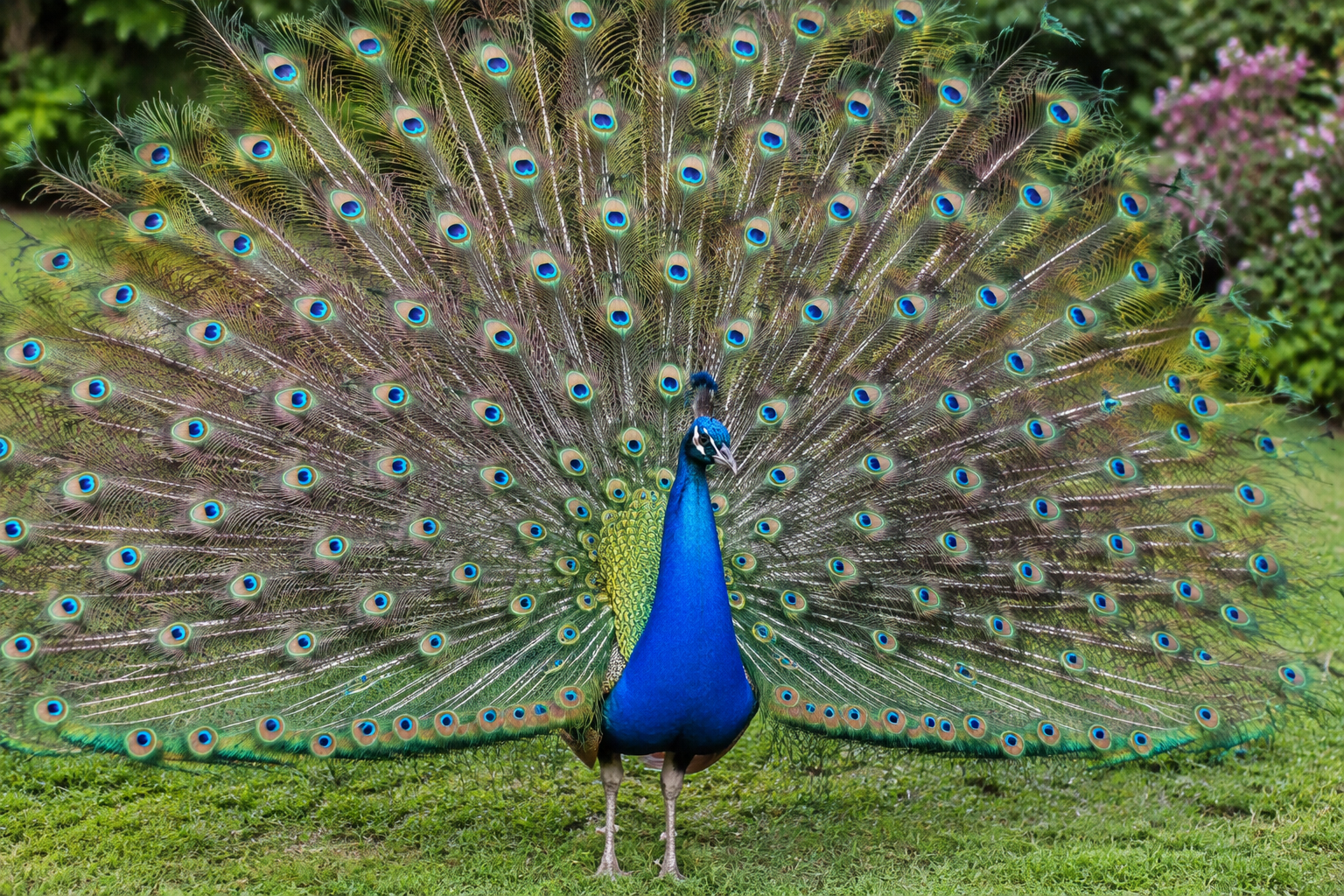
James: Imagine a bird that carries a spectacular fan of shimmering feathers, each decorated with what looks like a tiny, colorful eye. When sunlight strikes this display, brilliant blues, greens, bronze, and gold seem to dance across its surface. The bird spreads its magnificent fan, shakes it rapidly, and produces a curious rattling sound. This is the peacock, and its extraordinary appearance is only the beginning of the story. Beneath those beautiful feathers lies some remarkable engineering.
Christopher: The peacock is the male of a bird known scientifically as the Indian peafowl. Its female counterpart is called a peahen. Both belong to the pheasant family and are native to the Indian subcontinent. The male is famous for his spectacular appearance, while the female has more subdued brown and green coloring. But the most extraordinary feature of the male is the enormous train of feathers that he displays during courtship.
James: Here’s something many people don’t realize: the famous fan isn’t actually made up of the bird’s true tail feathers. It consists mainly of greatly elongated upper-tail covert feathers, which grow over and extend beyond the true tail. The ordinary tail feathers help support and lift this magnificent display. When the male raises his train, he can spread it into a fan roughly five feet tall, decorated with as many as 100 to 175 colorful eyespots.
Christopher: Now let’s look at what makes those feathers so extraordinary. You might assume that the brilliant blue and green colors come from ordinary pigments, much like paint on a surface. But much of the peacock’s spectacular coloration is produced in a very different way. The tiny structures inside its feathers interact with light, selectively reflecting particular wavelengths and producing the brilliant colors we see. Scientists call this structural coloration.
James: Under a powerful microscope, the tiny branches of a feather reveal an astonishing arrangement. Within these structures are microscopic rods of melanin, a natural pigment, arranged in an organized pattern within a material called keratin. Tiny spaces containing air are also part of this structure. Together, these materials form a microscopic optical system. The spacing and arrangement of these structures influence which wavelengths of light are reflected. Change that microscopic arrangement, and the resulting color changes as well.
Christopher: This also explains why peacock feathers appear to change color as you move around them. The brilliant hues are iridescent, meaning their appearance depends partly on the angle at which light strikes the feather and the angle from which we observe it. A feather may appear intensely blue or green from one direction and look quite different from another. The bird is not changing its feathers. The way the microscopic structures interact with light is producing the changing appearance.
James: And those famous eyespots are not merely decorative circles. Their intricate patterns and shimmering colors are part of the male’s courtship display. Researchers have studied the relationship between the appearance of these eyespots and mating success. Some findings suggest that the brightness and changing iridescent colors of the eyespots are associated with how successful males are in attracting females. The peahen is evaluating a complicated visual display, not simply looking at the largest fan.
Christopher: But the peacock has another surprise. His display is not just something to look at. It is something to hear as well. When he performs his courtship routine, he rapidly vibrates his train, causing the feathers to shimmer and produce a rattling sound. Scientists used high-speed video to study this behavior and measured the vibration at an average of about 25.6 times per second. That is more than 25 vibrations every second!
James: The sound is produced as the feathers move and rub against one another. Researchers have found that the feather arrangement has natural resonant properties in the frequency range used during this display. In other words, the structure of the feathers helps determine how they vibrate. The male is combining visual effects and sound in a remarkably coordinated performance. It is a biological display involving optics, acoustics, and biomechanics all at once.
Christopher: So what is the purpose of all this elaborate equipment? Courtship, of course. The male spreads his train, turns toward the female, shakes his feathers, and tries to capture her attention. The peahen observes the display and decides whether the male is suitable as a mate. The spectacular train is costly to grow and maintain, but it plays an important role in reproduction.
James: Despite carrying this enormous feather display, the peacock is still capable of flight. It spends much of its time walking and feeding on the ground, but it can fly strongly when necessary. At night, peafowl often fly up into trees to roost, where they are safer from many ground-dwelling predators. That magnificent train may look cumbersome, but it does not prevent the bird from taking to the air.
Christopher: The peacock reminds us that feathers are much more than simple coverings. They can provide insulation, assist with flight, communicate information, and even manipulate light through microscopic structures. In this bird are combined an intricate optical system with a remarkable courtship display. What looks like a collection of beautiful feathers is actually a sophisticated arrangement of biological materials working together.
James: Think about it: a microscopic pattern of melanin, keratin, and air spaces produces colors that appear to shimmer and change as the bird moves. A carefully arranged collection of feathers vibrates more than 25 times each second, creating both movement and sound. And all of this is part of a courtship display that helps determine which males reproduce.
Christopher: The peacock is far more than a beautiful bird. It is a living example of how intricate structures can produce extraordinary effects. Its feathers demonstrate brilliant color without relying entirely on pigments, and its courtship routine shows how several biological systems can work together in one remarkable performance.
James: Sometimes we see a peacock spreading its magnificent fan and think we are simply looking at a beautiful bird. But when we look closer, we discover a world of microscopic engineering, remarkable physics, and extraordinary biological design. And that is the real wonder of the peacock.

















Thanks! Share it with your friends!
Tweet
Share
Pin It
LinkedIn
Google+
Reddit
Tumblr