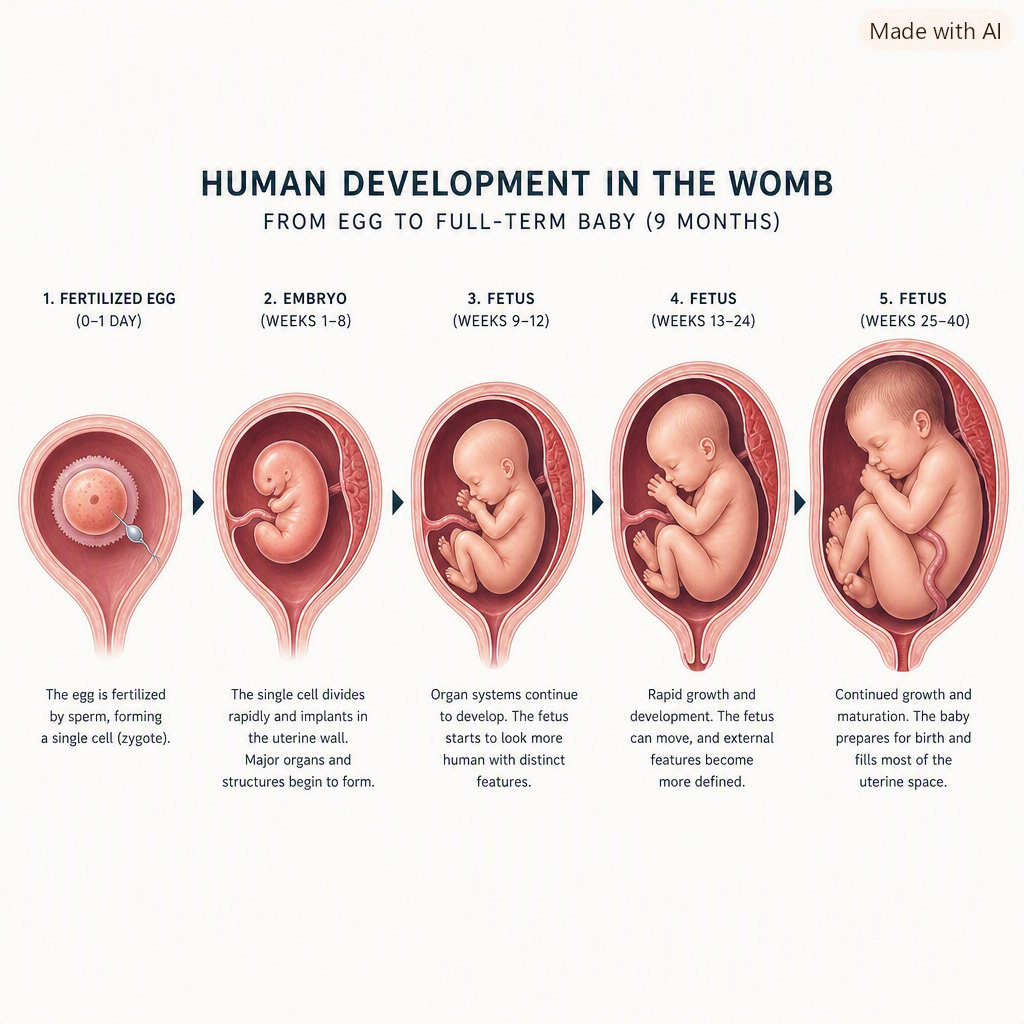
John: Welcome to ‘The Nine-Month Baby Miracle.’ Today, we’re diving deep into one of life’s most profound mysteries: how a single, microscopic cell becomes a fully formed human baby. It’s an incredible journey of precise coordination and complex instructions. Honestly, it’s just astounding to consider the scale of transformation.
Nigel: That’s mind-boggling, John. I mean, we all know babies grow in the womb, but to think it all starts from just one cell, smaller than a speck of dust, is wild. How does that even begin? What happens right at the very start to kick off such a monumental process?
John: It all begins with fertilization. When a sperm successfully penetrates an egg, their genetic material merges, forming a single, unique cell called a zygote. This tiny cell contains all the instructions needed to build an entire human being. It’s the blueprint, the starting point, for everything that follows.
Nigel: So, this single zygote has all the genetic information. But how does one cell become two, then four, then millions? Is it just a simple process of splitting, or is there more to it than that? How does it know when and where to divide?
John: That’s where the magic begins, Nigel. The zygote immediately starts a rapid series of divisions, called cleavage. Within hours, it’s two cells, then four, then eight, forming a ball of cells. Crucially, it’s not just increasing cell count; these cells are already beginning to organize themselves, preparing for their future roles.
Nigel: Organizing already? That’s fascinating! I always pictured it as just a blob of identical cells growing larger. But if they’re organizing, does that mean they’re already starting to become different types of cells? Like, even at this super early stage?
John: Precisely! This leads us to one of the most astonishing aspects: cell differentiation. All these cells start with the exact same genetic instructions from that original zygote. Yet, somehow, they begin to specialize, becoming nerve cells, muscle cells, blood cells, bone cells, skin cells, and countless others that form organs.
Nigel: Okay, that’s the big question for me: If they all came from the same original cell and have the same DNA, what causes one cell to become, say, a nerve cell, while another becomes a muscle cell? How does that decision get made?
John: It’s an incredible interplay. Cells don’t just blindly follow instructions; they respond to signals from their environment and from neighboring cells. Certain genes are activated or deactivated, directing a cell down a specific developmental pathway. Its position and molecular signals literally tell it what type of cell to become.
Nigel: So, it’s like a complex communication network, even at the earliest stages? Cells are essentially ‘talking’ to each other, right? How does that communication actually work on a molecular level to guide such precise development?
John: Absolutely, Nigel. Developing cells constantly send and receive molecular signals. These signals are like tiny messages telling cells where to go, what type of cell to become, when to divide, and when to stop. This coordinated communication ensures everything develops in its correct location and sequence.
Nigel: That’s pretty advanced for microscopic cells. So, if they’re receiving signals about where to go, does that imply cells are actually moving around during development? Like, they aren’t just fixed in one spot from the beginning?
John: Indeed! Cell migration is crucial. For example, during the formation of complex structures like our limbs, cells don’t just grow in place; they move, sometimes over significant distances. Their final position dictates what tissues or organs they contribute to, illustrating immense precision and orchestration.
Nigel: So, we’re talking about division, specialization, communication, and now movement, all happening simultaneously, right? It’s not just a linear process. How does that all coordinate so perfectly to form something as complex as, say, a heart or an eye?
John: You’ve hit on a crucial point: coordination. It’s not ‘first build the heart, then the brain.’ Many developmental events overlap. As cells differentiate and migrate, rudimentary structures of major body systems begin to emerge. For instance, the very early cardiovascular system forms quite rapidly in the first weeks.
Nigel: Wow. So, the heart, which is this incredibly complex pump, starts to take shape almost immediately while all these other processes are still in motion? It’s like an orchestra where every instrument starts playing its part at exactly the right moment to create a symphony.
John: Exactly. Once the cells multiply, the real marvel begins: differentiation. While every cell has the full genetic blueprint, they don’t use all of it. Imagine a vast library; different cells access different sections. Signals from surrounding cells and their environment tell specific genes to ‘turn on’ or ‘turn off,’ guiding their unique destiny.
Nigel: That’s fascinating. So, if they all start with the same instructions, what causes one cell to become, say, a nerve cell, while its neighbor becomes a muscle cell? It can’t just be random; there must be incredible precision to it, right?
John: Absolutely, it’s incredibly precise. It’s all about context and communication. Cells aren’t isolated; they’re constantly receiving molecular signals from their neighbors and the extracellular matrix. These signals act like directives, influencing which genes are expressed and thus, what type of cell they become, where they go, and even when they divide or stop.
Nigel: So, it’s like an orchestra where each instrument knows its part, but also listens to the conductor and the other instruments to play in harmony. And these cells don’t just stay put, do they? I’ve heard they can actually move around during development.
John: That’s a perfect analogy, Nigel. And yes, cell movement, or migration, is crucial. Think of the formation of our limbs. Cells don’t just grow in place; entire sheets of cells migrate and fold, organizing into the precise structures that will become our arms and legs. Their final position dictates the structures they form.
Nigel: That’s mind-boggling. So, we have division, specialization, communication, and movement all happening at once. How does something as complex as a heart, with its specific chambers and valves, or the intricate nervous system, begin to take shape from all this?
John: That’s where the coordination becomes truly phenomenal. The heart, for instance, begins as a simple tube around week three. Cells migrate, fold, and twist this tube, forming distinct chambers. It starts beating rhythmically even before it’s fully formed, gradually developing its sophisticated pumping mechanism and circulatory network.
Nigel: A beating heart from a tube – wow. And the brain, our most complex organ, how does that begin to wire itself up? It must involve an unbelievable number of connections forming at precisely the right time and place.
John: Indeed. The nervous system starts with the neural tube, which then expands and differentiates into the brain and spinal cord. Nerve cells, or neurons, specialize and extend axons and dendrites, forming billions of intricate connections. These pathways are established through precise molecular guidance and electrical activity, creating a functional network.
Nigel: It seems like it’s not just about building individual organs sequentially, but rather a simultaneous, integrated construction project. Like, the heart isn’t finished before the brain starts, right? Everything has to develop in concert.
John: Precisely! This overlapping and continuous interaction is a cornerstone of development. While the heart is forming, the eyes are also developing from different tissue layers that precisely coordinate to form the lens, retina, and cornea. Timing is absolutely critical; a slight delay in one area can profoundly impact others.
Nigel: So, it’s not like an assembly line where you finish one part and move to the next. It’s more like a highly choreographed dance, with countless dancers all moving in sync, anticipating each other’s next steps to form a complete whole. That’s incredible orchestration.
John: Exactly. As pregnancy progresses into the later stages, this intricate coordination continues, but shifts towards growth and maturation. Organs and tissues continue to specialize, the nervous system refines its connections, and all body systems begin working together more cohesively, preparing the baby for life outside the womb.
Nigel: It’s hard to imagine, watching a newborn, that every single cell originated from just one. From that microscopic beginning, to the complexity of a baby, with all its distinct features, organs, and a beating heart ready for the world. It really makes you pause.
John: It truly is astounding. Every breath, every movement, every thought in that newborn is the result of billions of cells dividing, specializing, communicating, moving, and organizing with unbelievable precision. It’s a testament to the sheer depth of information and coordination guiding this entire process.
Nigel: I came into this knowing babies grow in the womb, but now I have an entirely new appreciation for the absolute miracle unfolding, cell by cell, moment by moment. It’s an extraordinary journey from a single cell to a complete human being. It’s an incredible marvel of design. Thanks, John, that was truly eye-opening.















![My Lord and I [Live]](http://img.youtube.com/vi/ZFh24DccDXc/0.jpg "My Lord and I [Live]")
Thanks! Share it with your friends!
Tweet
Share
Pin It
LinkedIn
Google+
Reddit
Tumblr