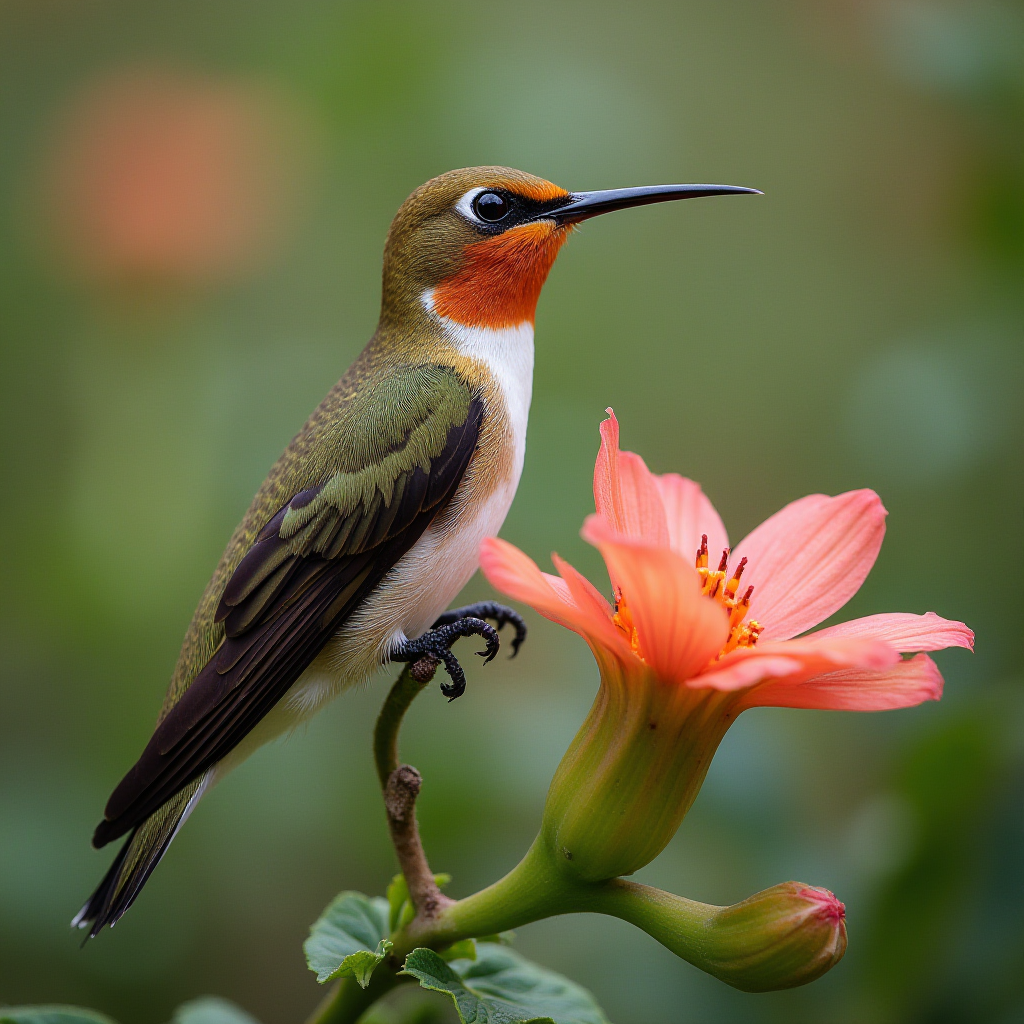
John: Nigel, have you ever just stopped and truly watched a hummingbird? I mean, really watched one, up close?
Nigel: Oh, absolutely, John. It’s like witnessing a miniature miracle, isn’t it? They’re just… beyond belief. The speed, the iridescence… it’s almost otherworldly.
John: Otherworldly is the perfect word. I was out in the garden this morning, and one zipped past me, then just hung there, suspended in mid-air, right in front of a fuchsia. It was like it defied physics.
Nigel: That hovering capability alone is just astounding. You think about how much energy that must take, the precision required. It’s not just flapping; it’s a completely unique form of flight, like nothing else in the avian world.
John: Exactly! They’re not just moving their wings up and down. From what I understand, they rotate their wings almost in a figure-eight pattern. It’s like a tiny helicopter, but organic. Who thought of that?
Nigel: It’s an incredible piece of biomechanical engineering, isn’t it? The way the wing can rotate 180 degrees at the shoulder joint, allowing them to generate lift on both the downstroke and the upstroke. That’s what gives them that unparalleled maneuverability – flying forwards, backwards, even upside down for a split second. It’s all built in.
John: And the speed! Their wings can beat something like 50 to 80 times per second, sometimes even up to 200 for smaller ones. You can barely even see the individual wing beats; it’s just a blur.
Nigel: That incredible wing speed is directly linked to their absolutely insane metabolism. These little guys are living life in the fast lane all the time. Their heart rate can reach up to 1,200 beats per minute! That’s not just ‘fast,’ that’s pushing the limits of biological machinery.
John: Twelve hundred beats? That’s… that’s almost unbelievable. It makes you wonder how their tiny bodies can sustain that kind of output. It’s like having a super-charged engine in a miniature chassis.
Nigel: Precisely. And that’s why they have to eat constantly. They need to consume roughly half their body weight in sugar every single day just to keep that engine running. Their lives are literally a continuous search for nectar.
John: Which brings us to their feeding apparatus. Their beaks are so perfectly suited for reaching deep into flowers, and then that tongue… I read somewhere it’s like a tiny, double-barreled pump.
Nigel: It’s not just a straw, is it? It’s far more sophisticated. Their tongue is actually bifid – forked at the tip – and it has these little lamellae, or fringes, that extend outward. When they retract their tongue, these lamellae fold inward, trapping nectar. It’s a capillary action combined with a miniature pump, all perfectly designed to extract liquid gold.
John: So, it’s not just sticking it in and sucking. It’s a specialized, highly efficient system. And you see how specific some flowers are for hummingbirds, with their long, tubular shapes. It’s like the flower and the bird were made for each other.
Nigel: A perfect lock-and-key mechanism, wouldn’t you say? The precise dimensions of the beak matching the flower depth, ensuring efficient pollen transfer for the plant, and a reliable food source for the bird. It’s a beautifully coordinated arrangement.
John: And it’s not just nectar, either. They also need protein, which they get from tiny insects. So, they have to be able to spot these minuscule bugs while flying at incredible speeds.
Nigel: Another incredible feature! Their vision is exceptional. They can see not just the visible light spectrum that we do, but also into the ultraviolet range. That helps them locate flowers that might look plain to us but glow brightly to them, and likely helps them spot those tiny insects against foliage. It’s like having built-in night vision or a special filter.
John: It’s like every single component, every tiny detail, is optimized for survival and function. There’s no wasted space, no inefficiency. It’s all purpose-built.
Nigel: And consider their size. They’re some of the smallest birds on the planet, some weighing less than a penny. Yet, they undertake these massive migrations. The Rufous hummingbird, for example, travels thousands of miles from Alaska all the way down to Mexico and back.
John: That’s another thing that blows my mind! A creature so small, making such an epic journey. How do they navigate? How do they store enough energy? It’s not like they have a massive fuel tank.
Nigel: Well, before migration, they enter a period of hyperphagia – they basically gorge themselves, building up their fat reserves, sometimes doubling their body weight. And they navigate using a combination of the sun’s position, polarized light, and landmarks. It’s an innate, complex navigational system for a bird with a brain the size of a pea.
John: The sheer tenacity, the endurance… it just seems so improbable for such a delicate creature. It’s like they were given exactly what they needed to achieve these incredible feats.
Nigel: And let’s not forget how they survive cold nights. With that blistering metabolism, they’d burn through all their energy reserves very quickly if they maintained that pace. So, they have this remarkable ability to go into a state called torpor.
John: Torpor, yes! Where they essentially slow down their whole system, right? Like a mini-hibernation?
Nigel: Exactly. Their body temperature drops dramatically, their heart rate slows to perhaps 50 beats per minute, and their metabolism plummets. It’s a brilliant energy-saving mechanism, a built-in survival strategy for when food is scarce or temperatures drop. And then, at dawn, they can warm themselves back up in about 20 minutes.
John: It’s like someone designed them with an ‘off-switch’ or a ‘power-saving mode’ that kicks in automatically. Everything about them is so meticulously thought out.
Nigel: It truly is. From their daily energy demands to their long-distance travel, to their nightly survival tactics, every single piece fits perfectly into a cohesive system.
John: And we haven’t even touched on their dazzling beauty. Those iridescent feathers! They shimmer and change color depending on the light and the angle. It’s not pigment, is it? It’s structural.
Nigel: You’re absolutely right, John. It’s structural coloration. Their feathers have these tiny, intricate structures, like microscopic prisms, that scatter and refract light. So, the color we see isn’t from a pigment, but from the way light interacts with these incredibly precise, engineered surfaces.
John: So, it’s not painted on, it’s built in. The feather itself is a tiny, optical device designed to produce that shimmering effect. It’s just another layer of incredible detail.
Nigel: Precisely. It’s another example of the meticulous craftsmanship evident in every aspect of the hummingbird. The functionality of their flight, the efficiency of their feeding, the genius of their survival mechanisms, and the sheer artistry of their appearance – it all points to an incredibly sophisticated blueprint.
John: When you put it all together, the tiny size, the blistering speed, the complex feeding system, the incredible migrations, the energy management, the optical brilliance of their feathers… it’s not just a collection of cool features. It’s an entire system working in perfect harmony.
Nigel: Harmony is the key word, John. Every component is interdependent and perfectly tuned. It’s a testament to the idea that these creatures are not just random assemblages, but exquisitely designed and manufactured marvels.
John: I mean, if you saw a watch this intricate, you wouldn’t question if someone made it, would you? You’d immediately assume a master watchmaker was behind it.
Nigel: Absolutely. And the hummingbird, with all its integrated systems and incredible functionality, is far, far more complex than any watch. It performs feats of engineering and biology that we’re still striving to replicate.
John: It just makes you stop and appreciate the sheer genius behind every little detail. The whole thing, from the inside out, is just spectacular. It really is a flying jewel, perfectly crafted.
Nigel: Indeed, John. A profound reminder of the intricate and purposeful design woven into the fabric of the natural world. It really makes you look at a hummingbird in your garden with entirely new eyes. What a truly astonishing creation.
John: Definitely. It’s a tiny powerhouse of wonder. Well, Nigel, it’s been a real pleasure diving into the incredible world of the hummingbird with you.
Nigel: The pleasure was all mine, John. Let’s keep looking up, and appreciate these small miracles around us.















Thanks! Share it with your friends!
Tweet
Share
Pin It
LinkedIn
Google+
Reddit
Tumblr