John:Hey Nigel, have you ever stopped to consider the sheer ingenuity present in some of the creatures dwelling in our oceans? I mean, beyond just their outward appearance, the internal workings, the systems that enable their very existence, are truly mind-boggling. It speaks to a level of engineering that we’re only just beginning to comprehend.
Nigel:Absolutely, John. It’s like finding a perfectly crafted machine where you’d least expect it. What particular marvel has captured your attention recently? There are so many examples of highly complex biological systems out there; it’s hard to pick just one that stands out above the rest in terms of its unique functionality.
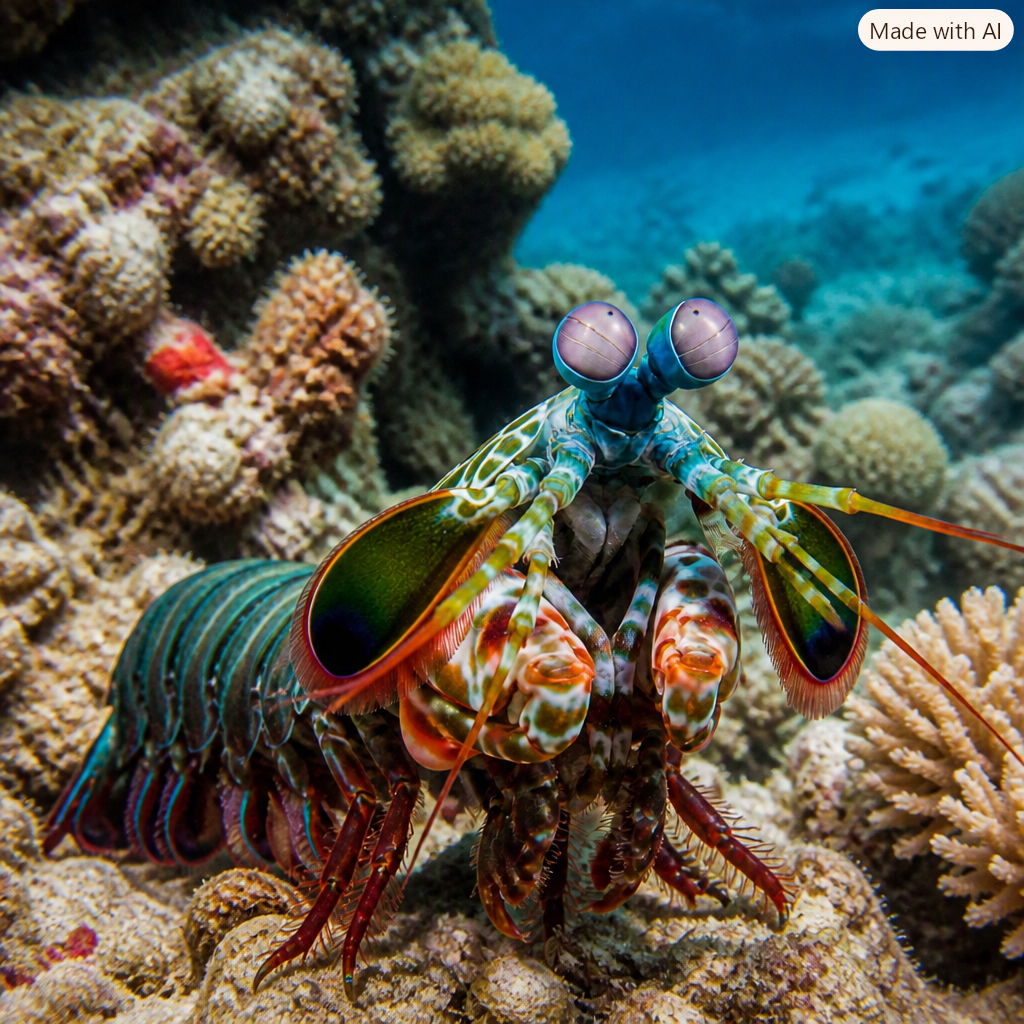
John:Well, today, I wanted to focus on one specific creature often hailed as an absolute wonder of intricate construction: the Mantis Shrimp. It’s not just another sea creature; it’s a living testament to sophisticated design, from its sensory organs to its powerful, specialized appendages. It’s an underwater masterpiece, really.
Nigel:The Mantis Shrimp! Ah, I’ve heard whispers of its extraordinary capabilities, but I’ve never really delved into the specifics. What makes this particular organism so fascinating from a design standpoint? Is it its vibrant colors, or something deeper about its operational mechanics? Do tell, I’m intrigued.
John:Let’s start with its eyes, Nigel. They are, without a doubt, one of the most complex visual systems known to exist. While humans have three photoreceptors, allowing us to see red, green, and blue, the Mantis Shrimp possesses between 12 and 16 different types. Think about the implications of that kind of visual processing!
Nigel:Twelve to sixteen? That’s an astonishing leap in complexity! What kind of visual information could an organism possibly process with so many receptors? I mean, our three are pretty good for navigating the world, but that many suggests an entirely different plane of sight. It implies a very deliberate construction.
John:It can perceive not only a wider spectrum of colors but also different types of polarized light, including linear and circular polarization. This gives it an unparalleled ability to discern details, textures, and even transparency that are completely invisible to us. It’s like having built-in, advanced optical filters.
Nigel:So, it’s not just about seeing ‘more colors,’ but fundamentally different properties of light. That’s truly remarkable. It suggests a complete integration of visual input for very specific purposes, almost as if its entire world is rendered with an advanced data overlay. Such precision points to intricate internal logic.
John:Precisely. This incredible visual acuity isn’t just for show. It’s a critical component of its hunting strategy, enabling it to detect prey hiding in plain sight or communicate with other Mantis Shrimp using complex patterns of polarized light. It’s an entire language woven into light itself, a masterful setup.
Nigel:That’s an amazing sensory system. But I’ve also heard tales of its striking power. Does its physical prowess live up to the hype, or is it more of an exaggeration? What’s the design secret behind that legendary punch? Is it as ingeniously constructed as its eyes?
John:Oh, its striking power is absolutely legendary, Nigel. There are two main types: the ‘smashers’ and the ‘spearers.’ Both possess specialized raptorial appendages designed with incredible mechanical efficiency. The ‘smasher’ type, in particular, is an engineering marvel, capable of delivering a blow with astonishing force.
Nigel:So, it’s not just a quick flick, but a genuine, powerful strike. What kind of mechanism allows for such incredible acceleration and force underwater? Water is quite resistant, so overcoming that friction alone suggests a very specific, optimized design for power output. I’m keen to understand the physics here.
John:It’s a spring-loaded hammer system. The shrimp contracts specific muscles, storing potential energy in its appendage, then releases it with a latch mechanism. This allows it to accelerate its dactyl club from rest to speeds comparable to a .22 caliber bullet in milliseconds, generating a cavitation bubble from the sheer force.
Nigel:A cavitation bubble? So it’s not just the direct impact of the appendage, but the shockwave from the collapsing bubble that delivers a secondary, devastating blow. That’s an unbelievably precise and destructive system. It’s like having a built-in miniature sonic weapon, engineered for maximum effect.
John:Exactly. The appendage itself, the ‘dactyl club,’ is also a masterpiece of material science. It’s constructed from a dense, mineralized chitin arranged in complex layered structures, specifically designed to resist fracturing from the immense forces it generates. It’s a self-repairing, super-strong component.
Nigel:So, we’re talking about a creature with the most advanced visual system on the planet, paired with an equally sophisticated, high-velocity weapon that even incorporates complex material design. It’s as if every component was meticulously engineered to complement the others, creating an apex predator with astounding capabilities.
John:It’s astounding to consider the sheer precision embedded within the mantis shrimp’s visual system. We touched on its unique ability to perceive polarized light, but it’s more than just seeing it; it’s processing that information with incredible speed and accuracy, almost like a biological supercomputer. Each eye moves independently, gathering data for a truly panoramic view.
Nigel:Exactly, John. And the way those different photoreceptors are arranged, almost in bands, suggests a highly specialized optical instrument. It’s not just detecting light; it’s discerning subtle differences in polarization across various wavelengths. This allows it to identify prey and predators with a level of detail that our most advanced technology struggles to replicate in such a compact form.
John:That’s a fantastic point about the compact form. It truly is a testament to efficient design. But let’s shift to its other famous tool: the club. The sheer force and speed of its strike are mind-boggling. It’s like a tiny, underwater jackhammer, capable of delivering a blow that can shatter mollusk shells and even aquarium glass.
Nigel:The mechanics behind that strike are truly baffling. It utilizes a spring-loaded mechanism, storing immense potential energy, then releasing it faster than a bullet. The acceleration is incredible, creating a cavitation bubble that, when it collapses, generates another powerful shockwave. It’s a dual-action weapon system, all contained within one appendage.
John:And the material science of that club itself! It’s composed of layers of chitin and calcium phosphate, spiraled in a way that makes it incredibly resistant to cracking and fracturing. It’s built to withstand hundreds, if not thousands, of high-impact strikes without degrading. That’s a level of material engineering we’re still trying to fully understand and mimic.
Nigel:It absolutely is. You’ve got a biological structure that outperforms many synthetic composites. It suggests an incredibly refined structural blueprint. Consider the precise angles and orientations of those chitin fibers. It’s a textbook example of how intricate internal architecture provides extraordinary strength and durability in a functional component.
John:It makes you wonder about the coordination involved. How does a creature so small manage to execute such complex actions? The brain must have an incredibly sophisticated control system to manage the independent eye movements, process the vast visual data, and then precisely time that hyper-fast strike. It’s a master-class in motor control.
Nigel:Indeed. The integration of its sensory input with its motor output is seamless. It’s not just a collection of impressive parts; it’s an exquisitely integrated system. The information from those advanced eyes directly informs the timing and trajectory of that powerful club. Every component seems purposefully tuned to work in concert, achieving maximum effectiveness.
John:And let’s not forget its remarkable ability to heal and regenerate. If a limb is damaged, it can regrow, maintaining the same intricate design and functionality. This capacity for self-repair and maintenance speaks volumes about the inherent robustness and sophisticated underlying programming of its entire biological system.
Nigel:That regeneration capability is truly a marvel, ensuring sustained operational capacity. It’s like having a self-repairing machine. This isn’t just about constructing something amazing; it’s about constructing something amazing that can also fix itself when components are compromised. It highlights a comprehensive design philosophy.
John:So, when we look at the mantis shrimp, we’re not just seeing a creature; we’re witnessing a complete package of specialized, high-performance systems. From its unparalleled vision to its extraordinary weaponry and the resilient materials, every aspect points to a level of engineering brilliance that frankly, defies simple explanation.
Nigel:Absolutely, John. It showcases an intricate blueprint where every detail, every mechanism, every material choice seems optimized for its specific function. It’s a living testament to complex, multi-functional components working in perfect harmony, a true masterpiece of biological architecture and functionality.
John:It leaves you with a profound appreciation for the level of ingenuity present in the world around us. To pack so much advanced capability into such a small package, with such efficiency and durability, it really makes you pause and consider the meticulous thought that must have gone into its construction.
Nigel:It certainly does. The mantis shrimp, in its entirety, stands as an emblem of sophisticated systems integration.
John:Nigel, this has been an incredibly insightful dive into one of the ocean’s most astonishing inhabitants. It’s clear there’s so much more to appreciate about the purposeful complexity embedded within its form and function. Thanks for sharing your thoughts on this truly remarkable creature.
Nigel:My pleasure, John. It’s always a delight to discuss such an extraordinary example of biological engineering. There’s no doubt the mantis shrimp continues to offer endless avenues for discovery regarding its intricate and finely tuned systems. Thanks for having me.


















Thanks! Share it with your friends!
Tweet
Share
Pin It
LinkedIn
Google+
Reddit
Tumblr