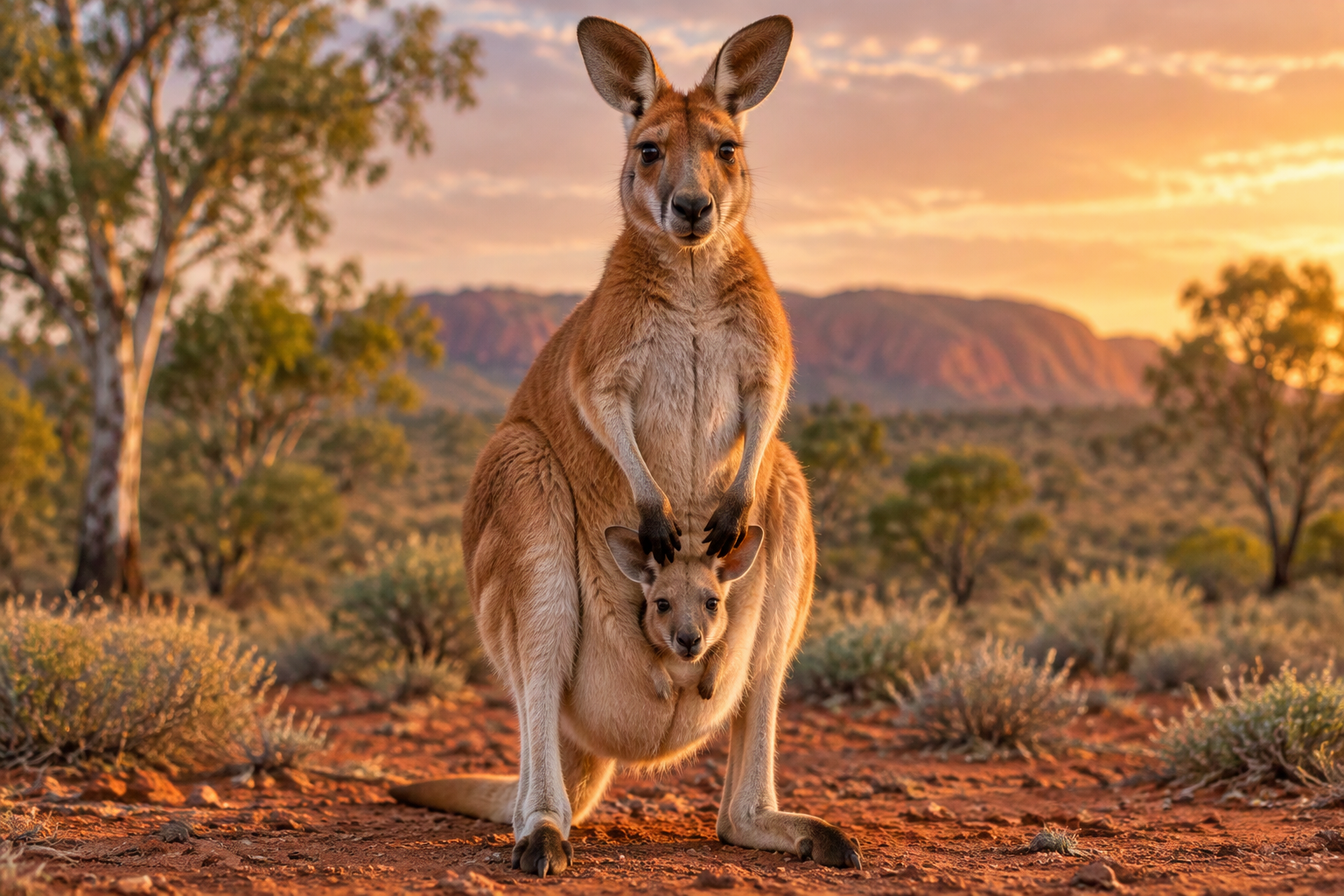
James: Imagine an animal equipped with powerful springs in its legs, a built-in balancing system, a muscular tail that can function as a fifth leg, and a reproductive system that allows a mother to nurture offspring at remarkably different stages of development. Now add powerful boxing arms, muscular hind legs capable of delivering devastating kicks, and sharp claws that make it a formidable opponent. It sounds like something out of a science-fiction laboratory, but this remarkable creature actually lives in the Australian outback. We’re talking about the kangaroo!
Christopher: Kangaroos are among the most recognizable animals in the world. They are famous for hopping across the Australian landscape, carrying their young in pouches, and occasionally engaging in what looks remarkably like a boxing match. But behind that familiar appearance is an extraordinary collection of biological features that make the kangaroo a fascinating example of engineering in nature. Let’s take a closer look.
James: One of the most remarkable features of the kangaroo is its ability to travel by hopping. Unlike most mammals, which use different patterns of walking and running, large kangaroos rely heavily on powerful hind legs to propel themselves forward. But there’s something especially interesting about how this works. Their legs contain long, elastic tendons that act somewhat like powerful springs. When a kangaroo lands, these tendons stretch and store mechanical energy. When the animal takes off again, much of that energy is released.
Christopher: This allows kangaroos to recycle energy with each hop rather than having to generate all the energy from their muscles every time. As a result, hopping can be remarkably energy-efficient, particularly when traveling at higher speeds. A large red kangaroo can cover impressive distances in a single bound, and its powerful legs allow it to reach speeds of approximately 35 miles per hour under favorable conditions. Its long feet and strong hind legs are clearly adapted for this unusual form of transportation.
James: Now let’s examine another remarkable feature: the kangaroo’s tail. Most people assume the tail is primarily used for balance while hopping, and that’s certainly one of its functions. But researchers have discovered something even more interesting. When a large kangaroo moves slowly, it uses its forelimbs and its tail to support its body while bringing its hind legs forward. In effect, the animal is walking on five points of contact!
Christopher: Scientists call this pentapedal locomotion. In a scientific study, researchers discovered that the tail actually generates substantial forward-propelling force. During this unusual walking movement, the tail can contribute as much propulsive force as the front and hind limbs combined. So the kangaroo’s tail isn’t simply a counterbalance. It is a muscular, working part of the animal’s locomotion system. That’s quite an accomplishment for an appendage that most animals simply drag around or use for balance!
James: Perhaps one of the most fascinating features of the kangaroo is its reproductive system. Kangaroos are marsupials, meaning their young are born at a very early stage of development and continue growing inside the mother’s pouch. A newborn red kangaroo is incredibly tiny, weighing approximately one gram. Think about that for a moment. A mother weighing many times that amount gives birth to a baby about the size of a large jellybean!
Christopher: After birth, the tiny newborn makes its way up the mother’s abdomen and into the pouch, where it attaches to a teat and continues developing. It will remain there for months while it grows and becomes strong enough to venture outside. But the mother’s reproductive system has another extraordinary feature. Some kangaroos can temporarily suspend the development of an embryo. This is known as embryonic diapause. If conditions are unfavorable, the embryo can remain in a suspended state until circumstances are more suitable.
James: In certain species, a mother can also produce different types of milk from different mammary glands to meet the nutritional needs of offspring at different developmental stages. Under the right circumstances, she may be caring for a young joey in her pouch, nursing an older offspring outside the pouch, and carrying a dormant embryo. It’s a remarkable reproductive arrangement adapted to the unpredictable conditions of the Australian environment.
Christopher: Now we come to a feature that might be the most entertaining of all: the kangaroo’s boxing ability! Male kangaroos frequently engage in contests to establish dominance and compete for access to females. They rise up on their hind legs, extend their forearms, and begin pushing, grabbing, and striking one another. Sometimes these encounters look remarkably like a heavyweight boxing match. But kangaroos have something that human boxers don’t: their powerful hind legs!
James: A kangaroo can lean backward, use its muscular tail for support, and deliver powerful kicks with both hind feet. Its sharp claws add another dimension to these encounters. The tail provides an important support point, allowing the animal to stabilize itself while using its hind legs offensively. These contests aren’t simply random displays of aggression. They are part of the social behavior through which males establish dominance. Young kangaroos also engage in play fighting, which helps them develop the skills they will eventually use as adults. So perhaps we should think of the kangaroo as having its own built-in boxing training program!
Christopher: The kangaroo’s fighting abilities also serve another purpose: self-defense. Australia has its share of predators, and kangaroos have developed some impressive ways of protecting themselves. Their powerful hind legs can deliver extremely forceful kicks. Their claws can inflict serious injuries, and their forelimbs can be used to grab and wrestle an opponent. Their size and muscular development make large adult kangaroos formidable animals.
James: Kangaroos may also use water as a defensive refuge when pursued by predators. There are documented observations of large kangaroos entering water and attempting to hold pursuing animals underwater. This behavior is not something they routinely do, but it demonstrates how an animal can use its environment as part of its defensive strategy. Between its powerful legs, sharp claws, muscular tail, and strong forelimbs, the kangaroo has quite an impressive collection of defensive equipment. I wouldn’t recommend picking a fight with one!
Christopher: When we put all these features together, we begin to appreciate just how remarkable the kangaroo really is. Its legs are adapted to store and release mechanical energy. Its tail serves as a balancing device, a support structure, and even a fifth leg during slow movement. Its reproductive system allows remarkable flexibility in raising young under changing environmental conditions. And its muscular body provides both the power to travel across the Australian landscape and the ability to defend itself against threats.
James: Each of these features serves a particular purpose, and together they make the kangaroo exceptionally well adapted to its environment. The kangaroo is much more than an animal that hops around the Australian outback. It is a fascinating example of the complexity and ingenuity found in the living world. From its spring-like tendons to its remarkable reproductive system, from its multifunctional tail to its powerful defensive abilities, the kangaroo offers us plenty to appreciate and investigate.
Christopher: When we examine creatures like this, we’re reminded that nature contains an incredible variety of biological designs. And the next time you see a kangaroo hopping across a field, remember that you’re looking at much more than a funny-looking animal with a pouch. You’re looking at a remarkable biological system, equipped with an extraordinary collection of features that work together to support its way of life.
James: This has been another episode of Design in Nature. Thanks for joining us, and we’ll see you next time as we continue exploring the remarkable world around us.















Thanks! Share it with your friends!
Tweet
Share
Pin It
LinkedIn
Google+
Reddit
Tumblr