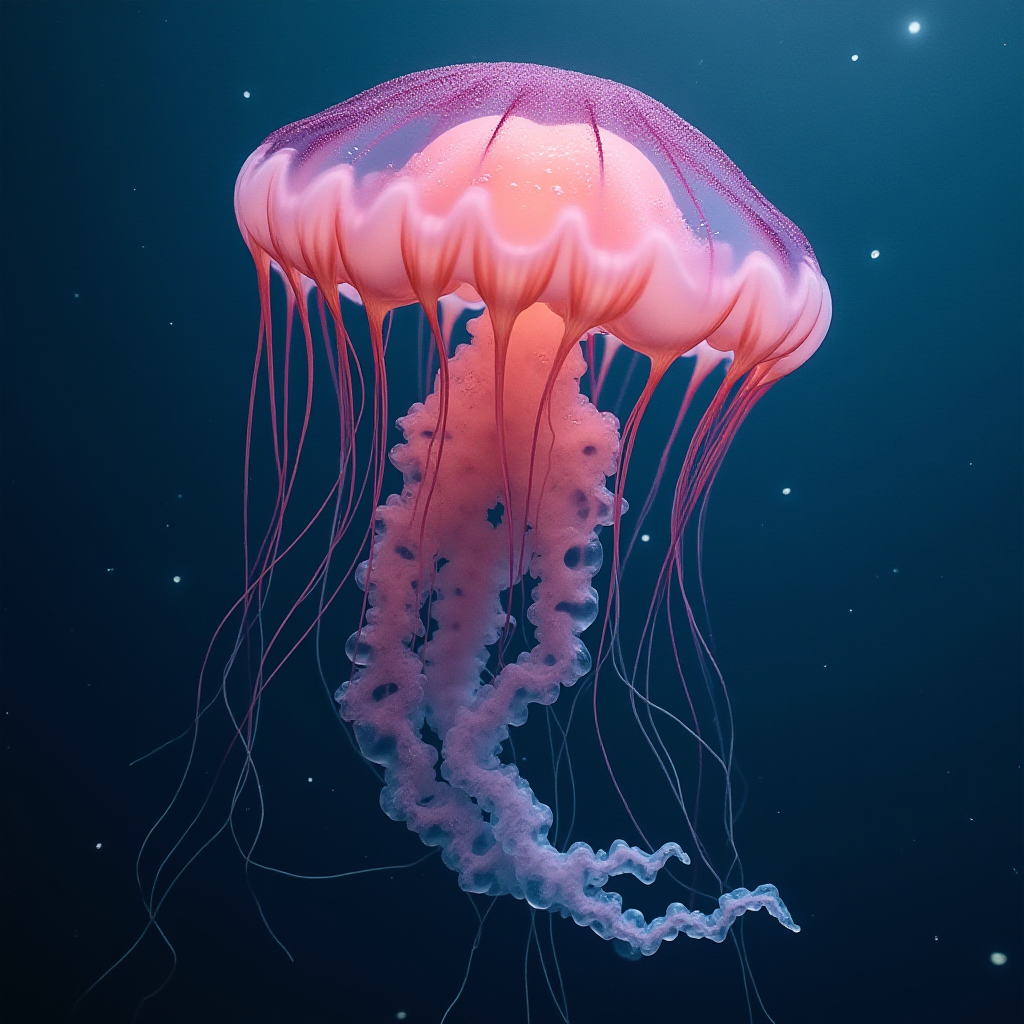
John: On todays show Nigel we’ll be discussing the amazing Jellyfish! It’s not just some blob floating by but an incredible, living entity.
Nigel: Oh, absolutely, John! They are utterly mesmerizing, aren’t they? It’s like watching a living piece of art, perfectly crafted, drifting through the water with such grace. There’s just nothing else quite like them.
John: Right? And the more you learn about them, the more jaw-dropping they become. We often think of complex life forms needing a brain, a heart, a skeleton… and then there’s the jellyfish. No brain, no heart, no bones, and yet they are incredibly successful, adaptable, and, dare I say, perfectly engineered for their environment.
Nigel: It’s true. Their design is so elegant in its simplicity, yet profoundly sophisticated in its functionality. Take their movement, for instance. That rhythmic pulsation of their bell, it’s not just random. It’s a highly efficient form of jet propulsion, allowing them to navigate the vast oceans with minimal energy expenditure. It’s like a living, self-correcting pump.
John: And the way they use that movement, not just for locomotion, but also to create currents that draw food right to their tentacles. It’s like they’ve got this built-in, passive filtration system that also moves them around. It’s a dual-purpose design that’s just brilliant.
Nigel: Exactly! And speaking of tentacles, let’s talk about those stinging cells, the nematocysts. These aren’t just simple barbed wires; they are some of the fastest biological mechanisms known. Each one is a miniature harpoon, coiled under immense pressure, ready to fire at the slightest touch. We’re talking about pressures exceeding 150 atmospheres, and they deploy in microseconds!
John: It’s like each tentacle is armed with millions of microscopic, spring-loaded weapons, each one programmed to detect and inject venom into prey. Think about the precision required for that. A cell within a cell, designed to sense, trigger, and deliver with such incredible speed and accuracy. It’s an absolute masterpiece of biochemical and mechanical engineering at a microscopic scale.
Nigel: And the venom itself! It’s often a complex cocktail of neurotoxins, hemolysins, and cardiotoxins, tailored to incapacitate their specific prey, whether it’s a tiny plankton or a small fish. The specificity and effectiveness of these chemical compounds, combined with the firing mechanism, point to an incredibly refined system.
John: And without a central brain, how do they even know where they’re going, or what to sting? That’s where it gets even more fascinating. They have these structures called rhopalia, right?
Nigel: Yes, the rhopalia! These are like their decentralized sensory hubs. Along the rim of their bell, they have these small, club-shaped structures that act as a combination of light sensors – often simple ocelli, or ‘eyespots’ – and statocysts, which are balance organs. These statocysts contain tiny mineral particles that shift with gravity, telling the jellyfish which way is up and down.
John: So, they can sense light and maintain orientation without a processing unit. It’s like having a distributed network of mini-computers, each doing its part, ensuring the entire organism functions coherently. It’s a completely different paradigm of intelligence or functional organization than we’re used to seeing.
Nigel: Precisely. Each rhopalium can send signals to the nerve net that controls the bell’s contractions. So, if one side senses light, it might contract more frequently, subtly steering the jellyfish towards the surface or away from it. It’s a testament to the fact that complex behaviors don’t always require a central brain; a perfectly integrated sensory and motor system can achieve remarkable feats.
John: It’s as if their very form and function are an argument for intentionality. How can such an intricate, self-sustaining, and thriving system come about without some underlying blueprint? Every component seems perfectly suited for its role, from the microscopic nematocyst to the overall bell shape.
Nigel: And consider their life cycle, John. It’s not straightforward either. Many jellyfish have a two-stage life cycle, alternating between a free-swimming medusa, which is what we typically recognize as a jellyfish, and a sessile polyp stage. The polyp often attaches to rocks or other surfaces, budding off new medusae. It’s an incredibly clever way to ensure species propagation and adapt to different environmental conditions.
John: So, it’s not just a creature; it’s a whole system with built-in redundancy and different forms to maximize its chances of survival and reproduction. The blueprint for both forms, and the transition between them, must be incredibly sophisticated. It’s like having two perfectly designed vehicles for different terrains, all from the same initial design.
Nigel: And some species take this regeneration to an even higher level. There’s the famous ‘immortal jellyfish,’ Turritopsis dohrnii. When stressed or injured, it doesn’t just die; it can revert back to its polyp stage, essentially starting its life cycle over again. It’s like a reset button, allowing it to potentially live indefinitely.
John: That’s mind-boggling, Nigel. A creature that can essentially reverse its aging process and regenerate itself fully. How does a biological system ‘know’ to do that? To de-differentiate its specialized cells and revert to an earlier, foundational state? It speaks volumes about the incredible programming within its genetic makeup.
Nigel: It absolutely does. It implies a profound level of intrinsic programming, a kind of biological contingency plan built into its very structure. It’s not just about surviving; it’s about having a multi-layered strategy for perpetuation that seems almost beyond what we can comprehend in terms of self-repair and renewal.
John: And then there’s the sheer aesthetic beauty. Some of them are bioluminescent, right? Glowing in the dark depths of the ocean. Why would a creature that seems so ‘simple’ be given the ability to produce light?
Nigel: Many of them are, indeed! It’s another astonishing feature. Bioluminescence in jellyfish serves multiple purposes. For some, it might be a way to attract prey in the darkness, luring them in like a living light trap. For others, it’s a defensive mechanism – a sudden flash of light can startle a predator or act as a burglar alarm, attracting a larger predator to attack the initial threat.
John: So, it’s not just for show; it’s integrated into their survival strategy. A light show that doubles as a hunting tool or a defense system. It’s like a built-in multi-tool, perfectly suited for the dark, expansive environment they inhabit. Every element, from the light production to the venom, to the regenerative capabilities, seems to be part of a larger, coherent plan.
Nigel: Exactly. The complexity isn’t always overt, like in a mammal with a large brain. Sometimes, the most intricate designs are found in these seemingly ‘simple’ organisms, where every component is optimized and interconnected in ways that frankly, just make you marvel.
John: It really does. When you look at the elegant symmetry of their bell, the intricate network of canals that distribute nutrients, the precision of their nematocysts, the distributed sensory system, and that incredible life cycle, you can’t help but see a clear signature of intentionality. It’s like finding a perfectly functioning, incredibly efficient machine that assembled itself, but then you realize the blueprints for every gear and lever were already there, right from the beginning.
Nigel: Absolutely. The sheer diversity of jellyfish forms, too, is a testament. From the tiny hydromedusae to the massive lion’s mane jellyfish, each with its own unique adaptations, yet all adhering to that fundamental bell-shaped plan. It’s a foundational design that’s been adapted and refined in countless beautiful ways, each one perfectly suited to its niche.
John: It’s like a designer had a fundamental principle, ‘the bell and tentacles,’ and then explored all the possible, effective variations within that framework. Each variation a testament to the versatility and robustness of the original concept. You see them thriving in every ocean, from the surface to the deepest trenches, enduring incredible pressures and temperatures.
Nigel: And often, they’re the primary predators in their ecosystems, playing a crucial role in maintaining balance. They’re not just passive drifters; they’re active, effective hunters and survivors. They fill their role in the oceanic tapestry so completely and efficiently.
John: It makes you think about our own designs, doesn’t it? How we strive for efficiency, multi-functionality, and resilience. And here, in the natural world, we see a creature that embodies all of those principles without any ‘brain’ in the way we understand it. It just is perfectly designed.
Nigel: It really does put our own engineering feats into perspective. We struggle to create materials that self-heal, or systems that can revert to an earlier state, and here’s a jellyfish just doing it naturally. It’s a humbling and inspiring display of nature’s incredible ingenuity.
John: So, the next time someone dismisses a jellyfish as ‘just a simple organism,’ I think we have plenty to tell them about the incredible intelligence and purposeful design woven into every fiber of these magnificent creatures. They’re anything but simple.
Nigel: Couldn’t agree more, John. They are truly one of the ocean’s most compelling arguments for an underlying sophisticated hand in the natural world. A true marvel, from every angle.
John: Absolutely. Well, that’s all the time we have for today, but what a conversation it’s been. Thank you, Nigel, for shedding light on these incredible creatures.
Nigel: My pleasure, John. It’s always a joy to dive deep into the wonders of the natural world with you. Until next time, everyone, keep looking for the design in the details!


















Thanks! Share it with your friends!
Tweet
Share
Pin It
LinkedIn
Google+
Reddit
Tumblr