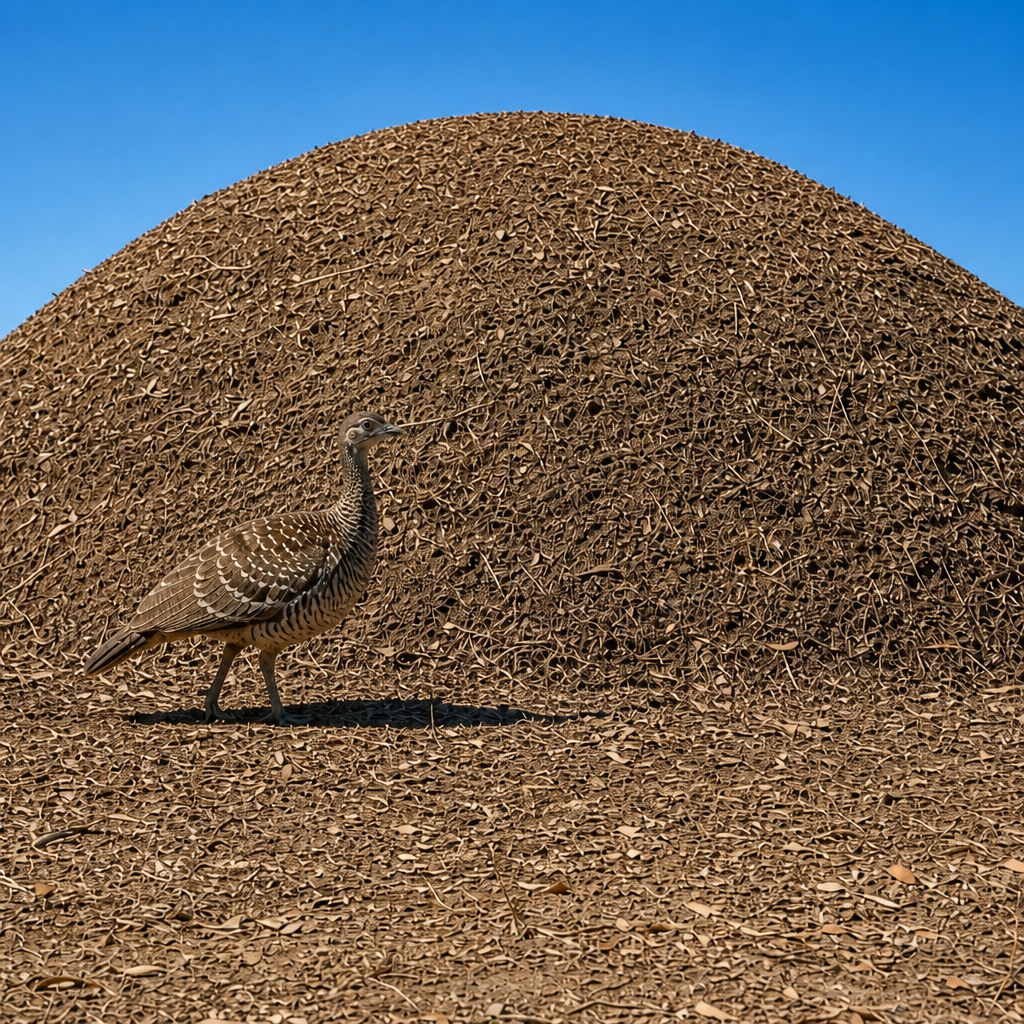
John: Welcome, everyone, to a fascinating dive into the natural world. Today, Nigel and I are going to talk about something truly extraordinary, a creature that honestly just makes you scratch your head and wonder at the sheer brilliance embedded within nature. We’re heading down under, to Australia, to discuss a bird that’s a marvel of instinct and, frankly, what looks like incredible engineering.
Nigel: Absolutely, John. We’re talking about the Australian Incubator Bird, or as it’s more commonly known, the Malleefowl. And when we say ‘incubator bird,’ we mean it literally. This isn’t just a bird that sits on its eggs; this is a bird that builds a living, breathing, self-regulating incubator, a structure so complex it almost defies belief for an animal.
John: It’s wild, isn’t it? When you first hear about it, you picture a nest, maybe a bit bigger than usual. But no, we’re not talking about a nest. We’re talking about a mound. A massive, meticulously constructed mound that can be up to 15 feet across and a 3 feet high. That’s larger than many garden sheds!
Nigel: Exactly. And it’s not just a pile of dirt. This mound is a sophisticated heat-regulating system. The male Malleefowl, which is the primary architect here, spends months constructing this thing. He starts by digging a large pit, then fills it with organic matter—leaves, twigs, bark—all carefully selected.
John: Months! Think about that commitment. This isn’t a quick weekend DIY project. This is a monumental effort, a long-term investment. And the purpose of that organic matter isn’t just filler, right? It’s key to the whole operation.
Nigel: Oh, absolutely. That organic material is the furnace. It decomposes, and as it breaks down, it generates heat. This is the bird’s primary heat source for incubating its eggs. But here’s where it gets truly mind-boggling: the bird doesn’t just let it heat up to whatever temperature. It regulates it with an almost unbelievable precision.
John: Right, so it’s not enough to just have heat. The developing embryos need a specific, stable temperature. We’re talking about 91 to 92 degrees Fahrenheit, consistently, for months on end. If it’s too hot, they cook; too cold, they don’t develop. It’s a tiny window, and this bird, without a thermometer, maintains it.
Nigel: It’s like an expert engineer designing a climate control system. After the organic material is in place, the male covers it with a thick layer of sand, sometimes up to a meter deep. This sand acts as insulation, protecting the delicate eggs from external temperature fluctuations and also helping to trap the heat generated by the decomposition.
John: Okay, so we have the furnace layer and the insulation layer. Now, the female comes along and lays her eggs, but not all at once. She’ll lay them intermittently over several months, sometimes up to 35 eggs in a season, each one buried individually within the mound.
Nigel: And the male’s job isn’t done. Oh no, it’s just beginning. He becomes the ultimate thermostat. Every day, sometimes multiple times a day, he’ll visit the mound, meticulously checking the temperature. He’ll dig down into the central egg chamber, often using his incredibly sensitive beak and tongue as a thermometer.
John: A biological thermometer! Think about the sophistication required there. To be able to discern a one-degree difference, consistently, with nothing but biological sensory input. It’s not just feeling hot or cold; it’s sensing a precise degree range and adjusting. How does a creature ‘know’ what 91 degrees Fahrenheit feels like, and that it needs to be maintained?
Nigel: That’s the million-dollar question, isn’t it? It implies an inherent, pre-programmed knowledge, an intricate set of instructions. And then, based on that precise sensory input, the male takes action. If the mound is too hot, maybe due to strong sun or vigorous decomposition, he’ll dig vents, remove some sand to allow heat to escape, or even add more sand to further insulate it from the sun’s rays.
John: And if it’s too cold? Say the decomposition is slowing down, or it’s been a cold spell. What does he do then?
Nigel: If it’s too cold, he’s got another set of behaviors. He might open up the mound, exposing the inner organic layers to the sun to kickstart decomposition again, or he might add more fresh organic material to fuel the furnace. He’s constantly calibrating, constantly adjusting, ensuring that sweet spot of 91 to 92 degrees Fahrenheit is maintained.
John: It’s like he has a full set of environmental engineering tools at his disposal. He’s managing a biological reaction, solar radiation, insulation, and ventilation, all to a precise set point. And it’s not learned behavior in the traditional sense; this is deeply ingrained, instinctual behavior passed down through generations. You don’t see Malleefowl going to engineering school.
Nigel: Exactly. It’s a complete, integrated system. The bird’s physiology – its sensitive beak, its strong legs for digging – perfectly complements its behavioral strategy. And the mound itself is a feat of material science and thermal dynamics. It’s not just random. It works.
John: The consistency is what floors me. For months, for every single egg laid in that mound, the temperature has to be just right. Imagine the energy expenditure, the sheer dedication of this male Malleefowl. It’s his life’s work for that breeding season.
Nigel: It truly is. And this dedication leads to an astonishing outcome for the chicks. Because they’re incubated so perfectly, they emerge from the mound in a state of remarkable independence. They aren’t helpless, featherless hatchlings like many other bird species.
John: That’s another layer of the ‘wow’ factor, isn’t it? These Malleefowl chicks are essentially pre-programmed for survival. They hatch fully feathered, with their eyes open, and within hours, they can run, and sometimes even fly. No parental care needed. They kick their way out of the mound, which can take days of digging, and then they’re off.
Nigel: Think about the level of coordination required for that. The incubation system has to be perfect, leading to a chick that is already fully developed and ready to face the world alone. It’s not just the mound that’s intelligently structured; it’s the entire life cycle, from egg to independent bird, that seems to have every contingency planned for.
John: It really highlights a profound sense of foresight, doesn’t it? As if the outcome was considered at the very beginning of the design process. How does an intricate system for precise temperature control, coupled with a completely self-sufficient chick, just… come about? It screams of purpose.
Nigel: It does. And let’s not forget the sheer adaptability within this system. The male Malleefowl isn’t just following a rigid script; he’s responding to variable conditions. Rain, drought, intense sun, cooler periods – he adapts his strategies to maintain that consistent temperature. It’s dynamic regulation.
John: So, the complexity isn’t just in the mound, or the beak, or the chick. It’s in the dynamic interaction of all these elements, guided by an intrinsic set of instructions that enable the bird to navigate an unpredictable environment with remarkable success. It’s almost like a tiny, living supercomputer processing environmental data and executing solutions.
Nigel: And the raw materials are just what’s available in the Mallee scrub: sand, leaves, twigs. Yet, these simple components are assembled into a sophisticated biological machine. It makes you wonder about the source of such innovative problem-solving and exquisite attention to detail.
John: It pushes us to consider what kind of intelligence could be behind such intricate, purposeful systems. It’s not just a collection of random features; it’s an integrated, fully functional, self-correcting system with a clear objective: successful propagation of the species.
Nigel: It feels like observing a highly specialized piece of equipment, designed for a very specific task, with all the necessary components working in perfect synergy. Each part, from the sensitive beak to the massive mound, plays a critical role, and if one part were missing or flawed, the whole system would likely collapse.
John: Absolutely. It’s what we call irreducible complexity, isn’t it? You can’t really take away any major component of this Malleefowl incubation system without rendering the whole thing non-functional. The precise temperature, the organic matter, the male’s monitoring, the insulating sand, the independent chick – they’re all vital.
Nigel: It truly challenges conventional thinking about how such perfection could arise. It points to a blueprint, a grand design, rather than a piecemeal accumulation. The Malleefowl is a living testament to an incredible design intelligence at work in the natural world.
John: I mean, if a human engineer built a system like this, we’d be hailing them as a genius. We’d study their blueprints, marvel at their foresight. Yet, here we have this bird, acting on instinct, replicating this complex process generation after generation, without any formal training.
Nigel: It’s beyond fascinating. It encourages us to look deeper, to appreciate the sheer ingenuity that underpins so much of what we see in the living world. The Malleefowl isn’t just a bird; it’s a living, breathing, thermal-regulating masterpiece.
John: And a powerful reminder that there’s a level of sophistication and intentionality in nature that often goes unappreciated. When you consider the Malleefowl, it’s hard not to be filled with a sense of wonder at the incredible intelligence that must lie behind such a creation.
Nigel: Definitely. It’s a privilege to explore these kinds of examples. The Malleefowl certainly gives us a lot to think about, a lot to admire. Its story really does speak volumes about the astonishing design we can observe all around us.
John: Absolutely. And with that, we’ll wrap up this incredible journey into the world of the Malleefowl. What an amazing creature. Thank you, Nigel, for sharing your insights, and thank you all for joining us on this exploration of intelligent design in the wild.
Nigel: My pleasure, John. It’s always a joy to discuss these wonders. Until next time, keep exploring and keep wondering!













![Where No One Stands Alone [Live]](http://img.youtube.com/vi/ktjRlDYE3Gw/0.jpg "Where No One Stands Alone [Live]")


Thanks! Share it with your friends!
Tweet
Share
Pin It
LinkedIn
Google+
Reddit
Tumblr