Speaker 1 (John):
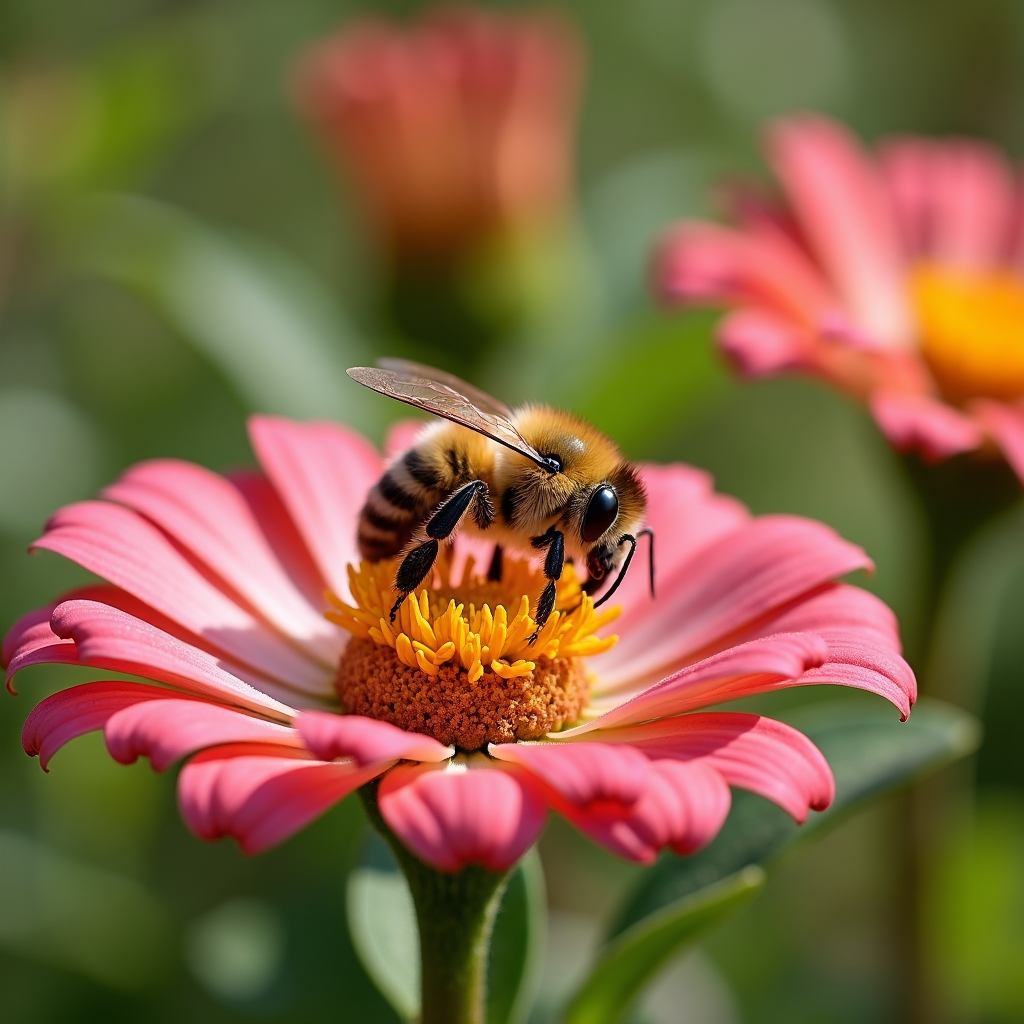
Welcome everyone to a truly fascinating episode today. We’re buzzing with excitement to talk about one of nature’s most incredible architects—the humble honeybee—and specifically its mesmerizing dance. You know, when you really start to look closely, it’s just astounding what these creatures can do.
Speaker 2 (Janet):
Absolutely, John. And “humble” is almost an understatement for something so complex, wouldn’t you say? I mean, we’re talking about a creature that communicates directions, distance, and even the quality of a food source—all without speaking a single word. It’s truly a marvel.
Speaker 1:
It is, isn’t it? For centuries, people just observed bees. But it wasn’t until Carl von Frisch’s groundbreaking work in the mid-20th century that we truly began to understand the language of their dance. It’s not just random buzzing around. It’s a sophisticated method of information transfer.
Speaker 2:
And that’s where the intelligent design aspect really comes into focus for me. Think about it—a system so precise, so universally understood within the colony, that it allows for collective foraging efficiency. How could something so perfectly calibrated arise through purely undirected random processes? It seems to scream purposeful engineering.
Speaker 1:
That’s a great point. Let’s dive into the waggle dance for a moment, because it’s the most famous—and perhaps the most complex. When a scout bee finds a really good source of nectar or pollen, it returns to the hive—often to a vertical comb in the dark—and performs this intricate dance.
Speaker 2:
In the dark, mind you—that’s another layer of complexity. They’re not using visual cues from the followers. It’s all about vibration and tactile information, right?
Speaker 1:
Exactly. The core of the waggle dance is a figure-eight pattern. The bee runs in a straight line, waggling its abdomen vigorously, then makes a turn, circles back, runs the straight line again, and then turns the other way. It repeats this pattern, often for several minutes.
Speaker 2:
So how do the other bees read this? Because it’s not just a cute performance—it’s conveying critical data.
Speaker 1:
That’s the genius of it. The direction of the straight waggle run indicates the direction of the food source relative to the sun. If the bee waggles straight up the comb, it means fly directly toward the sun. If it waggles at, say, 30 degrees to the left of vertical, it means fly 30 degrees to the left of the sun’s position. It’s like a living compass.
Speaker 2:
And this is where it really gets mind-boggling from an intelligent design perspective. Not only is there a coded language, but it’s a language that incorporates celestial navigation. The bee has to process the sun’s azimuth, translate that into a vertical angle on a dark comb, and then the followers have to decode it and re-translate it into a flight path using the sun as their reference.
That’s not just simple instinct—that’s computation.
Speaker 1:
And it gets even better. The duration of that waggle run—how long the bee wiggles and vibrates—communicates the distance to the food source. A longer waggle run means a farther distance. So a short waggle might mean 50 meters, while a much longer one could mean several kilometers. It’s remarkably precise.
Speaker 2:
So it’s not just “go this way,” it’s “go this way for this long.” It’s a complete set of instructions—direction and distance.
And they’re also getting clues about the quality of the source, right? The vigor of the dance, the buzzing sounds, even little samples of nectar or pollen they might share. It’s a multi-sensory information packet.
Speaker 1:
Exactly. The intensity of the dance, the number of repetitions—all signal the richness of the find. A truly abundant flower patch will elicit a more enthusiastic and prolonged dance, recruiting more bees. It’s an economic system, really—optimizing the colony’s foraging efforts.
Speaker 2:
And the fact that the entire system—from encoding to decoding—is present and functional in every bee—that’s what makes it so difficult to explain by gradual step-by-step evolution. You need the whole system, the “software” and the “hardware,” to be in place for it to work. An incomplete dance—or a bee that can’t decode it—wouldn’t confer any survival advantage. It’s irreducibly complex.
Speaker 1:
You know, before we even get to the waggle dance, there’s the round dance for closer food sources—usually within 50 meters or so. For those, the bee just dances in a circle, alternating directions. It means “food is close—go find it.”
Speaker 2:
Right, which is simpler but still effective. It’s like a local alert versus a navigational instruction.
And again, the colony understands the nuance. It’s not just one dance—it’s a graded response depending on the situation. That flexibility also speaks to incredible design.
Speaker 1:
Think about the tiny brain of a bee—just about a cubic millimeter in size, containing roughly a million neurons. And yet it’s capable of complex spatial memory, calculating angles relative to the sun, measuring distance, and then encoding that information into a physical performance that other bees can understand and act upon. It’s truly astonishing.
Speaker 2:
Astonishing is the right word. It challenges the notion that such sophisticated communication requires a large brain or advanced cognitive abilities that we typically associate with higher animals. Here, in a tiny insect, we see a perfectly optimized, elegant solution to resource allocation.
It points to an intelligence far beyond the bee itself—an intelligence that designed the bee.
Speaker 1:
It also highlights the consistency of design throughout nature. We see these solutions to complex problems appearing in various forms across different species—but always perfectly suited to their environment and needs. The bee’s dance is just one shining example.
Speaker 2:
And what about the audience for this dance—the follower bees? They’re not just passively watching. They press close to the dancer, antennae vibrating, sensing the air currents, the chemicals, the sounds, the actual physical movements. They’re actively engaged in receiving this data.
Speaker 1:
They’re absolutely essential for the system to work. It’s a two-way street of communication—even if one side is performing and the other is receiving. It’s like a perfectly choreographed ballet where every participant knows their role instinctively.
Speaker 2:
And it underscores the idea of a community within the hive. Each bee has a role, but their collective intelligence—their ability to work together through these intricate communication methods—is what allows the colony to thrive. It’s a testament to cooperative design.
Speaker 1:
When you consider the evolution of flight, navigation, and then this highly specialized communication system—all co-evolving simultaneously and perfectly synchronized—it just adds another layer of wonder. How do these complex traits arise together exactly when and where they’re needed, without any foresight or planning?
Speaker 2:
That’s precisely the challenge for a purely materialistic explanation. The argument for intelligent design isn’t just “it’s too complex to have evolved.” It’s that it exhibits hallmarks of design that we recognize from human engineering—but on a scale and with a sophistication that vastly exceeds our own. The bees dance has a clear purpose, a clear encoding scheme and a clear decoding mechanism.
Speaker 1:
It’s a complete communication system functionaly integrated.
Think about trying to invent a language without any pre-existing framework—and then getting an entire population to instantly understand and use it perfectly. It just doesn’t happen. There has to be an underlying blueprint—a foundational structure.
Speaker 2:
Right—and the blueprint isn’t just for the dance, but for the bee’s entire life cycle: its social structure, its ability to produce honey and wax, to build those perfect hexagonal cells. Everything points to an incredible level of pre-programming—an innate knowledge.
Speaker 1:
Even the bee’s ability to sense polarized light—which helps it navigate using the sun even on cloudy days—is part of this larger design. It’s not just the dance itself, but all the sensory inputs and processing capabilities that make the dance effective. It’s an ecosystem of features.
Speaker 2:
An ecosystem of features that are interdependent. Remove one piece, and the whole system crumbles. If the sun went away, the dance would be useless. If the bees couldn’t interpret the angle, it would be useless. If the waggle duration didn’t correlate to distance—also useless. It’s a finely tuned machine or rather organism.
Speaker 1:
And it makes you think about how much we take for granted in the natural world. These tiny insects, going about their daily lives, are demonstrating a level of sophisticated engineering that we’re still striving to fully understand and replicate in our own technology.
Speaker 2:
It certainly gives me a deeper appreciation for creation. When you see something so perfectly adapted, so elegantly designed for its purpose, it just makes you think there has to be a mind behind it all. The bee’s dance isn’t just a behavior—it’s a message. And I believe it’s a message from the designer.
Speaker 1:
It really does humble you, doesn’t it? To see such intricate beauty and functionality in something so small. The honeybee, with its incredible dance, stands as a testament to the wonders of the natural world—and for many, a clear indicator of intelligent design.
Speaker 2:
Absolutely. It’s a tiny dancer with a colossal message—and it’s a message we’d all do well to listen to and appreciate. What an amazing creature.
Speaker 1:
Indeed. Well, that wraps up our discussion on the marvelous honeybee and its dance. Thank you, Janet, for shedding such insightful light on this incredible topic.
Speaker 2:
My pleasure, John. It’s always a joy to explore these wonders with you.
And thank you all for joining us on this fascinating journey into the world of the honeybee.
Speaker 1
We hope you’ll look at these incredible creatures with new eyes—and perhaps a renewed sense of wonder about the intricate design woven into the fabric of life. Until next time, keep exploring.






Thanks! Share it with your friends!
Tweet
Share
Pin It
LinkedIn
Google+
Reddit
Tumblr