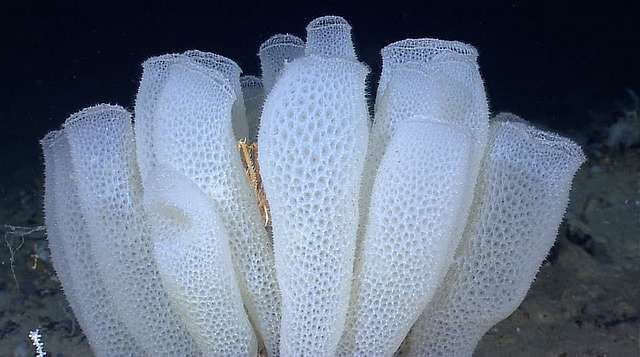
John: Nigel, have you ever looked at something in the natural world and just thought, ‘How in the world did that come to be?’ I mean, truly just stopped you in your tracks with its sheer ingenuity?
Nigel: Absolutely, John. It happens more often than I’d care to admit. The complexity, the elegance of certain structures… it’s mind-boggling. What’s on your mind today, specifically?
John: Well, I’ve been completely captivated by the Euplectella aspergillum sponge, often called ‘Venus’ Flower Basket.’ It’s a deep-sea creature, looks almost like something out of a futuristic architectural exhibit, but it’s entirely organic. And when you start looking into its structure, Nigel, it’s just… I don’t even have words.
Nigel: Ah, the Venus’ Flower Basket! I know the one. Those incredible glass skeletons, right? They’re quite striking even in pictures. But you’re saying there’s more to it than just aesthetic beauty?
John: Oh, so much more! It’s not just beautiful; it’s a structural masterpiece. Imagine a living, breathing skyscraper, but made of glass, at the bottom of the ocean, under immense pressure. Its skeleton is made of silica—essentially glass—but it’s built in such an unbelievably precise and robust way.
Nigel: Glass in the deep sea? That sounds incredibly fragile. How does it not just shatter under the enormous hydrostatic pressure down there? We’re talking about pressures that would crush a submarine, let alone a delicate glass structure.
John: That’s exactly it, Nigel! That’s where the brilliance of its design comes in. It’s not just a solid chunk of glass. It’s an intricate, lattice-like basket, formed from millions of tiny, interlocking silica spicules. These spicules are arranged in a perfectly diagonal, square grid pattern, and they create a structure that’s not only incredibly strong but also remarkably lightweight and flexible.
Nigel: So, it’s the geometry, then? Not just the material itself. It’s like how engineers design bridges or buildings, distributing stress points through specific patterns. You’re saying this sponge does something similar?
John: Exactly! It’s a perfect example of advanced bio-engineering. The diagonal bracing in its lattice provides incredible shear resistance. It’s the same principle we use in our most stable and robust structures. But this sponge does it with microscopic glass fibers. And here’s another layer: these spicules aren’t uniform. They’re composed of multiple concentric layers of silica and organic material, almost like plywood, but spherical or cylindrical. This makes them incredibly tough and resistant to fracturing.
Nigel: Fascinating. So, it’s got layered construction for resilience and a grid pattern for strength. It sounds like something an elite team of materials scientists and structural engineers would devise after years of research and development, not something found naturally growing on the seabed.
John: Precisely my point! And it gets even wilder. Beyond the structural integrity, these silica spicules also function as incredibly efficient fiber optic cables. We’re talking about natural fiber optics that are, in some respects, superior to the synthetic ones we produce in labs.
Nigel: Wait, fiber optics? You mean it transmits light? In the deep sea, where light is almost non-existent? What would be the purpose of that?
John: That’s a fantastic question, and scientists are still exploring all the potential reasons. But think about it: deep-sea organisms often use bioluminescence for communication, attracting mates, or luring prey. A structure capable of efficiently gathering and transmitting what little light is available, or perhaps amplifying its own bioluminescence, would be an incredible advantage. The efficiency of these natural fibers is stunning – they can transmit light with very little loss, which is exactly what we strive for in our man-made fiber optics.
Nigel: So, not only is it a structural marvel, but it’s also a sophisticated optical instrument. It’s like someone designed it with multiple functions in mind, integrating them seamlessly into a single, cohesive unit. That kind of multi-functionality in design is incredibly difficult to achieve, even with all our modern technology.
John: Exactly. It speaks to an underlying intelligence in its blueprint. Consider the overall form: it’s a cylindrical basket, often flaring slightly at the top. This shape itself is optimal for filtering water, allowing the sponge to extract nutrients efficiently from the passing currents. Every aspect, from the microscopic layered spicules to the macroscopic basket shape, seems to be optimally designed for its environment and function.
Nigel: It’s almost as if every problem the deep sea could throw at an immobile organism – immense pressure, scarce light, nutrient filtering – has been anticipated and solved within its very structure. What kind of attachment does it have to the seabed, given its delicate appearance?
John: Another brilliant feature! It’s anchored by a root tuft of long, hair-like spicules. These aren’t just any spicules; they’re incredibly tough and flexible, like a bundle of ultra-strong optical fibers. They extend into the sediment, providing a secure footing without being rigid. This flexibility allows it to sway slightly with the currents, further distributing stress rather than snapping.
Nigel: So, it’s got a well-engineered base, a robust yet flexible body, and a top designed for efficient feeding and potentially communication. It’s the complete package. It makes you wonder about the principles behind such intricate blueprints. We spend millions researching optimal designs for our structures, and here’s a creature that’s been doing it perfectly for… well, for as long as it’s been around.
John: That’s the striking thing, isn’t it? The sheer foresight. It’s not just a random collection of parts; it’s an integrated system where every component serves multiple, critical roles, all working in harmony. The way the tiny spicules are woven into a lattice that forms a cylindrical structure, which then acts as a filter and a light guide, and is anchored by a root system that flexes with the environment – it’s a masterclass in holistic design.
Nigel: It’s almost like a blueprint was followed, meticulously detailed, ensuring every aspect of its survival and function was accounted for. From the micro-level of the layered silica in each spicule to the macro-level of the basket’s overall form. You mentioned biomimicry earlier; are engineers actually studying this sponge?
John: Absolutely, Nigel. It’s a goldmine for biomimicry. Researchers are looking at its structural design for stronger, lighter buildings, especially in earthquake-prone areas. Imagine skyscrapers designed with the shear-resistant properties of the Venus’ Flower Basket. And the fiber optics? Scientists are studying how it forms its silica fibers at low temperatures and pressures, which could revolutionize our manufacturing processes for optical cables, making them more environmentally friendly and cost-effective.
Nigel: So, this humble deep-sea sponge holds secrets that could redefine architecture and telecommunications. That’s a pretty humbling thought. It truly underscores the idea that nature holds incredibly sophisticated solutions to complex engineering challenges.
John: It does. And there’s another fascinating aspect to the Euplectella that truly highlights this integrated design. These sponges often host a pair of shrimp, a male and a female, who enter the sponge as larvae and grow too large to leave. They spend their entire adult lives within the sponge, feeding on detritus filtered by the sponge.
Nigel: A permanent guest in a glass house! That’s quite a symbiotic relationship. How does that tie into the design aspect?
John: Well, it adds another layer of purpose, doesn’t it? The sponge provides shelter and food for the shrimp, and it’s thought that the shrimp, in turn, help keep the sponge clean, preventing it from being clogged by sediment. It’s a perfectly balanced, reciprocal arrangement. The architecture of the sponge is even perfectly suited to create this sort of secure, self-sustaining habitat for these creatures. It’s not just a structure for itself; it’s a sanctuary.
Nigel: So, the design isn’t just about its own survival, but it extends to facilitating life for other organisms in a beneficial partnership. That suggests a level of coordinated complexity that goes beyond mere accidental forms. It’s almost as if the sponge was intended to be a complete ecosystem in miniature.
John: Exactly, Nigel! It’s this intricate web of interconnected systems. The strength, the flexibility, the optical properties, the filtering efficiency, and even its role as a habitat – all are perfectly orchestrated. It’s not just ‘good design’; it’s optimal, multi-functional design from every conceivable angle.
Nigel: It really makes you appreciate the incredible sophistication present in the natural world. We humans are always striving for efficiency and elegance in our creations, and here’s a deep-sea sponge that’s been demonstrating it with unparalleled mastery for… well, for as long as it has existed, without any trial and error as we understand it in engineering.
John: Indeed. It’s a testament to incredible forethought. Every component, from the foundational spicules to the overall structural configuration, serves a precise, integrated function. The geometry of its lattice, the layered materials, the way it anchors itself, its capacity to conduct light – it all points to a coherent, purposeful plan. It doesn’t look like something that just ‘happened’ piecemeal.
Nigel: It implies a kind of engineering blueprint that’s far beyond anything we could conjure. The deep sea is an incredibly challenging environment, and this creature doesn’t just survive; it thrives with such elegant solutions. The amount of pressure it withstands, the minimal light it captures, the efficient filtering of scarce nutrients – it’s all addressed with such ingenious design principles.
John: And the fact that engineers are actively trying to replicate its methods in our own structures speaks volumes, doesn’t it? They’re not just admiring its beauty; they’re trying to decode its underlying code of construction to solve our toughest engineering problems. It’s the ultimate form of flattery, I suppose.
Nigel: It really is. And it’s a constant reminder that sometimes the most profound lessons in engineering, in materials science, and in efficient design aren’t found in a textbook or a lab, but in the most unexpected corners of the natural world, like a delicate-looking glass sponge at the bottom of the ocean.
John: It makes you think about the source of such brilliant innovation, doesn’t it? This isn’t just functionality; it’s optimized, integrated, and multi-functional perfection. It’s a testament to design on a level we can barely comprehend, let alone create ourselves.
Nigel: Absolutely, John. The Venus’ Flower Basket is more than just a beautiful creature; it’s a living textbook of sophisticated design, urging us to look deeper and consider the incredible intentionality behind the forms we see around us. It’s a genuine marvel.
John: It certainly is. And I think that’s a perfect note to wrap up on for today. What an incredible creature to ponder. Thanks for diving into this with me, Nigel.
Nigel: My pleasure, John. Always a fascinating discussion when we’re exploring the wonders of the natural world. And the Euplectella sponge definitely qualifies as a top-tier wonder. Until next time, everyone.














![Point of Grace – Jesus Will Still Be There [with lyrics]](http://img.youtube.com/vi/XFqjq_LsZVg/0.jpg "Point of Grace – Jesus Will Still Be There [with lyrics]")

Thanks! Share it with your friends!
Tweet
Share
Pin It
LinkedIn
Google+
Reddit
Tumblr