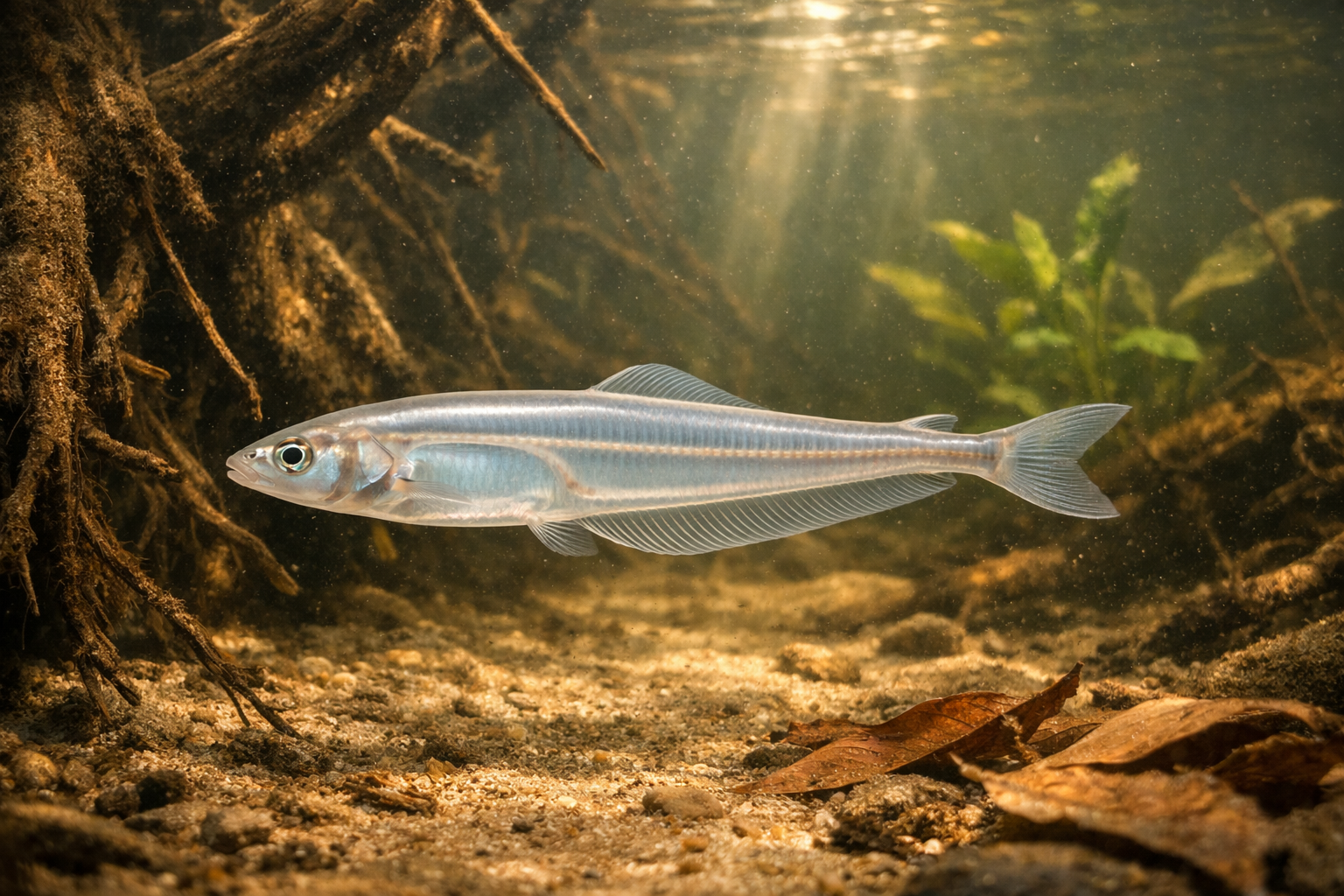
John: Alright, Nigel, have you ever imagined a creature that navigates its world not with its eyes, but with electricity? I mean, like a living sonar system, a biological radar?
Nigel: Electricity? You’re talking about an electric eel or something that gives a shock, right? But navigation? That sounds like something out of a science fiction novel, John. What exactly are we diving into today?
John: Even more incredible, my friend. We’re talking about the glass knife fish. It’s this utterly fascinating freshwater fish, often found in the murky, fast-flowing rivers of South America. And it truly is a master of its domain, thanks to an electrical system that’s nothing short of mind-boggling.
Nigel: The glass knife fish? I think I’ve seen pictures. They’re kind of translucent, almost ghostly, right? And they don’t have very prominent eyes, now that you mention it. Is that related to this electrical navigation?
John: Spot on, Nigel. They’re often described as looking like a floating leaf or a transparent blade – hence the ‘knife fish’ part. And yes, their vision isn’t their primary sense, especially in the low-light, often turbid waters they inhabit. That’s where their extraordinary electrical sense comes into play. It’s their entire perception of the world.
Nigel: Okay, so how does this actually work? Is it generating a strong shock, like those eels you mentioned? Because I can’t imagine that being very practical for ‘navigation.’
John: Excellent distinction! No, it’s not about shocking prey or predators. The glass knife fish generates a very weak, continuous electrical field around its body. Think of it like a bubble of electricity surrounding the fish. This field is created by a specialized organ in its tail, essentially modified muscle cells that produce electrical discharges instead of contracting.
Nigel: A weak, continuous field. So, it’s putting out a signal. But how does that help it ‘see’ in the dark?
John: This is where it gets truly ingenious. Its entire body, especially its skin, is covered with thousands of specialized receptors. These aren’t just any skin cells; they’re electrosensory receptors designed to detect minute distortions in the electrical field the fish itself is generating. When an object, like a rock, a plant, or even another fish, enters that electrical bubble, it subtly changes the shape or strength of the field.
Nigel: So, it’s like a living, breathing radar system. The fish sends out an electrical pulse, and then its body acts like an antenna array, detecting the ‘echoes’ or changes in that field?
John: Precisely! It’s an active electrosensory system. The fish’s brain processes these tiny distortions in the field, creating a remarkably detailed, real-time three-dimensional map of its surroundings. It can tell the size, shape, distance, and even the material properties of objects in its immediate vicinity, all without seeing them visually.
Nigel: That’s just incredible. Imagine being able to ‘feel’ your environment electrically. It’s like having an extra sense. And in those murky waters you mentioned, where light just doesn’t penetrate, it’s an absolute necessity, I suppose.
John: Exactly. This system allows it to navigate perfectly in total darkness, find food, avoid obstacles, and even communicate with other glass knife fish. Think about the engineering marvel here, Nigel. You need a specialized organ to generate the field, an array of precisely tuned receptors across the body to detect changes, and a sophisticated brain to interpret all that complex data instantly.
Nigel: It’s not just the presence of these components, is it? It’s the fact that they all have to be perfectly synchronized and integrated for the system to work at all. What would an electric organ be without the receptors to read its output? Or receptors without a field to distort?
John: That’s the crux of it, isn’t it? It’s what we call irreducible complexity. You can’t take away one part of that system and expect it to function. It’s like a finely tuned machine where every single gear, lever, and circuit board is essential. If you remove just one, the whole operation grinds to a halt. The electric organ needs the receptors, the receptors need the brain to interpret, and the brain needs the input from the receptors.
Nigel: So, it suggests a complete, fully functional blueprint from the very beginning. Not something that could be built up piecemeal over time. What about the precision involved? To generate a weak field, as you said, and then detect tiny changes without being overwhelmed by its own signal?
John: That’s a fantastic point. The fish has to somehow filter out its own self-generated field to perceive the external distortions. It’s like trying to listen for a whisper in a room while you’re shouting. Their brains have incredible processing capabilities to manage that, differentiating between the ‘outgoing’ and ‘incoming’ signals.
Nigel: And I’ve heard that some electric fish, not just the knife fish, can even adjust their electrical pulse frequency. Is that true for these guys too?
John: Absolutely! It’s another layer of sophistication. Imagine a group of glass knife fish in close proximity, all generating their own electrical fields. If they all used the same frequency, it would be pure chaos, like a radio jammed with multiple stations. But these fish can actually shift their frequencies to avoid interference with their neighbors. It’s called ‘jamming avoidance response,’ and it’s a testament to the system’s incredible adaptability and fine-tuning.
Nigel: So, they’re not just navigating; they’re also communicating and coordinating with each other electrically. That’s a level of biological engineering that’s truly staggering. It’s almost as if the designer thought of everything, anticipating the challenges of their environment and providing a perfect solution.
John: That’s precisely the word, Nigel: ‘design.’ When you look at the glass knife fish’s electrosensory system, it’s difficult to see it as anything other than a product of masterful engineering. Every component, from the electric organ in the tail to the receptors on the skin and the interpretive centers in the brain, works in perfect harmony. It’s a complete, integrated system that functions flawlessly right out of the box.
Nigel: It implies a foresight, doesn’t it? A plan that accounted for the murky waters, the need for communication, the detection of food, and even the problem of electrical interference among individuals. It’s not just a collection of useful parts; it’s an intelligent solution to a specific set of problems.
John: Exactly. Think about human technology. We strive to create systems that are robust, efficient, and capable of adapting to various conditions. The glass knife fish’s system checks all those boxes and more. It’s a testament to incredible foresight and intricate planning. The sheer elegance of it. It processes complex information, generates precise signals, and differentiates between subtle environmental changes. All packaged within a relatively small creature.
Nigel: And it does it all with organic materials, in real-time, without consuming vast amounts of energy like our equivalent technological solutions would. A submarine’s sonar system is enormous and power-hungry, yet this fish does something similar with its own biological machinery.
John: That’s where the awe truly sets in. The efficiency is astounding. It’s not just a system that works; it’s an optimally designed system. It begs the question: how could such a complex, interdependent, and finely tuned system, where all parts must be present and perfectly functioning simultaneously, come into existence?
Nigel: It really highlights a profound depth of organization. It’s not just a sum of its parts; it’s a synergistic whole, where the parts are meaningless without the others. It’s a complete, functional package, ready for its demanding environment.
John: And it’s a beautiful example of an intricate designed engineering solution to seemingly impossible problems. The glass knife fish isn’t just surviving; it’s thriving in an environment that would be completely hostile to most other creatures, all thanks to this remarkable electrical sense.
Nigel: So, for our listeners, what’s the ultimate takeaway from the amazing glass knife fish, John?
John: I think it’s an invitation to simply marvel. To look at the natural world and see the incredible depth of ingenuity and purpose woven into every living thing, right down to this little fish with its electrical superpower. It reminds us that there’s an extraordinary level of sophisticated planning behind the amazing creatures we share this planet with.
Nigel: Truly a masterpiece in the aquatic world. An electric marvel. Thanks for shedding light on such a brilliant creature, John.
John: My pleasure, Nigel. Always a joy to explore these wonders with you.

















![Bill & Gloria Gaither – Only a Look [Live] ft. Lillie Knauls](http://img.youtube.com/vi/S26pab94jao/0.jpg "Bill & Gloria Gaither – Only a Look [Live] ft. Lillie Knauls")

Thanks! Share it with your friends!
Tweet
Share
Pin It
LinkedIn
Google+
Reddit
Tumblr