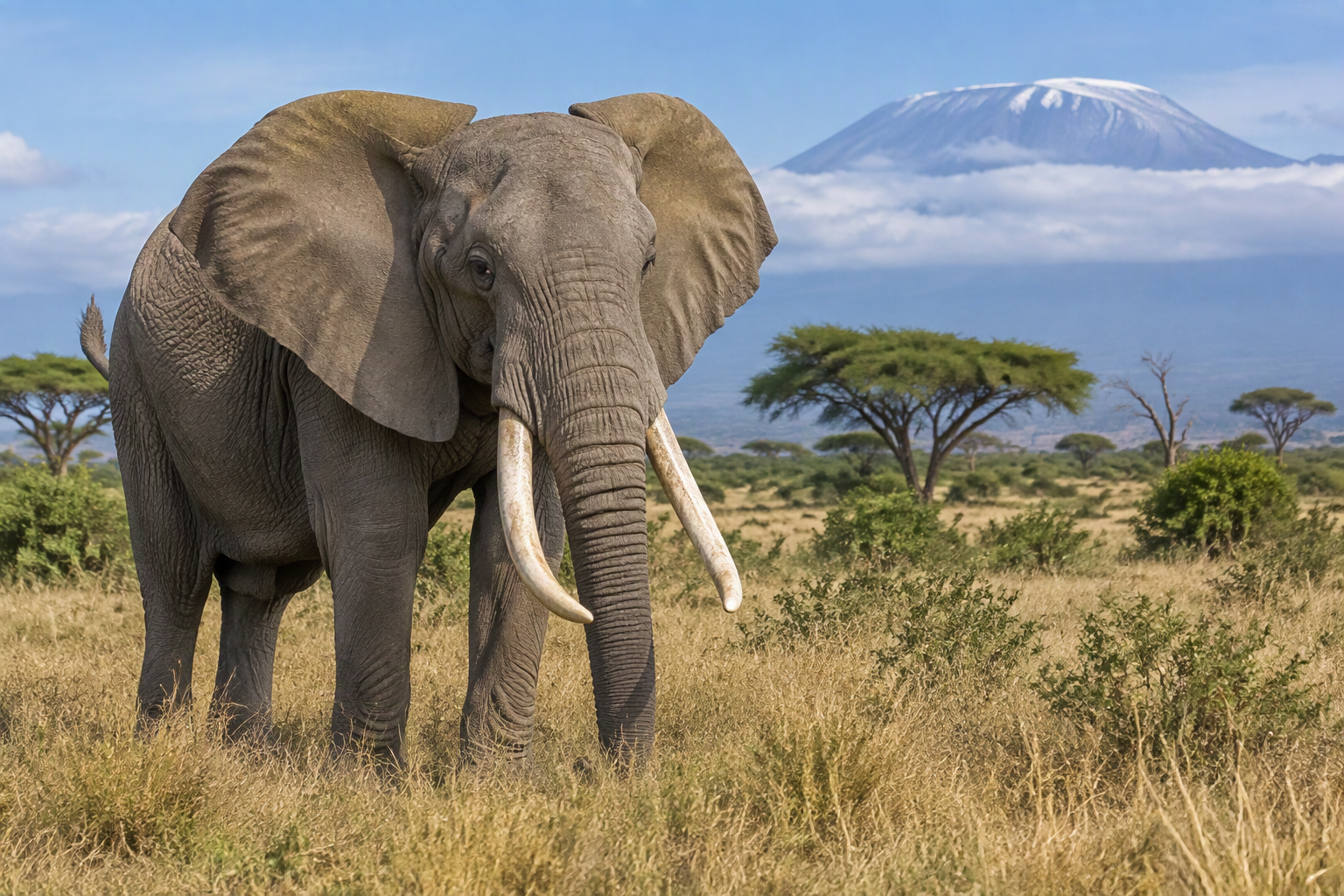
James: When we think of elephants, the first things that probably come to mind are their enormous size, their long trunks, and those impressive tusks. They are among the largest land animals on Earth, and there’s something almost unforgettable about seeing one walking across the African savanna or through the forests of Asia.
Christopher: But there’s much more to an elephant than its size. In fact, when we take a closer look, we discover an animal with some truly extraordinary features. Its trunk is an incredibly versatile instrument, its enormous ears help regulate body temperature, and its feet can detect subtle vibrations. Elephants also have a remarkable system of communication and a social life that is surprisingly complex.
James: Let’s start with what may be the elephant’s most remarkable feature: its trunk. The trunk is not simply a long nose. It is actually a combination of the nose and upper lip, and it contains tens of thousands of muscle bundles, along with nerves and blood vessels. There are no bones running through it, yet it can perform an astonishing variety of movements.
Christopher: An elephant uses its trunk for breathing, smelling, drinking, touching, lifting, and carrying objects. It can wrap the trunk around a branch and pull it down, or use the tip to pick up something as small as a piece of food. African elephants have two small finger-like projections at the tip of the trunk, while Asian elephants have one. These help the animal grasp objects with remarkable precision.
James: The trunk also serves as a drinking tool, although elephants don’t actually drink through it the way we drink through a straw. They draw water up into the trunk and then squirt it into their mouths. They can also spray water over their bodies, blow dust onto their skin, and gently touch another elephant as a form of greeting or reassurance. It is difficult to think of another animal that has such a versatile piece of equipment built into its body.
Christopher: Now let’s look at those enormous ears. An elephant’s ears are not just for hearing. They also play an important role in keeping the animal cool. Elephants have many blood vessels close to the surface of their ears, and as blood circulates through them, heat can escape into the surrounding air.
James: When an elephant flaps its ears, it increases the movement of air across those blood vessels and helps carry heat away. This is especially useful in the hot environments where many elephants live. African elephants generally have larger ears than Asian elephants, which is one reason their ears are often compared to the shape of the African continent.
Christopher: An elephant’s skin is another interesting feature. It can look thick, rough, and almost armor-like, but it is actually quite sensitive. The wrinkles and folds in the skin help hold moisture after the elephant has been in water or mud. That moisture evaporates slowly, helping to cool the animal.
James: Elephants also use mud and dust as a kind of natural protective coating. A coating of mud can help shield the skin from the sun and discourage biting insects. Their skin may look tough, but elephants are surprisingly careful about protecting it. Even a gentle touch from another elephant can be meaningful.
Christopher: Here’s something that may surprise you: elephants can communicate over long distances using sounds that are too low for most human ears to hear. These are called infrasound sounds, and they can travel considerable distances under the right conditions. Other elephants may detect these sounds and respond, even when the animals are far apart.
James: Elephants also communicate through ordinary trumpeting, rumbling, grunting, and other vocal sounds. They use body movements, ear positions, and touches as well. A rumble may help keep a family group in contact, while a trumpet can signal excitement, alarm, or distress. Their communication system is much richer than most people realize.
Christopher: And communication doesn’t stop with sound. Research suggests that elephants can also detect vibrations traveling through the ground. They may sense these vibrations through the sensitive tissues in their feet and through the bones of their legs. This could help them pick up signals from other elephants at a distance, although scientists are still learning exactly how this ability works.
James: The elephant’s feet are specially suited to supporting its enormous weight. Beneath the bones of each foot is a thick, springy pad of connective and fatty tissue. This pad helps spread the animal’s weight and cushions each step. Despite their size, elephants can walk surprisingly quietly, and that soft padding helps make it possible.
Christopher: Elephants also have remarkable brains and memories. They live in family groups, often led by an experienced older female known as the matriarch. Her knowledge can be extremely valuable, especially during difficult times. She may remember where water can be found during a drought, recognize familiar members of other groups, and guide the family through territory she has known for many years.
James: Elephants form strong social bonds, care for their young, and often help one another when a member of the group is in trouble. Young elephants remain close to their mothers and other family members for years. Older females help protect and guide the younger animals, and the group works together to raise its calves.
Christopher: Their memory is especially important in the wild, where knowing the location of seasonal water sources and feeding areas can mean the difference between survival and hardship. An elephant that has traveled through an area before may remember routes and resources that are useful many years later. This is one reason the experience of an older matriarch can be so important to the entire family.
James: Another remarkable feature is the way an elephant’s teeth are replaced. Unlike humans, who have just two sets of teeth during their lives, elephants have several sets of large grinding teeth. As one set wears down, another gradually moves forward from the back of the jaw to take its place. This process happens repeatedly during the elephant’s lifetime.
Christopher: Elephant tusks are also fascinating. They are actually enlarged incisor teeth, not horns. Tusks are used for digging, stripping bark from trees, moving objects, and sometimes for defense. Not every elephant has tusks, and the size and presence of tusks vary between species and individual animals.
James: Of course, an animal this large needs an enormous amount of food. Elephants spend much of their day eating grasses, leaves, bark, roots, fruit, and other vegetation. A large adult may consume well over a hundred pounds of food in a day, depending on its size and the food available. Their trunks allow them to reach high branches, pull up plants, and gather food from the ground.
Christopher: Elephants also play an important role in the environments where they live. As they move through forests and grasslands, they spread seeds in their dung, sometimes over considerable distances. They can open paths through dense vegetation, knock down branches, and dig for water during dry periods. These activities can create opportunities for other animals and help shape the landscape.
James: When we consider all these features together, the elephant becomes even more impressive. Its trunk combines the functions of a nose, hand, and tool. Its ears help control body temperature, its feet support tremendous weight while detecting subtle vibrations, and its communication system helps family groups stay connected over long distances.
Christopher: Its teeth are designed to be replaced as they wear down, its memory helps it navigate a changing environment, and its social structure allows experienced adults to guide and protect the young. Each feature serves a purpose, and many of them work together to help the elephant survive in its environment.
James: For those of us who see design in nature, the elephant offers a remarkable example. We are looking at an animal with an extraordinary collection of abilities, from the flexibility of its trunk to the sensitivity of its feet and the complexity of its social behavior. These are not isolated features. They form a coordinated system that allows one of the largest animals on Earth to live, feed, communicate, and care for its family.
Christopher: The elephant reminds us that nature is filled with examples worth examining more closely. Sometimes the most remarkable discoveries are found not by looking at something tiny under a microscope, but by taking a closer look at one of the largest creatures walking on our planet. And the more we learn about the elephant, the more there is to appreciate.



















Thanks! Share it with your friends!
Tweet
Share
Pin It
LinkedIn
Google+
Reddit
Tumblr