[John]
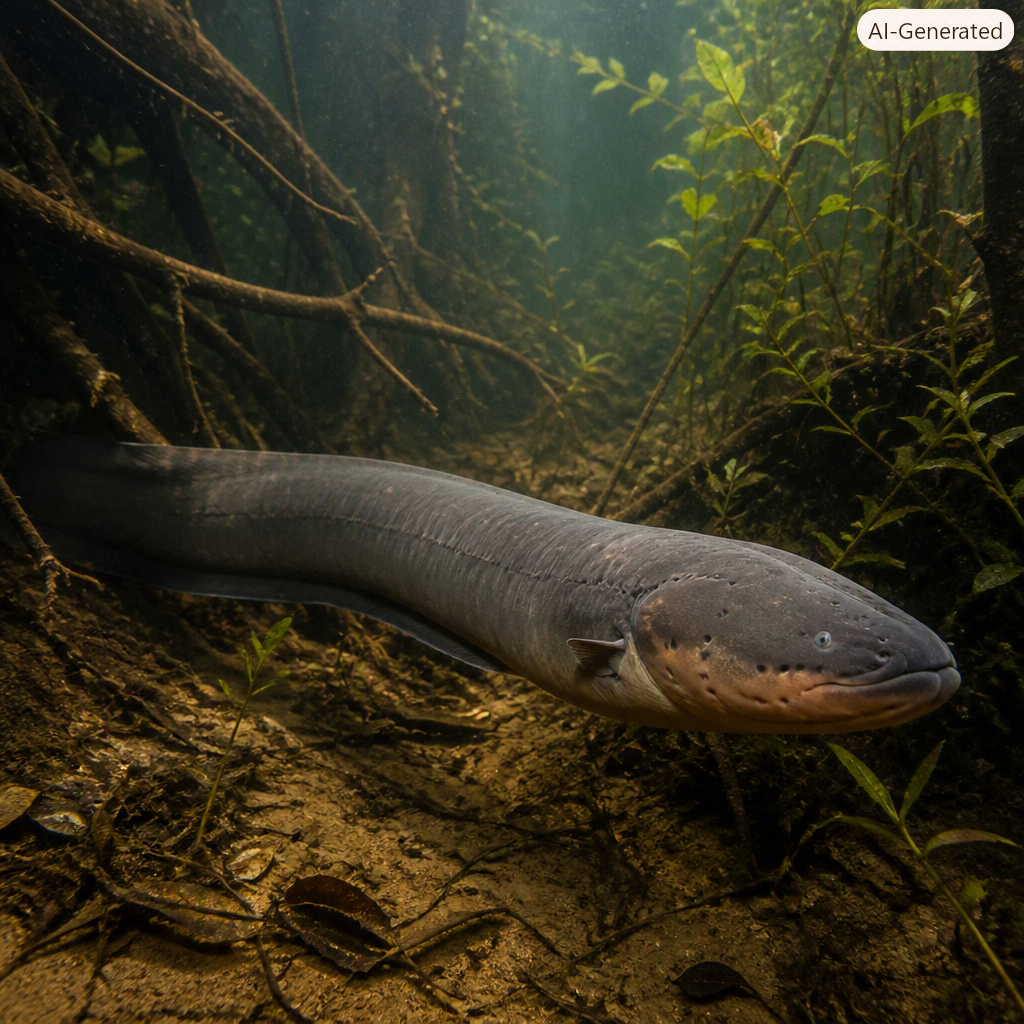
Welcome back to the show, everyone. Today, we’re diving into a topic that, honestly, leaves me absolutely flabbergasted every time I think about it. We’re talking about the electric eel. Nigel, I mean, this creature… it’s just something else, isn‘t it?
[Nigel]
It truly is, John. When you consider its capabilities, it stands out as one of the most uniquely equipped organisms. It’s not just a fish; it’s a living power generator, a sophisticated sensor, and a highly effective predator all rolled into one, with a system that seems to defy simple explanation.
[John]
Right? And I think most people just hear ‘electric eel’ and think, ‘Oh, it shocks things.’ But the depth of its electrical abilities, and how it achieves them, that’s where the real wonder lies. Where do we even begin with understanding this incredible ability?
[Nigel]
We have to start with the fundamental power source. The electric eel possesses not one, but three distinct electrical organs. That alone is remarkable. You have the main organ and Hunter’s organ, which are responsible for producing those powerful, high-voltage discharges, the ones strong enough to stun prey or deter a threat.
[John]
So, those are the ‘zap’ organs, so to speak.
[Nigel]
Exactly. They can generate up to 600 volts, sometimes even higher, at an amp or more. That’s a serious jolt, comparable to a wall socket, but delivered in a pulsed, directed way. But then there’s a third organ, the Sachs’ organ, which is just as fascinating, perhaps even more so when we consider the full picture.
[John]
The Sachs’ organ. What’s its role?
[Nigel]
It produces much weaker, low-voltage pulses. These aren’t for stunning. Instead, the eel uses these gentle electrical pulses to navigate its environment, essentially creating an electrical map around itself. It’s a form of active electroreception, like sonar but with electricity. It can detect objects, other creatures, and even changes in the electrical conductivity of the water around it.
[John]
So, it’s not just a weapon; it’s also a sensory system. That’s incredible. It’s like having a built-in radar. But how does it actually make electricity? We’re not talking about a battery here in the conventional sense, are we?
[Nigel]
Absolutely not. This is pure biological engineering at its finest. These organs are composed of thousands upon thousands of specialized cells called electrocytes. Imagine tiny biological batteries. Each electrocyte, on its own, generates a very small voltage, maybe around 0.15 volts. But here’s the crucial part: they’re arranged in series, stacked one after another, like coins in a roll, within those long organs.
[John]
Like a series circuit, essentially. So the individual voltages add up.
[Nigel]
Precisely. And not only in series, but also in parallel, to increase the current. The sheer number of these cells is staggering—we’re talking 5,000 to 6,000 electrocytes in the main organ alone, arranged in columns. For the entire system to work, every single one of these cells has to be perfectly oriented, perfectly connected, and capable of functioning in a coordinated manner.
[John]
That’s mind-boggling when you think about the precision required. I mean, if one of those tiny cells is out of sync or miswired, does the whole system break down?
[Nigel]
It certainly wouldn’t be as efficient, and a significant malfunction could cripple the system. This brings us to a critical point about the ‘piecemeal’ development of such a system. For it to be useful, it can’t just be ‘almost’ there. A tiny fraction of the necessary voltage wouldn’t be enough to stun prey or even effectively navigate. Imagine having an electric organ that only produces 5 volts. What good would that be? It’s not enough for defense, not enough for hunting, and certainly not enough for long-range navigation. It would be a liability, perhaps even drawing attention without providing any benefit.
[John]
So, you’re saying it’s an all-or-nothing kind of deal? It needs to be fully functional from the get-go to be effective.
[Nigel]
Exactly. Consider the complexity. You need the electrocytes themselves, which are modified muscle cells, but modified in a very specific way to generate electricity. Then you need the neural control system that can command these thousands of cells to fire in perfect synchronicity. If they don’t fire at precisely the same instant, the voltage output drops dramatically. It’s like trying to get thousands of tiny batteries to all switch on at the exact same millisecond. That requires an incredibly sophisticated command center.
[John]
And what about the eel itself? How does it not get shocked by its own powerful discharges? That’s always been a question for me.
[Nigel]
Another brilliant aspect of its intricate design! The eel essentially insulates itself. Its vital organs are positioned in the anterior part of its body, away from the bulk of the electric organs, which run along most of its length. Furthermore, its skin is remarkably thick, and its internal tissues, particularly fatty deposits, act as excellent electrical insulators. The current tends to flow away from the eel’s body and through the surrounding water, where the resistance is lower. It’s like having a perfectly designed conduit system within its own structure.
[John]
So, it’s not just the ability to generate electricity, but also the ability to direct it and protect itself from it. That’s a whole other layer of complexity. If any one of those elements—the generation, the insulation, the control—were missing or incomplete, the whole system would be useless, or even harmful to the eel itself.
[Nigel]
Precisely. And this is where the argument against a gradual, step-by-step assembly becomes compelling. Imagine a creature starting with, say, just a few proto-electrocytes. They might generate a minuscule voltage. But without the coordinated neural control, without the insulation to protect itself, without the thousands of cells arranged just so, that slight voltage offers no benefit. In fact, it might be detrimental, perhaps attracting predators without offering any defense, or simply being a metabolic drain for no purpose.
[John]
It’s like having half of a very complicated machine. If you only have the engine, but no transmission or steering wheel, it’s not going to get you anywhere. And in this case, it might actually explode.
[Nigel]
A perfect analogy, John. You need all the components—the power source, the control unit, the safety mechanisms, the delivery system—to be present and functional to a substantial degree simultaneously. The electrocytes must be differentiated correctly, the nerve endings must connect precisely, the insulating layers must be in place. Each piece is interdependent. A slight improvement in one area without corresponding developments in all the others wouldn’t yield a functional electric weapon or sensory system.
[John]
So, if we consider that this creature starts as a single fertilized cell, the blueprint for all this intricate machinery must be present from that very first moment. It’s not like it’s figuring it out as it grows.
[Nigel]
Exactly. The developmental program, the instructions contained within that initial cell, must be incredibly detailed and comprehensive. It directs the formation of these specialized cells, their precise arrangement, the sophisticated nervous system to control them, and the insulating structures. It’s a marvel of pre-programmed construction, building this highly complex, integrated electrical system from scratch during its development.
[John]
It really does make you wonder. I mean, the sheer engineering brilliance on display here. It’s not just a collection of random parts; it’s a perfectly integrated, highly efficient system. Every part seems to be there for a purpose, working in concert.
[Nigel]
Indeed. Think about the energy management involved. Generating such high voltages and currents requires a significant metabolic investment. The eel can actually deplete its energy stores rapidly if it discharges repeatedly. So, it also needs sophisticated control over when and how powerfully to discharge. It’s not just a binary ‘on-off’ switch; it can modulate the strength and frequency of its pulses based on the situation, whether it’s a gentle sniff for prey or a full-blast defensive shock.
[John]
So it’s got a dimmer switch, basically, and a volume control for its zaps. That’s another level of sophistication. It’s not just a blunt instrument.
[Nigel]
Precisely. And this ability to control its discharge, to differentiate between a weak pulse for exploration and a strong one for predation, requires an incredibly finely tuned neurological system. It needs to interpret sensory information, decide on an appropriate response, and then execute that response with precise control over thousands of independent biological cells.
[John]
It feels like we’re describing something that came off an advanced engineering design table, rather than something that just… appeared. The sheer number of co-dependent parts, each needing to be fully functional and integrated right from the start for the entire system to offer any benefit at all. It’s a huge hurdle for any step-by-step explanation.
[Nigel]
It truly highlights what’s often referred to as ‘irreducible complexity’ in a system, even without using that specific phrase. If you remove or impair any core component—the electrocytes, the neural timing, the insulation, the sensory feedback—the whole sophisticated mechanism fails to provide its characteristic functions. It’s not just a reduced version; it becomes non-functional or even detrimental.
[John]
And the fact that it can adapt this system to different scenarios, from hunting to communicating to defending itself, implies not just the presence of the system but a profound understanding of how to wield it. It’s not just a ‘shock and awe’ approach; there’s subtlety there.
[Nigel]
Absolutely. It can even use short, sharp bursts, sometimes called a ‘doublet’ or ‘triplet’ of high-voltage pulses, to pinpoint prey hiding in vegetation. These pulses cause involuntary muscle contractions in the prey, giving away their position. This is a very specific, targeted hunting strategy, not just a random discharge. It requires precise timing and interpretation of the electrical feedback.
[John]
So, it’s almost like a ‘remote control’ stunning system. That’s incredibly advanced. And again, this specific, coordinated strategy, how could that possibly arise without a comprehensive, pre-existing design?
[Nigel]
That’s exactly the question it poses, John. The integration of the electrical generation, the electroreception for sensing, the sophisticated neural control for precise discharge, the self-insulation, and even specific hunting tactics—all these elements function together as a unified, highly optimized system. It feels like a master plan, where every component was designed with foresight and purpose to create a fully functional, highly effective creature. A piecemeal construction simply doesn’t account for the seamless integration and functional perfection we observe.
[John]
It’s genuinely humbling to consider. We build machines that generate electricity, but we need vast power plants and complex grids. This creature does it all within its own body, with elegance and precision. It forces us to look beyond simple explanations and appreciate the incredible depth of ingenuity behind such life forms.
[Nigel]
And it does it day in and day out, as a normal part of its existence. It’s not a rare occurrence; it’s a foundational aspect of its being. The fact that all these components are perfectly integrated, from the sub-cellular level of the electrocytes to the full-body control mechanisms, really points to an extraordinary, comprehensive blueprint. It’s a living testament to an incredible design.
[John]
Nigel, this has been absolutely fascinating. The electric eel truly is a biological marvel, and exploring its capabilities from this perspective really opens your eyes to the intricate wisdom that must underpin such a creation. Thank you for shedding light on this incredible animal.
[Nigel]
My pleasure, John. It’s a creature that certainly gives us much to ponder about the origin and complexity of life. A true masterpiece.
[John]
And thank you to all our listeners for joining us on this electrifying journey. Until next time, keep pondering the incredible world around us.















![Point of Grace – Jesus Will Still Be There [with lyrics]](http://img.youtube.com/vi/XFqjq_LsZVg/0.jpg "Point of Grace – Jesus Will Still Be There [with lyrics]")



Thanks! Share it with your friends!
Tweet
Share
Pin It
LinkedIn
Google+
Reddit
Tumblr