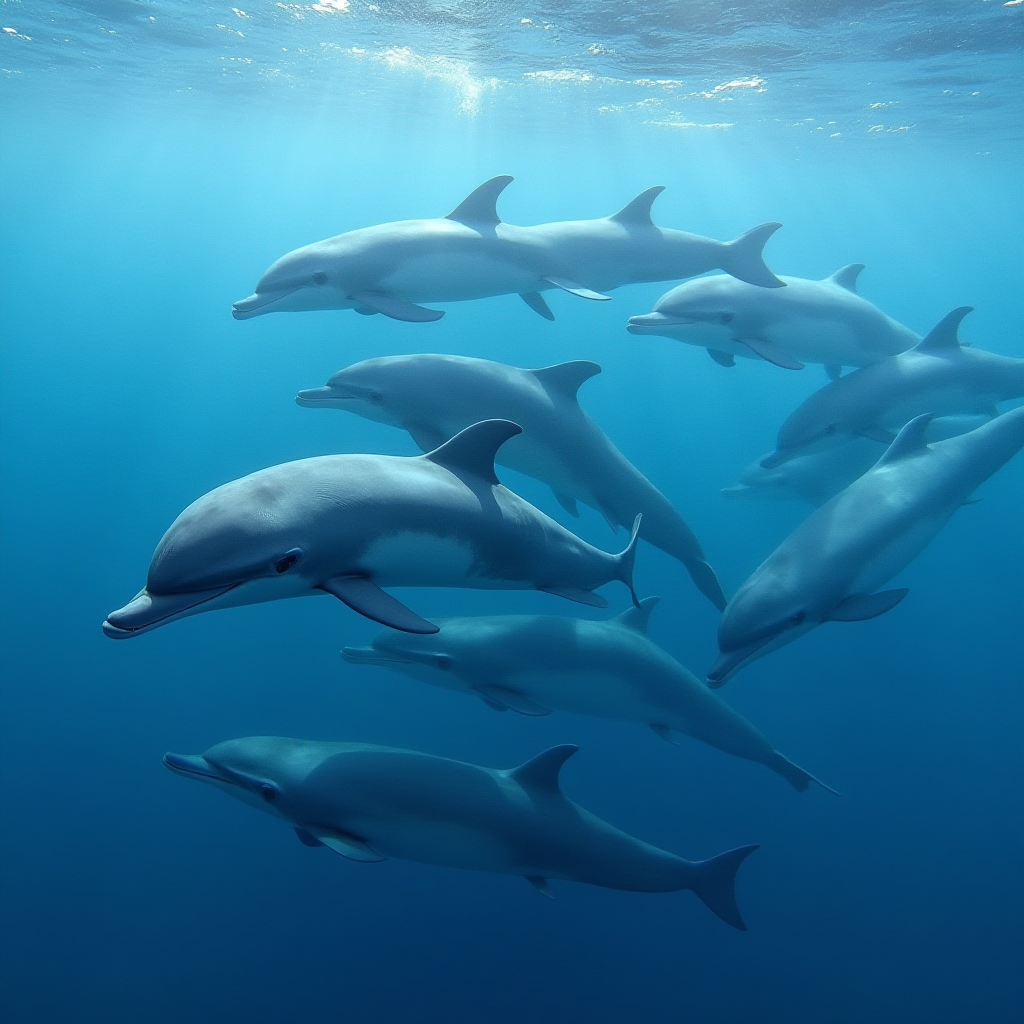
John: Welcome back to another great show, everyone! Today, we’re taking a plunge into one of the ocean’s most charismatic and, frankly, mind-boggling creatures: the dolphin. Now, when we think of marine life adapting to the ocean, it’s often framed as this slow, gradual process, right? Just a creature kind of ‘figuring it out’ over eons.
Nigel: Exactly, John. And while adaptation is a real phenomenon, the deeper you look at something like the dolphin, the more that narrative feels… woefully insufficient. It’s not just an animal that adapted to water; it’s a high-speed, sound-powered biological computer, precision-engineered for its environment in ways that defy simple, step-by-step modification.
John: A biological computer! That’s a great way to put it. Because when you start peeling back the layers of a dolphin’s physiology, you don’t find a collection of haphazard features. You find an incredibly integrated system where everything works together, almost like a meticulously designed machine. And nowhere is that more apparent than in their acoustic superpowers – their echolocation.
Nigel: Absolutely. Echolocation isn’t just about making sounds and listening for echoes. It’s an entire, sophisticated sonar system. Let’s start with the sound generation. Unlike us, dolphins don’t use vocal cords. Their ‘voice box,’ if you will, is actually a complex arrangement of nasal sacs and structures called ‘phonic lips’ located in their blowhole area.
John: Phonic lips? That’s fascinating. So, they’re essentially vibrating these specialized tissues to produce sound pulses, almost like a highly efficient, underwater speaker?
Nigel: Precisely. They can generate a huge range of frequencies, from low-frequency clicks for long-range navigation to incredibly rapid, high-frequency bursts for pinpointing prey. But generating the sound is only half the story. You need to direct it, focus it, and that’s where the ‘melon’ comes in.
John: The melon! That distinctive, rounded forehead. So, it’s not just for looks, it’s actually a functional part of their sonar?
Nigel: It’s critical. The melon is a specialized fatty organ that acts as an acoustic lens. It takes those sound pulses generated by the phonic lips and focuses them into a narrow, directional beam, much like a flashlight beam. This allows them to project sound with incredible precision, literally ‘pointing’ their sound at objects they want to investigate.
John: So, they’re generating sound from their nasal passages, focusing it with a fatty organ in their forehead… that’s already a huge leap in complexity from just ‘making noise.’ But then they need to hear the echoes. How do they do that, given water is such a different medium for sound than air?
Nigel: And this is where it gets even more intricate. They don’t hear with typical external ear canals like us. Instead, their primary receivers are their hollow lower jawbones. These jawbones are filled with a special, acoustic fat that acts as a super-efficient sound conductor, channeling the returning echoes directly to their middle ear.
John: Wait, so sound literally travels through their jaw to their ears? That’s wild.
Nigel: It is. And crucially, their middle ear is largely decoupled from their skull. This isolation is believed to protect the delicate auditory structures from the intense sounds they produce and to allow for precise directional hearing. It’s a completely different auditory pathway than ours, optimized for underwater acoustics.
John: So, you have the sound generation, the melon focusing it, and this unique jawbone receiver system. But all that raw data has to be processed, right? I mean, it’s not just a ‘ping’ and ‘pong,’ it’s creating a detailed picture.
Nigel: That’s the final, and perhaps most astonishing, piece of the puzzle: the brain. A dolphin’s brain is incredibly sophisticated, taking those echoes – which contain information about distance, size, shape, even density of objects – and translating that raw data into a real-time, three-dimensional, structural ‘X-ray’ map of their environment. They can effectively ‘see’ through murky water, even differentiate between fish species by their swim bladders.
John: An X-ray map… that’s just mind-blowing. And this is where the ‘irreducible complexity’ argument really comes into play, isn’t it? Because if you remove any one of those components – the phonic lips, the melon, the conductive jaw, or the specialized brain processing – the entire system fails. It’s completely useless.
Nigel: Precisely. A dolphin with phonic lips but no melon can’t focus sound. One with a melon but no special jawbone can’t efficiently receive echoes. One with all the hardware but no specialized brain to interpret the data might as well be deaf. It’s an all-or-nothing system. Each piece is interdependent, and their simultaneous presence and precise interaction are essential for function. It points to an integrated blueprint, not a series of lucky, disconnected accidents.
John: That’s a powerful point. It truly is a symphony of specialized parts. But let’s move from sound to motion, because dolphins are also absolute masters of hydrodynamics. They can slice through water with incredible speed and efficiency, and for years, scientists were puzzled by how they did it. It was even called ‘Gray’s Paradox,’ wasn’t it?
Nigel: That’s right. Sir James Gray observed dolphins moving at speeds that, based on their musculature and traditional fluid dynamics, shouldn’t have been possible without far more power output than they appeared to possess. The paradox was, how did they overcome the immense drag of water at high speeds? The answer lies in their utterly unique skin and body design.
John: Their skin? I always just thought of it as smooth. But there’s more to it than that, apparently.
Nigel: Oh, much more. A dolphin’s skin isn’t just smooth; it’s dynamically designed. It has a micro-structure that allows it to subtly flex and vibrate. This isn’t random; it’s believed to actively prevent the formation of turbulent eddies and vortices as water flows over its body. By maintaining laminar flow – smooth, unbroken layers of water – they drastically reduce drag.
John: So, it’s almost like an active, self-regulating surface that smooths out the water around them? That’s incredible. Like a natural form of active flow control.
Nigel: Exactly. And get this: their outer layer of skin, the epidermis, actually sheds at an astonishing rate. We’re talking about a complete turnover roughly every two hours! This constant shedding removes any buildup of algae, bacteria, or other microscopic organisms that would increase surface roughness and, you guessed it, increase drag. It’s like a continuous, self-cleaning, drag-reduction system.
John: Every two hours? That’s insane! That’s an energy-intensive process, too, which just highlights how critical drag reduction is to their survival and lifestyle. And then there’s the sheer power behind their movement.
Nigel: Indeed. While fish use horizontal tail fins, dolphins have vertical tail flukes. This allows them to use massive, incredibly powerful back muscle groups to drive that up-and-down motion. The sheer mechanical efficiency of that powerful vertical thrust, combined with their drag-reducing skin, makes them incredible marine athletes. They convert muscle power into propulsion with minimal loss, a testament to their integrated biomechanical design.
John: It’s a perfect storm of design features, isn’t it? The skin, the tail, the muscle groups—all perfectly synchronized for hydrodynamic efficiency. But let’s shift gears to something equally astounding: their cognitive strategies and life systems. How about their sleeping habits? They don’t just ‘lie down and go to sleep’ like us, do they?
Nigel: Not at all. In fact, if they slept like us, they’d drown! Dolphins are conscious breathers, meaning they have to actively choose to take each breath. So, how do you sleep in an environment where not breathing means death? They employ what’s called ‘unihemispheric sleep’.
John: Unihemispheric sleep. That’s where half of their brain sleeps at a time, right? I mean, that’s just brilliant engineering to get around a fundamental survival problem.
Nigel: Exactly. One hemisphere of their brain goes into a deep sleep state, while the other remains active and awake. The active half handles conscious breathing, ensures they surface regularly, and keeps an ‘eye’ – literally, one eye remains open – on their surroundings for predators. Then, after a period, they switch, allowing the other half to rest. This way, they’re always partially alert and never compromise their ability to breathe or detect danger. It’s an elegant solution to a profound challenge.
John: It’s like having a built-in co-pilot that never fully clocks out. That’s a level of brain specialization that’s just incredible. And it ties into their advanced social complexity too, doesn’t it? Like, they have ‘names’ for each other.
Nigel: They do! Research has shown that each dolphin develops a unique ‘signature whistle’ early in life. This isn’t just a random sound; it functions very much like a name. Other dolphins will even ‘call’ each other by mimicking their signature whistle. This level of individual recognition and communication is incredibly advanced, suggesting a complex social structure and cognitive abilities far beyond what many initially assumed.
John: Signature whistles, that’s wild. And it points to a level of individual identity and communication that you usually only see in primates, if that. But they also show incredible coordinated strategy in things like hunting, right? The ‘mud-ring hunting’ is a prime example.
Nigel: Mud-ring hunting is a fantastic illustration of their intelligence and cooperation. In certain shallow waters, pods of dolphins will coordinate. One or more dolphins will swim in a tight circle around a school of fish, stirring up mud from the seabed. This creates a circular ‘net’ of mud, confusing and trapping the fish inside. Then, the other dolphins, or sometimes the same ones, will take turns rushing into the mud ring to grab the disoriented fish.
John: So, it’s not just random, it’s a planned, synchronized effort involving a deep understanding of physics and cooperation. They’re basically using hydrodynamics and the environment to their advantage as a team.
Nigel: Precisely. It requires foresight, communication, and a shared understanding of a complex strategy. Again, it’s not just instinct; it’s a testament to their problem-solving capabilities and intricate social bonds.
John: It really highlights how much we’re still learning about their minds. Now, for our final incredible segment, I want to talk about something truly mysterious: their ability to heal. I’ve heard stories about dolphins surviving horrific injuries that would kill almost any other animal.
Nigel: Oh, their healing capabilities are nothing short of miraculous, John. Imagine a dolphin suffering a massive shark bite, a wound that might be a foot deep and wide, exposing internal organs. For almost any other creature, that’s a death sentence due to blood loss, infection, or organ damage.
John: Right, bleeding out alone would be the immediate concern. But dolphins… they seem to just bounce back.
Nigel: They do, and it involves a multi-pronged, pre-programmed response. First, they have an automatic mechanism to constrict blood flow around the injury. This isn’t just a simple clotting mechanism; it’s a rapid, efficient response that minimizes blood loss from even very large wounds. It’s like having internal tourniquets at the ready.
John: Internal tourniquets! That’s a critical first-response system. But then there’s the infection risk, especially in the ocean.
Nigel: And that’s where another layer of their biological genius comes in. Their blubber, that thick layer of fat beneath their skin, is packed with natural antimicrobial compounds. These compounds are believed to actively fight off bacteria and other pathogens, preventing the devastating infections that would otherwise plague an open wound in a marine environment. It’s like having a built-in antibiotic system.
John: So, they stop the bleeding, fight off infection… but then the tissue regeneration is another astonishing part. They heal deep wounds without massive scarring, don’t they?
Nigel: Yes, and this is perhaps the most complex aspect. They regenerate deep tissue, even muscle, with incredible efficiency and minimal scarring. Scar tissue tends to be less flexible and can impede function, but dolphins seem to restore the original tissue structure, maintaining their hydrodynamic perfection. We’re talking about complete tissue regeneration, often within weeks, leaving behind barely a trace. It’s a healing process that biomedical science is still trying to understand and replicate.
John: It’s like something out of science fiction. The ability to heal from such traumatic injuries, without infection and with full tissue regeneration, it’s just mind-boggling. It shows a level of biological resilience that fairly shouts it’s engineered.
Nigel: It truly does. Each of these systems we’ve discussed today—from the acoustic sonar, to the hydrodynamic skin, the unihemispheric sleep, their advanced social structures, and these incredible healing capabilities—they’re not just isolated features. They are independent subsystems, yet they seamlessly tie together, each contributing to the dolphin’s overall survival and thriving in its complex marine world.
John: And that brings us back to our core theme, doesn’t it? When you look at the dolphin’s anatomy, its physiology, its behavior, all these incredible features, it doesn’t just scream ‘lucky accidents over time.’ It screams something else.
Nigel: It screams intentional, sophisticated orchestration. The sheer number of highly complex, interdependent systems, each perfectly optimized and integrated with the others, implies a level of foresight and design that’s hard to reconcile with purely random, undirected processes. How could a creature possibly evolve a fully functional echolocation system, or unihemispheric sleep, or these healing properties, if each component part is useless on its own? It requires a complete, synchronized blueprint to function at all, a testament to what appears to be an astonishingly intelligent design.
John: That’s a powerful and thought-provoking conclusion, Nigel. The dolphin truly is an engineering marvel, a living testament to complexity and integration. Thank you for taking us on this deep dive today.
Nigel: My pleasure, John. It’s always a privilege to explore the wonders of the natural world and see the incredible design woven into it.
John: And thank you, listeners, for joining us on this episode. We hope you look at the ocean, and indeed all life, with a renewed sense of wonder and appreciation for the incredible complexity that surrounds us. Until next time, keep exploring

















Thanks! Share it with your friends!
Tweet
Share
Pin It
LinkedIn
Google+
Reddit
Tumblr