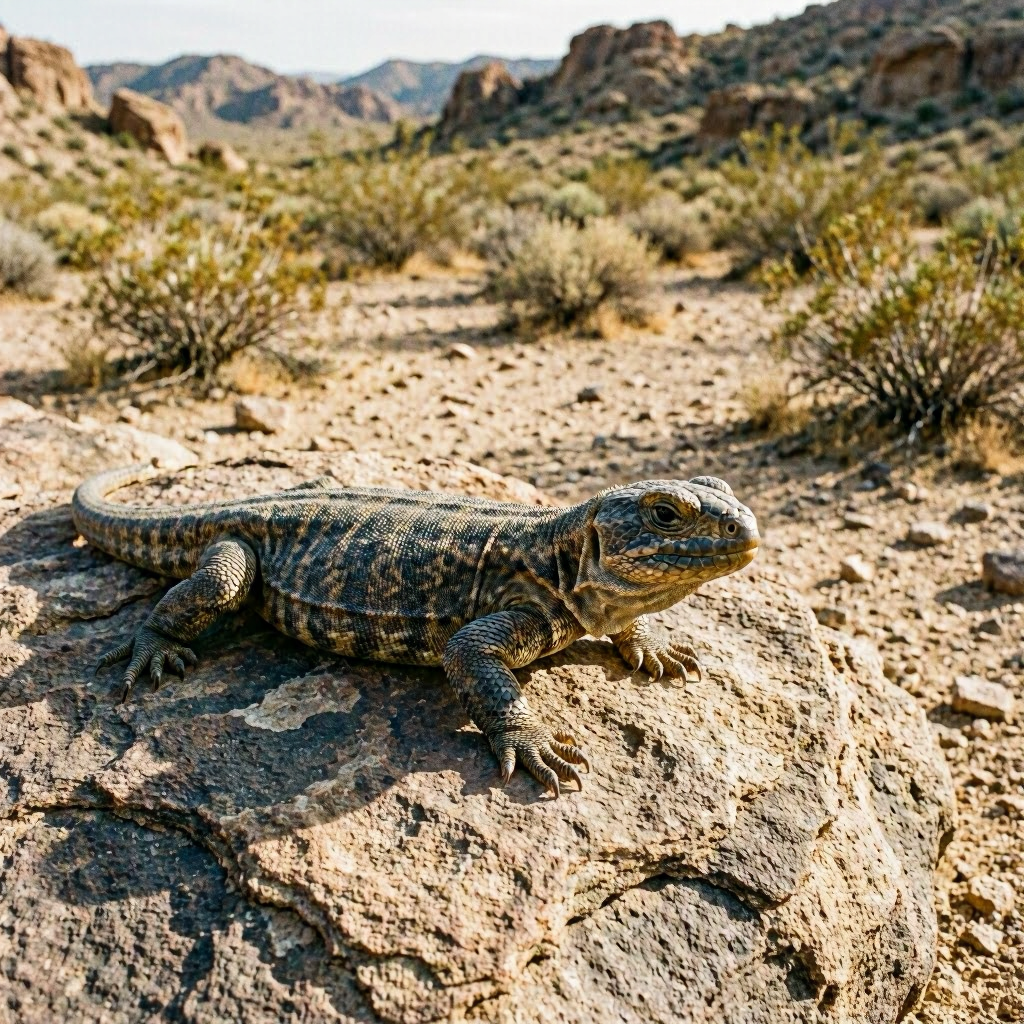
John: Welcome back everyone! Today, Nigel, we’re diving into the scorching, sun-drenched deserts of the American Southwest, to talk about a creature that, for me, just screams ‘masterful engineering’ in every single one of its incredible features. We’re talking about the Chuckwalla lizard.
Nigel: Ah, the Chuckwalla! A truly fascinating reptile, John. It’s one of those animals that, when you really look at its specific adaptations, you can’t help but be struck by how perfectly it’s fitted for its incredibly harsh environment. It’s almost as if every part of it was meticulously planned for desert life.
John: Exactly! And for listeners who might not be familiar, imagine a large, robust lizard, often with a somewhat flattened body, looking like it’s been carved from the very rocks it inhabits. They can grow quite substantial, sometimes up to nearly a foot and a half long, including that broad, rather stubby tail.
Nigel: And their coloration, too, is a marvel in itself. Often dark, mottled grays, browns, and blacks, perfectly blending with the basalt and granite rocks of their preferred habitat. It’s like nature’s own camouflage expert at work, designed to vanish into the landscape. You often have to look twice, or even three times, to spot one basking.
John: Absolutely. But let’s talk about its most famous, and frankly, most astonishing feature: its defense mechanism. This is where the Chuckwalla truly shines as an example of brilliant biological architecture. When threatened, it doesn’t run far. Instead, it bolts for the nearest rock crevice, and what it does next is simply mind-blowing.
Nigel: It inflates itself! It gulps air, puffing up its entire body, making itself incredibly wide and essentially wedging itself so tightly into that rock fissure that it becomes virtually impossible for a predator to extract it. Imagine trying to pull a cork out of a bottle when that cork is actively pushing back with all its might.
John: It’s a brilliant, simple, yet profoundly effective strategy. Think about the physical components needed for that: highly elastic skin, a flexible rib cage, powerful musculature to expand that rib cage and hold it, and obviously, the lung capacity to take in so much air so rapidly. It’s all perfectly synchronized for this one specific purpose.
Nigel: It truly is. And it’s not just a haphazard inflation. It’s controlled. It knows precisely how much to inflate to maximize its grip within the rock. This isn’t just a reflex; it’s a sophisticated, integrated system. The skin, for instance, isn’t just ‘stretchy’ – it’s designed to accommodate this dramatic expansion without tearing or causing injury.
John: And this particular defense really highlights how every aspect of its being is tailored to its rocky, arid home. If it lived in a grassy plain, this defense would be useless. But in a landscape littered with cracks and crevices, it’s an unbeatable strategy. It’s almost like it came with a user manual that said, ‘optimal deployment in rocky environments.’
Nigel: Indeed. It’s a testament to the specific planning that went into its design. Beyond defense, let’s consider how it handles the extreme temperatures of the desert. These places are brutal, reaching well over 100 degrees Fahrenheit consistently. The Chuckwalla, being a cold-blooded reptile, needs a very clever system to regulate its body temperature.
John: Right, it can’t generate its own heat internally like we do. So it relies on external sources. And its primary method for warming up in the morning is basking. You’ll see them flattened out on warm rocks, soaking up the sun’s rays. But there’s a lesser-known feature about how it does this that’s just mind-boggling.
Nigel: Yes, its internal lining. The Chuckwalla possesses a black peritoneum, which is the membrane lining its abdominal cavity. Think about that: an internal black lining. This isn’t just for aesthetics. It’s a highly functional design choice.
John: So, when it’s basking, that black peritoneum acts like an internal solar panel, absorbing every bit of thermal energy that penetrates its body. It’s a highly efficient way to warm up its internal organs and get its metabolism going, allowing it to be active during the day. It’s like having an internal heat sink, perfectly placed.
Nigel: Precisely. And it’s not just about getting warm; it’s also about not getting too warm. When the desert sun becomes unbearable, the Chuckwalla retreats into those same rock crevices, or burrows, where the temperature is significantly cooler and more stable. It’s a finely tuned behavioral and physiological dance with its environment.
John: This leads us naturally to another huge challenge in the desert: water. How does a creature survive in such an arid landscape where water is incredibly scarce? The Chuckwalla has some truly remarkable water conservation strategies.
Nigel: It really does. Primarily, they’re herbivores, feeding on leaves, flowers, and fruits, which provide a significant portion of their hydration. But beyond that, their kidneys are incredibly efficient at reabsorbing water, producing highly concentrated urine, minimizing water loss there. That’s a common but vital adaptation for desert life.
John: But it’s not just about conserving water when expelling waste. These plants they eat, particularly in desert environments, often contain high levels of salt. And too much salt is toxic. So, how does the Chuckwalla deal with that salt without losing precious water?
Nigel: Another brilliant solution: salt glands. Chuckwallas possess specialized salt glands, typically located in their nasal passages or sublingually, under the tongue. These glands literally excrete excess salt as a concentrated brine or crystalline solution, without losing the vital water that would be sacrificed through urination. It’s a completely separate, dedicated system for salt management.
John: Think about that level of specificity. A dedicated filtration and excretion system just for salt, designed to be completely independent of water balance. It’s an incredible piece of biological plumbing, perfectly adapted to their diet and environment. It’s not just ‘a lizard that eats plants.’ It’s a lizard specifically designed to eat desert plants with high salt content and thrive.
Nigel: And consider the synchronicity of these systems. The ability to find food that provides moisture, the efficient kidneys, and then the salt glands for the specific waste product of that food source. It’s a cohesive, interdependent network of features all working towards survival in a very specific, challenging niche.
John: It really paints a picture of intricate planning. Every component works in harmony. And we haven’t even touched on its appearance much beyond camouflage. Its skin, often quite wrinkled, isn’t just for show. That flexibility and looseness also contribute to its ability to inflate so dramatically.
Nigel: Absolutely. That loose, leathery skin, though it might look a bit ‘worn,’ is a key structural element for its primary defense. It’s not an afterthought; it’s integral. And their broad, somewhat flattened tails also play a role, providing balance as they navigate rocky terrain, and sometimes even aiding in anchoring themselves.
John: So, you have this creature, right? It lives in one of the most unforgiving environments on Earth. And every single aspect of its physiology and behavior seems purpose-built for that exact challenge. Its body shape for wedging, its internal organs for heat and salt management, its diet for hydration, its skin for defense. It’s a complete package.
Nigel: It’s a masterclass in biological engineering, truly. When you observe a Chuckwalla, you’re not just seeing a lizard; you’re witnessing the culmination of incredibly precise and integrated systems. Each feature supports the others, creating a robust, resilient organism perfectly at home in its niche. It’s a marvel of coherence.
John: It makes you think, doesn’t it? About the sheer ingenuity behind such a creature. It’s not just surviving; it’s thriving, generation after generation, in a place that would be fatal to most other animals. It’s a testament to the power of a well-designed blueprint.
Nigel: It absolutely does. And it encourages us to look closer, to appreciate the intricate details in the natural world, even in creatures we might initially dismiss as just ‘another lizard.’ There’s always a story of remarkable solutions and perfect adaptation waiting to be uncovered.
John: Indeed. The Chuckwalla lizard, a true unsung hero of the desert, demonstrating what incredible precision and thoughtful design can achieve. Nigel, this has been an illuminating journey into the world of this amazing reptile.
Nigel: My pleasure, John. It’s always a privilege to explore such wonders and discuss the masterful design we see in such creatures.
John: And to our listeners, thank you for joining us. We hope you’ll look at the humble Chuckwalla with newfound appreciation. Until next time, keep exploring the incredible world around you!












![Point of Grace – Jesus Will Still Be There [with lyrics]](http://img.youtube.com/vi/XFqjq_LsZVg/0.jpg "Point of Grace – Jesus Will Still Be There [with lyrics]")
Thanks! Share it with your friends!
Tweet
Share
Pin It
LinkedIn
Google+
Reddit
Tumblr