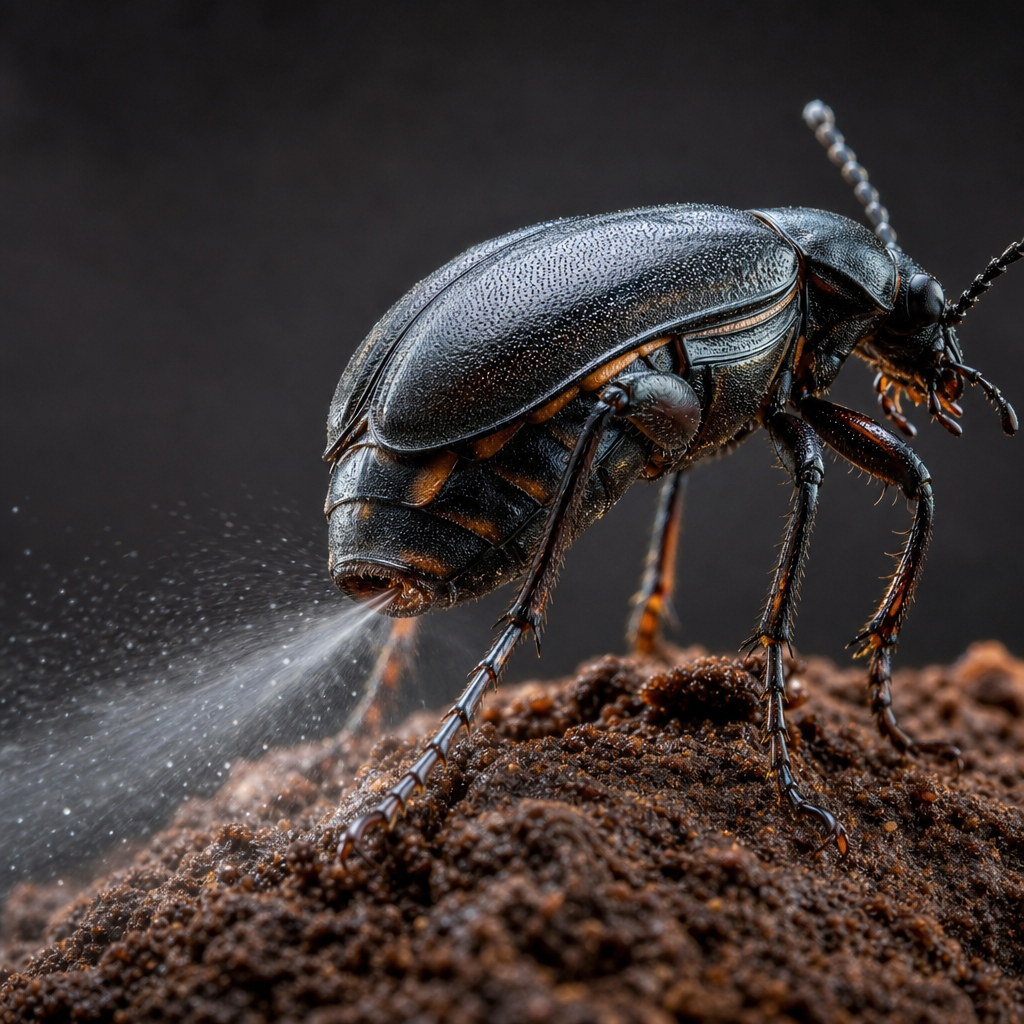
John: Nigel, you know, sometimes you stumble upon things in nature that just make you stop and think, ‘How in the world does that even work?’ And for me, recently, it’s been the bombardier beetle. I mean, it’s famous for a reason, right? But the more I dig into it, the more mind-boggling it gets. It’s not just a little pop; it’s a full-blown chemical reaction happening right there.
Nigel: Absolutely, John. It’s one of those creatures that truly challenges any notion of random, incremental development. The bombardier beetle’s defense system is not merely impressive; it’s a marvel of precision engineering, a tiny, living chemical factory. It doesn’t just ‘make’ a chemical; it synthesizes and deploys a scorching hot, noxious spray with incredible accuracy and control, and all this from something barely the size of your thumbnail.
John: Right! And that’s what gets me. We’re talking about a beetle that stores two highly reactive chemicals—hydroquinone and hydrogen peroxide—inside its body. I mean, just the idea of keeping those separate, safely, within its own system, is astonishing. If they just mixed willy-nilly, the beetle would essentially explode itself, wouldn’t it?
Nigel: Precisely. That’s the first layer of complexity. It has two distinct storage chambers, often called ‘reservoirs,’ where these chemicals are held in separate, inert states. They’re harmless as long as they stay apart. But the genius isn’t just in the separation; it’s in the controlled mixing and subsequent reaction. Imagine a factory needing to store two volatile substances; you’d need incredibly robust, purpose-built containers and strict protocols. This beetle has it built into its very anatomy.
John: So, it has these two separate tanks, if you will. But then, when it feels threatened, how does it go from safe storage to a boiling hot defensive spray in a fraction of a second? That’s where it really ramps up, isn’t it?
Nigel: That’s where the true orchestration comes into play. Each reservoir connects to a ‘reaction chamber.’ When the beetle decides to fire, it squirts a measured amount of both hydroquinone and hydrogen peroxide into this reaction chamber. But here’s the kicker: the chamber also contains a cocktail of specialized enzymes, specifically catalase and peroxidase. These aren’t just any enzymes; they are catalysts designed to dramatically speed up the reaction between those two stored chemicals.
John: Wait, so it’s not just mixing them; it’s actively accelerating the reaction with biological catalysts? That’s like having a tiny chemical plant with an on-demand accelerator pedal! And these enzymes have to be there, at the right concentration, perfectly designed to interact with those specific chemicals, right from the start. Otherwise, the whole thing just fizzles or, worse, explodes prematurely.
Nigel: Exactly. The enzymes are absolutely critical. Without them, the reaction would be too slow to be an effective defense. With them, the reaction is almost instantaneous and incredibly vigorous. The hydrogen peroxide rapidly decomposes into water and oxygen, and the hydroquinone is oxidized into quinones. This entire process generates immense heat, bringing the mixture to boiling point, often over 100 degrees Celsius and creates a significant amount of gaseous pressure from the oxygen produced.
John: Boiling hot acid! And it’s doing this inside its own body without cooking itself? That’s another layer of the enigma. How does the beetle protect itself from its own weapon?
Nigel: That’s a fantastic point, John, and it highlights another element of this intricate design. The reaction chamber itself is heavily fortified. It’s lined with tough, resilient protein structures that can withstand the intense heat and pressure. It’s essentially a miniature, armored combustion chamber. Furthermore, the ejection tubes, or ‘nozzles,’ are oriented away from its vital organs, directing the spray outward, usually towards the predator. Think of it: you need the storage chambers, the precise chemicals, the transfer mechanism, the reaction chamber, the specific enzymes, the protective lining and the directional nozzles, all present and fully functional from day one. If any single component is missing or improperly designed, the system either fails entirely or harms the beetle itself.
John: It’s like a Rube Goldberg machine, but instead of just being complicated, every single piece has to be there, perfectly formed and integrated for the whole thing to work. If you take away the storage chambers, it’s dead. If you take away the enzymes, it’s just harmless fizz. If the lining isn’t right, it blows itself up. It’s not a gradual assembly; it’s a complete, integrated system. And it’s not just a single squirt either, is it? I’ve heard it’s more like a pulsating jet.
Nigel: That’s right, John, and that adds another layer of sophistication that just defies simple, step-by-step explanations. The beetle doesn’t just release a continuous stream. Instead, it fires off a series of rapid, high-pressure pulses, sometimes up to 500 pulses per second. Each pulse is a tiny, directed explosion. This pulsating action isn’t random; it’s a strategic design element. It allows for better penetration of the spray onto a predator’s skin, making it more painful and irritating. It also means the beetle can control the duration and intensity of its defense, conserving its chemical ammunition.
John: A pulsating spray! So, it’s got a valve system, too, that can open and close at an incredible rate to create those pulses. It’s not just a simple open-and-shut case. We’re talking about precise control, not just ‘boom,’ but ‘boom-boom-boom-boom’ at a targeted enemy. This isn’t just about survival; it’s about optimized defense. It’s like having a fully automated, multi-stage missile defense system packed into a tiny organism.
Nigel: You hit the nail on the head, John. The ability to pulse the spray implies a sophisticated valve mechanism, muscular control, and neurological timing that is simply astonishing. And remember, the beetle also has the ability to swivel its ‘turrets’ – those nozzles – by about 270 degrees. So, not only can it generate this scorching, pulsating chemical deterrent, but it can also aim it with incredible precision at its attacker, even if the attacker is behind it. It’s a mobile, targeting, chemical weapon system on a micro scale.
John: It’s like the beetle itself is a highly engineered machine designed for this very specific purpose. You couldn’t just have one part of that system emerge by chance and then wait for another. What would be the benefit of having the chemicals if you don’t have the protective chamber? What good are the chambers if you don’t have the enzymes? And what’s the point of the whole thing if you can’t aim it? It all has to be there, ready to go, for it to be useful at all. It’s the ultimate ‘all-or-nothing’ scenario.
Nigel: Precisely. That’s the core of the argument against any random or piecemeal assembly. Each component, from the specific chemical compounds, their storage, the protective lining, the unique enzymes, the reaction chamber’s structure, the muscular control for targeting, and the rapid pulsing mechanism, must all be fully formed and integrated for the system to offer any survival advantage whatsoever. If you have only hydroquinone, it’s useless. If you have hydroquinone and hydrogen peroxide but no enzymes, you get a slow, ineffective fizz. If you have all of that but no protective chamber, the beetle is self-destructing. The probability of all these highly specialized, interdependent parts coming into existence simultaneously, in the correct configuration and location, through purely random, undirected processes, stretches credulity beyond its breaking point.
John: It feels like looking at a finely tuned Swiss watch and suggesting its intricate gears, springs, and levers just happened to appear in the right places and started telling time perfectly. Or a modern chemical plant that magically assembled itself, complete with safety protocols, storage tanks, and reaction vessels, all perfectly calibrated. We instinctively recognize design in human-made complexity. Why would we think differently when faced with this level of biological sophistication?
Nigel: Exactly. The elegance and efficiency of the bombardier beetle’s defense system speak volumes. It’s not just functional; it’s optimized. It’s a complete, integrated system where every component serves a specific, indispensable role, and they all work in perfect concert. It’s a masterclass in chemical engineering and biomechanics. The sheer improbability of such a system arising by mere accident, without any foresight or planning, is what truly makes one pause and consider a deeper explanation.
John: It’s a powerful reminder that there’s so much more to the natural world than meets the eye, and sometimes, the deeper you look, the more intelligent the underlying framework appears. The bombardier beetle isn’t just a bug; it’s a testament to incredible, intricate design. Nigel, this has been truly fascinating. Thanks for breaking down the mechanics of this incredible creature.
Nigel: My pleasure, John. It’s a subject that never ceases to amaze me, and it’s a prime example of the kind of exquisite craftsmanship we see everywhere in the living world, if we only take the time to truly observe it. The bombardier beetle certainly leaves us with a lot to ponder about the origins of such sophisticated systems.


















![I Believe in a Hill Called Mount Calvary [Live]](http://img.youtube.com/vi/4NSdy2N7mHA/0.jpg "I Believe in a Hill Called Mount Calvary [Live]")


Thanks! Share it with your friends!
Tweet
Share
Pin It
LinkedIn
Google+
Reddit
Tumblr