John: Nigel, you know, sometimes I just sit back and marvel at the sheer ingenuity we find in the natural world. Not just the big, obvious things, like a bird’s wing or the human eye, but the tiny, microscopic wonders.
Nigel: Oh, absolutely, John. It’s almost more striking, isn’t it? Because you have to dig a little deeper to even find them, and then when you do, it’s like uncovering a hidden universe of precision engineering. What’s on your mind today?
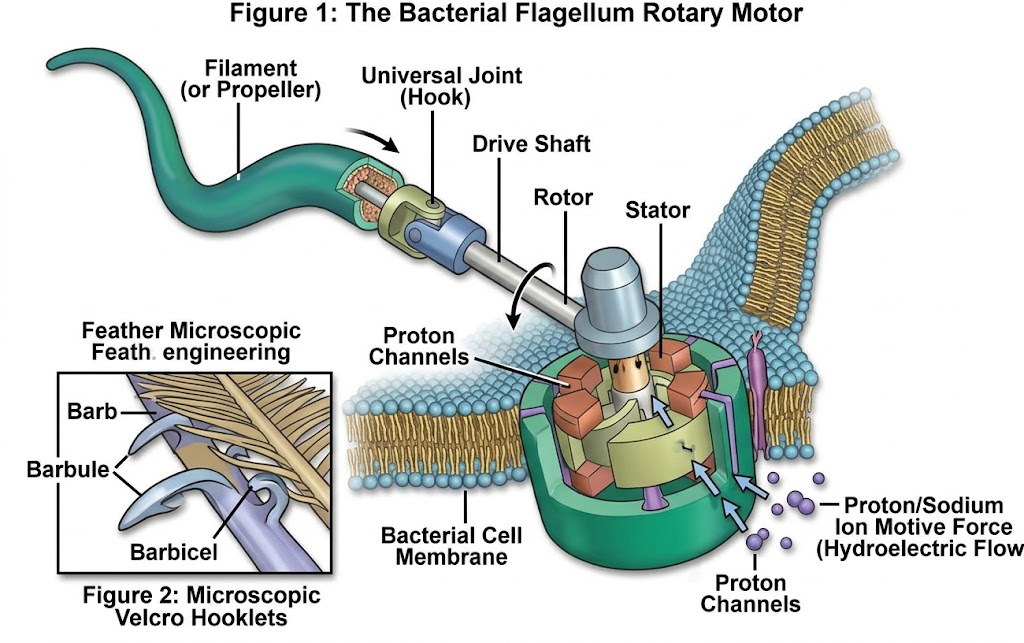
John: Well, I’ve been thinking a lot about the bacterial flagellum. I mean, honestly, it’s just mind-boggling. We’re talking about a microscopic motor, a true rotary engine, built right into a single-celled organism. It’s smaller than anything we’ve ever constructed, yet it performs with a level of sophistication that rivals our most advanced machines.
Nigel: The flagellum! Ah, yes, a true marvel. For anyone not familiar, imagine a tiny, hair-like appendage on a bacterium. But it’s not just a passive tail; it’s a meticulously crafted propeller system that can rotate at incredible speeds, allowing the bacterium to swim, dart, and navigate its environment with purpose.
John: Exactly! And when I say ‘motor,’ I’m not using hyperbole. It has all the classic components we’d expect in a rotary engine: a rotor, a stator, a drive shaft, universal joints, and a propeller. It even has a clutch and a braking system! Think about that – a living, self-assembling nanotechnology, complete with moving parts, all encoded within the organism’s instructions.
Nigel: It’s like an outboard motor on a boat, but scaled down to an unfathomable degree. And it’s not just about the parts existing; it’s about their precise arrangement and the way they all work together seamlessly. If even one of those crucial components is missing or misplaced, the whole system grinds to a halt. It’s all or nothing.
John: That’s the kicker, isn’t it? You can’t have half a flagellum and expect it to work. You need the proton channels for power, the stator for stability, the rotor for rotation, the drive shaft to transmit the motion, and the filament itself to act as the propeller. All of these have to be present and correctly formed for any function to occur.
Nigel: And the way it’s powered is fascinating too. It doesn’t use ATP in the same direct way many other cellular machines do. Instead, it harnesses a flow of protons – or sometimes sodium ions – across the cell membrane. It’s like a hydroelectric dam, but for molecular power, creating a proton motive force that drives the motor.
John: Right, a flow of positive charges creating a current that spins this incredibly intricate little engine. And the efficiency! These things can spin at up to 100,000 revolutions per minute. To put that in perspective, a typical car engine redlines around 6,000-7,000 RPM. This tiny biological motor is orders of magnitude faster and more efficient for its scale.
Nigel: And it can change direction almost instantly. A bacterium needs to be able to ‘tumble’ and reorient itself to find nutrients or escape toxins. The flagellum motor can switch its rotation from clockwise to counter-clockwise in a fraction of a second, allowing for precise maneuverability. That level of control speaks volumes about its sophistication.
John: It’s like having a universal joint at the base of the propeller, which allows the filament to rotate freely, preventing it from getting tangled as the cell moves. The engineering is just so precise. And let’s not forget the assembly process itself. These parts don’t just magically appear; they have to be built in a specific sequence, transported to the right location, and then assembled correctly.
Nigel: That’s another layer of complexity, isn’t it? Imagine trying to build a tiny outboard motor from scratch, not just designing the parts, but designing the process by which those parts are manufactured and put together automatically. The cell has molecular factories that produce these proteins, and then chaperones that guide them, and then a kind of ‘export system’ that sends them through the core of the growing flagellum to their final positions.
John: It truly is an assembly line, but on a nanoscale. Each component is a specific protein, coded by specific genetic instructions. There’s a master control system that regulates which proteins are produced and when, ensuring that the base of the motor is built first, then the rod, then the hook, and finally the filament. It’s a carefully choreographed ballet of molecular construction.
Nigel: And the filament itself, the propeller part, isn’t just a simple strand. It’s a hollow tube formed from thousands of flagellin protein subunits, arranged in a helical pattern. This precise arrangement is what gives it its corkscrew shape and its ability to act as an efficient propeller.
John: You know, it often makes me think about our own technology. If we saw something like this – a miniature rotary motor, self-assembling, incredibly efficient, capable of rapid direction changes – and we found it on, say, Mars, we would immediately conclude that it was the product of immense intelligence. We wouldn’t even question it.
Nigel: Exactly. We apply a standard to human-made machines – if it’s complex, purposeful, and functions like an engineered device, then it must be engineered. But when we look at life, sometimes that standard gets… muddled. The flagellum really challenges that. It’s not just a collection of parts; it’s an integrated system where every piece is essential for its function.
John: Take away the rotor, the drive shaft, or the stator, and you don’t have a partially working motor; you have a non-working collection of proteins. It’s like taking the engine block out of a car. The wheels are there, the steering wheel is there, but it won’t move.
Nigel: That’s a fantastic analogy. It really highlights the concept that for this motor to exist and function, all its critical parts must be present and correctly assembled from the very beginning. You can’t just incrementally add a piece here or there over vast stretches of time and expect it to suddenly start working when the ‘final piece’ arrives. It needs to be operational right away to confer any benefit.
John: And the bacterium relies on this motor for its very survival. Many bacteria use flagella to move towards food sources or away from harmful chemicals. Without it, they’d be largely static, at the mercy of their environment, unable to actively seek out what they need.
Nigel: So, the purpose is clear, the design is undeniable, and the functionality is astounding. It’s a testament to incredible foresight and planning, to envision such a complex machine and then encode all the instructions for its construction and operation into the very fabric of life. It’s just… elegant.
John: Elegant is the perfect word, Nigel. When you really stop and consider the flagellum, it’s not just an interesting biological feature; it’s a profound statement about the nature of sophisticated machinery at the smallest scales. It truly begs the question: how did such an intricate, purposefully designed system come to be?
Nigel: It certainly does, John. And it leaves you with a sense of wonder, really. That such precision, such engineering genius, is found not in some high-tech lab, but inside a single-celled organism. It’s a marvel that continues to inspire awe and curiosity. A truly humbling experience to contemplate.
John: Absolutely. It reminds us that there’s so much more to discover, and so much more to appreciate, even in the smallest corners of the living world. Thanks for diving into this microscopic marvel with me, Nigel.
Nigel: Always a pleasure, John. It’s these kinds of discussions that really highlight the incredible design that underpins everything around us. Until next time!















![Point of Grace – Jesus Will Still Be There [with lyrics]](http://img.youtube.com/vi/XFqjq_LsZVg/0.jpg "Point of Grace – Jesus Will Still Be There [with lyrics]")


Thanks! Share it with your friends!
Tweet
Share
Pin It
LinkedIn
Google+
Reddit
Tumblr