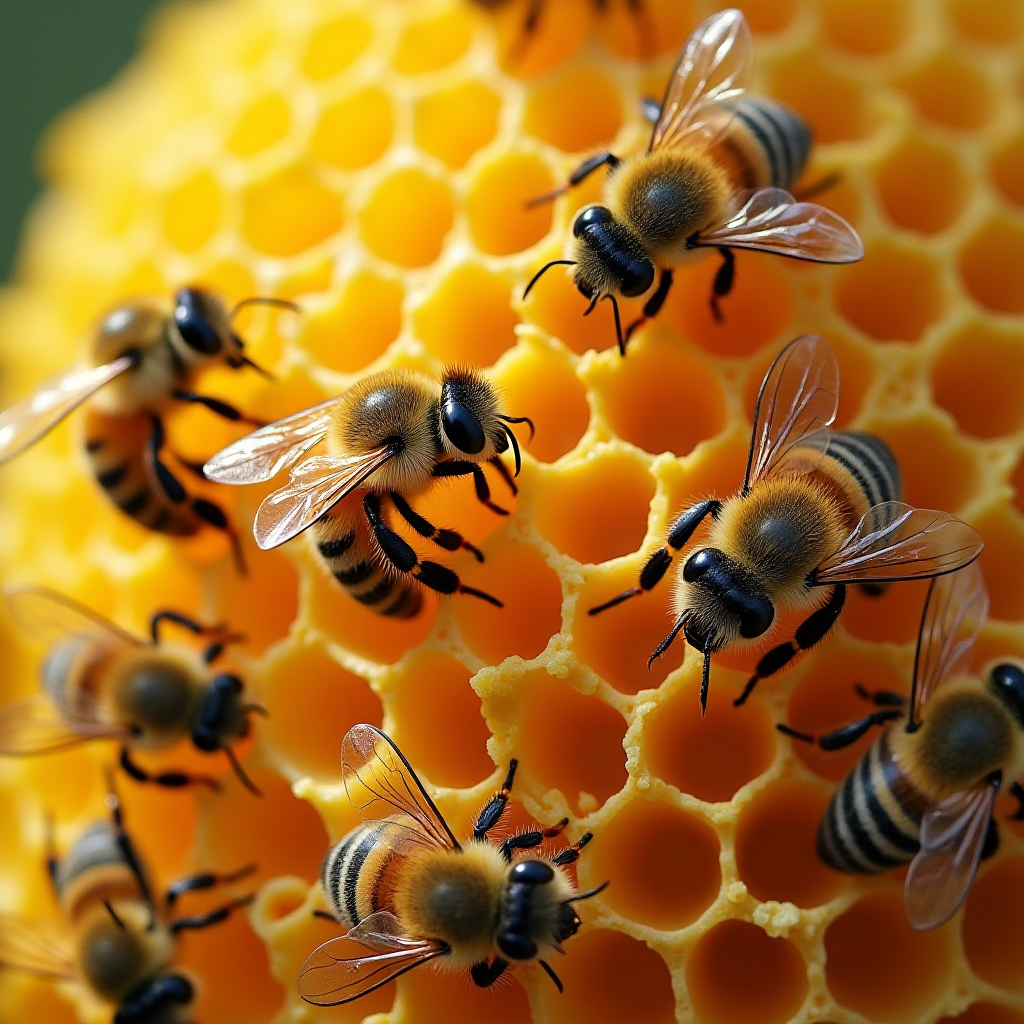
John: Nigel, you know, sometimes you just look at something in nature, something so seemingly simple, and it just stops you in your tracks. For me, lately, it’s been the humble honeycomb.
Nigel: Oh, absolutely, John! The honeycomb. It’s one of those things you see a million times, but do you ever really look at it? The intricate patterns, the sheer uniformity… it’s just astounding, isn’t it? It always gets me thinking about the incredible engineering behind it.
John: Exactly! I mean, we’re talking about a structure built by tiny insects, yet it adheres to mathematical principles that human minds only formally proved a couple of decades ago. It’s wild. It’s like they’ve got this intrinsic blueprint built into their very being.
Nigel: Intrinsic blueprint is the perfect way to put it. You know, when you think about how a swarm of bees, without any architectural plans, without a foreman or a CAD program, manages to construct these perfectly uniform geometric structures… it’s just mind-boggling. They just know how to do it.
John: And the key, as we both know, is the hexagon. It’s not just a pretty shape. There’s a profound mathematical reason why every single cell in a honeycomb is a hexagon. It’s called the Honeycomb Conjecture, and it basically states that a hexagonal grid is the most efficient way to divide space into equal areas with the absolute minimum perimeter.
Nigel: The most efficient! Think about that for a second. Human mathematicians grappled with this problem for centuries. It wasn’t until 1999 that Thomas Hales, a brilliant mathematician, finally provided a logical, formal proof for it. Yet, bees have been employing this optimal design from day one, without a single geometry lesson.
John: That’s the part that gets me every time. We, with all our advanced tools and intellectual prowess, needed until 1999 to confirm what a bee instinctively knows and builds. It speaks volumes about the level of inherent design we see throughout the natural world, doesn’t it?
Nigel: It truly does. It’s not just a happy accident; it’s precision engineering on a scale that frankly humbles us. And it’s not just about space efficiency, it’s about material optimization, which is even more critical for these little guys.
John: Absolutely. That’s the second big design milestone that always blows me away. Material optimization. To produce just one ounce of wax, bees have to consume about eight ounces of honey. That’s an astronomical metabolic cost, like us having to eat eight times our weight in food just to build a small shed.
Nigel: Eight ounces of honey for one ounce of wax! So, inefficient design isn’t just a minor inconvenience for them; it literally means hive starvation. If they wasted wax, they wouldn’t survive as a colony. There’s zero room for error.
John: Exactly. So, they can’t afford to use a single extra bit of wax. Imagine if they tried to build circles. You’d have all these wasted gaps in between, meaning less storage for honey, less insulation, and a weaker structure. Just completely impractical.
Nigel: And what about squares or triangles? They’d fit together without gaps, sure, but the perimeter for the same amount of area would be significantly longer. Which means a lot more wax. A lot more precious honey consumed. They simply couldn’t afford it.
John: Precisely. The hexagon is the single perfect mathematical sweet spot. It’s the most compact shape that tiles a plane without gaps, and it uses the absolute minimum amount of material – wax, in this case – to enclose the maximum possible volume. It’s just brilliant. It’s like the ultimate eco-friendly, ultra-efficient storage unit.
Nigel: It’s not just efficient; it’s robust too, isn’t it? The way the forces are distributed evenly across the hexagonal walls makes the entire structure incredibly strong. You can walk on a honeycomb and it holds your weight, proportional to its scale, of course.
John: Yeah, it’s not just about the geometry, but the precision with which they execute it. That brings us to the third point, which, honestly, just elevates the whole thing to another level of awe for me: the high-precision building itself.
Nigel: Oh, tell me about it! They’re not exactly working with spotlights and rulers, are they? It’s pitch black in there, for the most part, right?
John: Pitch black! Imagine trying to build a perfectly straight wall, to exacting specifications, in complete darkness. Bees do it using their antennae. They’re not just for smelling; they’re incredibly sensitive measuring tools. They use them to constantly check and maintain uniform wall thickness to a fraction of a millimeter. We’re talking about tolerances that would impress any human engineer with advanced laser-guided equipment.
John: The angle! Yes! Each cell isn’t perfectly horizontal. They’re precisely tilted upward at a 14-degree angle. Fourteen degrees! Why? Because honey, especially when it’s still uncapped, is viscous but not completely solid. That tilt ensures gravity keeps the honey securely inside, preventing it from spilling out before it’s capped with wax for storage. It’s a built-in anti-spill mechanism.
Nigel: A 14-degree tilt! That’s not a random number. That’s a specific, calculated angle that perfectly counteracts the viscosity of honey. It’s like having a team of fluid dynamics experts designing each and every cell. It’s not just building a container; it’s building a container optimized for its specific liquid contents and the forces of nature.
John: It’s a perfect example of what you might call ‘intentional engineering.’ Every single aspect of the honeycomb, from the choice of shape to the material economy to the minute construction details, points to a purpose-driven, optimized design. There’s no waste, no guesswork, just pure efficiency and elegance.
Nigel: You know, it makes you wonder. If we stumbled upon a tiny, intricately designed microchip or a complex mechanical component, we’d immediately recognize it as the product of intelligent design. Yet, when we see something like the honeycomb, which embodies far greater complexity and optimized function, we sometimes just brush it off as ‘nature.’
John: It truly does challenge your perspective, doesn’t it? The sheer consistency, the universal application of these principles across countless hives, generation after generation of bees, without any ‘learning curve’ or ‘trial and error’ that we see in human construction. They just build it right, every single time.
Nigel: It’s as if the knowledge for building this perfect structure is hardwired. It’s not taught; it’s simply there. A bee doesn’t go to ‘Honeycomb Construction School’ to learn the Pythagorean theorem or fluid dynamics. They just… execute perfection.
John: And that’s the beauty of it. It’s a silent testament to a level of intelligence embedded within the very fabric of existence. The more you dig into these natural wonders, the more you realize that what appears simple on the surface holds layers upon layers of sophisticated design.
Nigel: It really does make you stop and appreciate the world around us in a whole new light. From the smallest bee to the grandest galaxy, there’s an order, a precision, and a sheer brilliance that’s just waiting for us to observe and be utterly amazed by. The honeycomb, truly, is one of those everyday miracles.
John: Absolutely, Nigel. It’s a reminder that sometimes, the greatest lessons in engineering and design aren’t found in a textbook or a lab, but in a backyard, watching a tiny creature build a home that defies explanation. Thanks for joining me to unravel a bit of this mystery today.
Nigel: My pleasure, John! Always a joy to explore these incredible designs with you. It really gives you pause, doesn’t it? Just incredible.






















Thanks! Share it with your friends!
Tweet
Share
Pin It
LinkedIn
Google+
Reddit
Tumblr