Stars have an amazing variety, and pose problems for evolutionary views of their origin.
Humans are not meat-based computers; no matter how good an AI program might be at churning out responses to questions, it will never be emotionally involved with anything it does.
If there are errors of detail in the Bible, doesn’t that mean that everything—including
the Resurrection—is open to question?
Skeptics come up with Bible contradiction claims all the time—from the superficially plausible to the supremely preposterous. How do we deal with them? Also, does the Bible say pi = 3, and what does it mean by “God is light”?
Parents, how responsible are you for your child’s education, the formation of their worldview? Read More
Ancient astronomers believed that everything in the heavens revolved around the earth. But planets occasionally seemed to go backwards briefly (retrograde motion), before going on their forward path again. How come?
The ice cores need to be interpreted, and our starting point determines how we interpret the evidence. Read More
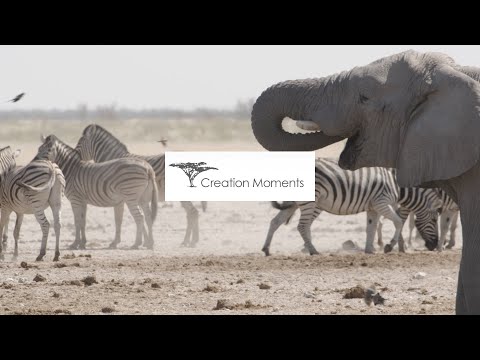
How do elephants keep their cool on a hot day? Find out on today’s Creation Moments Minute. For more creation resources visit https://creationmoments.com
The Satanic Temple is targeting kids by establishing after-school Satan clubs within multiple states, ranging from IL to CA to KS to TN. Read More
The ice age, which came after the flood, provided the perfect conditions for mankind to spread around the Earth. Read More
There was only one ice age, and it came after the global flood. As the fountains of the great deep burst open, underwater volcanoes warmed the oceans. Read More
The fossil record shows that hummingbirds have always been hummingbirds. Such amazing mastery of aerial acrobatics could never have evolved.1,2 ICR’s Dr. Jeff Tomkins put it succinctly:
The hummingbird is another animal that glorifies the Creator. This little creature is distinctly different from all other bird kinds. Hummingbirds are the only bird that can fly backward. They can litera... More...
Skin is the largest organ of your body. It helps maintain a person’s or animal’s homeostasis (a relatively stable equilibrium), insulation, and sensory functions. As such, it is very complex. Creation scientists predict that wherever skin is found in the fossil record, it would be 100% skin, unique and functional to that animal group.
Recently, a tiny piece of amniote, or terrestrial vertebrate, epidermal skin was dis... More...
A new study challenges “decades of scientific understanding” by suggesting that maybe evolution isn’t as random as was thought. Read More
During the days our attractions are closed in winter, our artists and fabrication teams work on very needed cleaning and repairing of the exhibits. Read More
For a few years now, we have been documenting the on-going progress of one of the most powerful scientific evidences of a young Earth.1 Since evolutionist Mary Schweitzer began bringing to light soft tissue in dinosaur fossils in the early 2000s, the list of dinosaur species in which soft, stretchy tissue, collagen, blood vessels, cells, or proteins have been found has grown significantly, reaching ever deeper into the geologic column. Obviously, her research has been controversial and dismissed by many from the beginning, since all dinosaur fossils allegedly are at least 65-66 million years old—according to the evolutionary paradigm. Read
[More]
The idea of an icy world inhabited by mammoths and saber-toothed tigers fascinates people. But where does this fit into biblical history? Read More
The New Testament is the most well-attested ancient work—and we are finding new manuscripts even today!
You can learn more about flood geology, fossils, and more in the Flood Geology playlist on our Answers in Genesis YouTube channel. Read More
Perhaps the most shocking twist of Scripture is when people say that the Bible supports a woman’s supposed right to abortion (to killing her child). Read More
Zonkeys are the offspring of zebras and donkeys, ligers come from lions and tigers, and wholphins come from false killer whales and dolphins. Read More
Tyrannosaurs were large terrestrial predators after the Fall.1 Juvenile or not, they conjure visions of terrible, fearsome creatures of the pre-Flood world when the earth was “filled with violence.”2,3 Like all dinosaurs, their origin and evolution are an enigma to evolutionists.4
Recently, Dinosaur Park Formation in Alberta, Canada, revealed a juvenile tyrannosaurid skeleton allegedly... More...
God created a great variety of stars—many sizes and colours—which could not have formed naturally.
Some evolutionists are admitting that it’s just impossible for life to have
begun from nothing, on Earth. So they’re asking…
DNA is an information system with all the instructions on how to make you. So where did this information come from? Read More
Should public schools be allowed to teach the idea of Intelligent Design in the classroom? Read More
There was more than enough vegetation before the flood to produce all the coal we have today. Read More
 8,496 views
 13,214 views
 503,481 views
 16,391 views
 19,277 views
 13,624 views