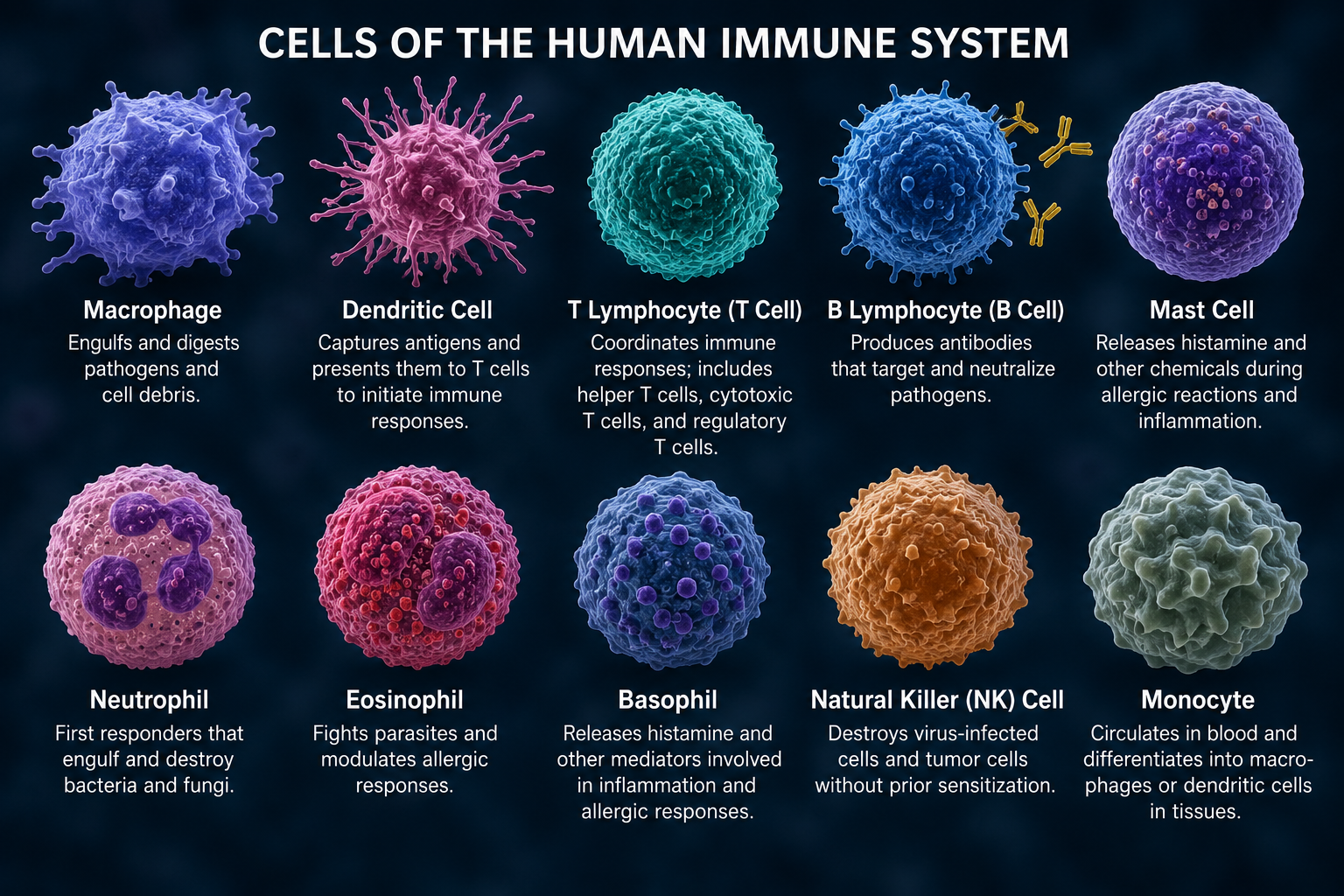
John: Hey Nigel, have you ever just stopped and really thought about what’s going on inside us, right now, as we’re just sitting here chatting?
Nigel: I mean, vaguely, John. My heart’s pumping, lungs are breathing. The usual stuff. Why, what deep philosophical thought have you stumbled upon today?
John: It’s not so much philosophical as it is… an engineering marvel. I’m talking about the human immune system. We take it completely for granted until we get sick, but honestly, it’s one of the most intricately designed, unbelievably complex systems imaginable. It’s like a miniature, hyper-efficient defense force operating 24/7 without us even realizing it.
Nigel: You know, you’re right. We only notice it when it fails, or when we catch a cold and our body just… fights it off. But what actually is it? I always think of it as just ‘antibodies’ or something.
John: Ah, antibodies are just one part, albeit a crucial one. Think of the immune system as having layers, or different branches of an army. You’ve got your innate immunity, which is your body’s first, general response – it’s fast and non-specific. Then you have adaptive immunity, which is the specialized, highly targeted force that ‘remembers’ past invaders. It’s like having a rapid response team and a special ops unit all rolled into one.
Nigel: Okay, ‘rapid response team’ versus ‘special ops unit.’ I like that analogy. So, what’s in the rapid response team? Like, my skin, right? That’s part of it.
John: Absolutely! Your skin is your physical barrier, your first line of defense. But beyond that, internally, you’ve got these amazing cells called phagocytes – literally ‘eater cells.’ Think of macrophages and neutrophils. They’re like the clean-up crew, patrolling for anything foreign, anything that shouldn’t be there, and just engulfing it and destroying it. They don’t need to identify a specific threat; they just recognize ‘foreign’ and get to work. It’s brilliant in its simplicity and speed.
Nigel: So, they just gobble up whatever looks suspicious? Like little biological Pac-Men?
John: Exactly! And they do it with incredible efficiency. When you cut yourself, and it gets a little red and inflamed, that’s often these guys rushing to the scene, along with other chemicals that signal ‘trouble here!’ It’s an immediate, coordinated response to contain the threat before it spreads.
Nigel: That’s pretty wild to think about. I’m just walking around, and these tiny soldiers are constantly on patrol. But what about the ‘special ops’ unit? The adaptive immunity? That sounds even more complex.
John: It is, and this is where it gets truly mind-boggling, Nigel. Adaptive immunity is handled by lymphocytes, primarily T cells and B cells. These aren’t just general clean-up crews; they’re highly specialized detectives and assassins. What sets them apart is their ability to recognize specific pathogens – a particular virus, a specific bacteria – and then mount a tailored attack.
Nigel: How do they ‘recognize’ anything? I mean, a virus is just a tiny speck. How does a cell ‘know’ what it is?
John: That’s the genius of it. Pathogens have unique molecular signatures on their surface, like tiny flags, called antigens. Our T cells and B cells have receptors that are specifically designed to bind to these antigens, like a lock and key. And here’s the kicker: the human body can generate an almost infinite variety of these receptors, meaning it can potentially recognize almost any pathogen it encounters throughout a lifetime. It’s a system designed for immense versatility and foresight.
Nigel: Wait, so your body just… produces trillions of different ‘keys’ on the off chance one of them will fit a future ‘lock’ it hasn’t even seen yet? That’s… incredible.
John: Precisely! It’s a pre-programmed readiness. When a B cell or T cell encounters an antigen that fits its specific receptor, it gets activated. Let’s talk about B cells first. Once activated, they become plasma cells, which are essentially antibody factories. These antibodies are Y-shaped proteins that are exquisitely designed to bind to that specific antigen. They can neutralize the pathogen directly, mark it for destruction by those ‘Pac-Men’ phagocytes we talked about, or prevent it from entering cells.
Nigel: So, it’s like a targeted missile system. The B cells build the missiles, and the missiles go straight for the enemy.
John: Exactly! And not just that. After the infection is cleared, some of those B cells don’t die off; they transform into ‘memory B cells.’ These cells are like a biological database, remembering that specific pathogen. If you encounter it again, these memory cells spring into action much faster and produce antibodies more effectively, often preventing you from even realizing you’ve been exposed.
Nigel: It’s like the immune system is learning. It’s got this incredible capacity for learning and adaptation built right in. So, what about the T cells? What are their specific roles?
John: T cells are even more diverse and perform different, equally vital roles. You’ve got ‘helper T cells,’ which are like the commanders of the special ops unit. They don’t fight directly but identify threats and activate other immune cells, including B cells and other types of T cells. Then there are ‘killer T cells,’ or cytotoxic T lymphocytes. These are the direct assassins. They recognize and destroy infected cells, like cells taken over by a virus, or even cancerous cells. They’re like snipers, eliminating threats one by one.
Nigel: So, the helper T cells are the strategists, and the killer T cells are the direct combatants. How do these killer T cells know which cells to destroy? Don’t they ever make a mistake and attack healthy cells?
John: That’s another incredible layer of precision: self-recognition. Our cells have these special proteins on their surface called Major Histocompatibility Complex, or MHC molecules. Think of them as tiny display cases. Healthy cells display bits of ‘self’ proteins in their MHC molecules, signaling to T cells, ‘I’m one of us, all good here.’ But if a cell is infected, say by a virus, it starts displaying fragments of viral proteins in its MHC molecules. Killer T cells are specifically designed to recognize these ‘non-self’ or ‘altered-self’ antigens presented on MHC molecules, and only then do they engage and eliminate the compromised cell. It’s an internal surveillance system that distinguishes friend from foe with astonishing accuracy.
Nigel: That’s absolutely wild. So, every single cell in my body is basically broadcasting a ‘hello, I’m healthy’ signal, and my immune system is listening for the ones that don’t? And if it hears a ‘mayday’ signal, it sends in the killers? That’s… that’s an incredibly sophisticated communication network.
John: It truly is. And this communication isn’t just one-way. Immune cells communicate with each other using chemical messengers called cytokines and chemokines. These are like biological emails or text messages, directing cells where to go, what to do, and when to stop. It’s an exquisitely orchestrated symphony of billions of cells, each with specific roles, all working in concert to maintain our health.
Nigel: A symphony… that’s a perfect way to put it. Because if one instrument is out of tune, or if the conductor makes a mistake, the whole thing falls apart. I imagine that’s what happens with autoimmune diseases, right?
John: Exactly. Autoimmune diseases are tragic examples of when this incredibly precise system malfunctions, when the immune system mistakenly identifies ‘self’ as ‘non-self’ and starts attacking healthy tissues. The fact that these conditions are relatively rare, given the sheer complexity and number of recognition steps involved, really underscores the usual perfection and specificity of the system. It’s a testament to the elegant design that it normally works so flawlessly.
Nigel: I’m just picturing this vast, interconnected network, billions of cells, constantly scanning, identifying, communicating, deploying defenses. And it’s all happening inside me, right now, without me having to lift a finger. It’s not just a collection of parts; it’s an integrated, purposeful system.
John: That’s the beauty of it. Think about the level of foresight required to design a system that can not only defend against known threats but also adapt to new ones, remember them, and orchestrate a multi-pronged attack with such specificity and power. It’s not just reactive; it’s proactive and has a built-in learning mechanism.
Nigel: And the sheer scale! How many different types of pathogens are out there? Millions? And the immune system is prepared for all of them, or can develop a response to them. That’s just… it beggars belief, honestly.
John: It truly does. Every breath we take, every surface we touch, introduces potential invaders. And yet, most of the time, we’re completely oblivious because this internal guardian system is doing its job, perfectly. From the structural components like skin and mucous membranes, to the chemical warfare of complement proteins, to the cellular battalions of phagocytes, T cells, and B cells, it’s a multi-layered, multi-faceted defense that points to an incredible, intelligent blueprint.
Nigel: It sounds like a grand engineering project, meticulously planned and executed. Each component has its specific function, but it’s their coordination, their interaction, that makes the whole thing work so seamlessly. It’s not just complex; it’s coherently complex.
John: Coherently complex – I love that. And that coherence is what hints at something beyond random chance. When you look at the nested levels of organization, the built-in redundancy, the self-correction mechanisms, the memory function… it’s hard not to see the fingerprints of brilliant design. It’s a system that anticipates needs, adapts, and maintains balance with incredible elegance.
Nigel: It makes you think twice about just how much is going on inside us that we take for granted. Next time I feel a bit under the weather and then miraculously recover, I’m going to have a newfound appreciation for that internal army working tirelessly.
John: Exactly! It’s a daily miracle. The human immune system isn’t just a collection of parts; it’s a testament to incredible, ingenious design, a masterpiece of biological engineering that protects us from countless threats every single moment. It’s truly one of the most astonishing systems in all of biology, quietly ensuring our survival day in and day out.
Nigel: Well, John, you’ve certainly given me a lot to ponder about my own inner workings. It makes you feel incredibly grateful for the hidden genius that’s safeguarding us. What an amazing discussion!















![Farther Along / We’ll Understand It Better By and By [Live]](http://img.youtube.com/vi/2tcx4GVAVRY/0.jpg "Farther Along / We’ll Understand It Better By and By [Live]")
Thanks! Share it with your friends!
Tweet
Share
Pin It
LinkedIn
Google+
Reddit
Tumblr