01 [James]
If you stop and really think about it, the fact that you can look at a face, catch an expression, read emotion, judge distance, notice color, and do it all instantly is amazing The human eye feels so ordinary because we use it every waking moment, but the deeper you go, the more it starts to look like a masterpiece hiding in plain sight.
02 [Christopher]
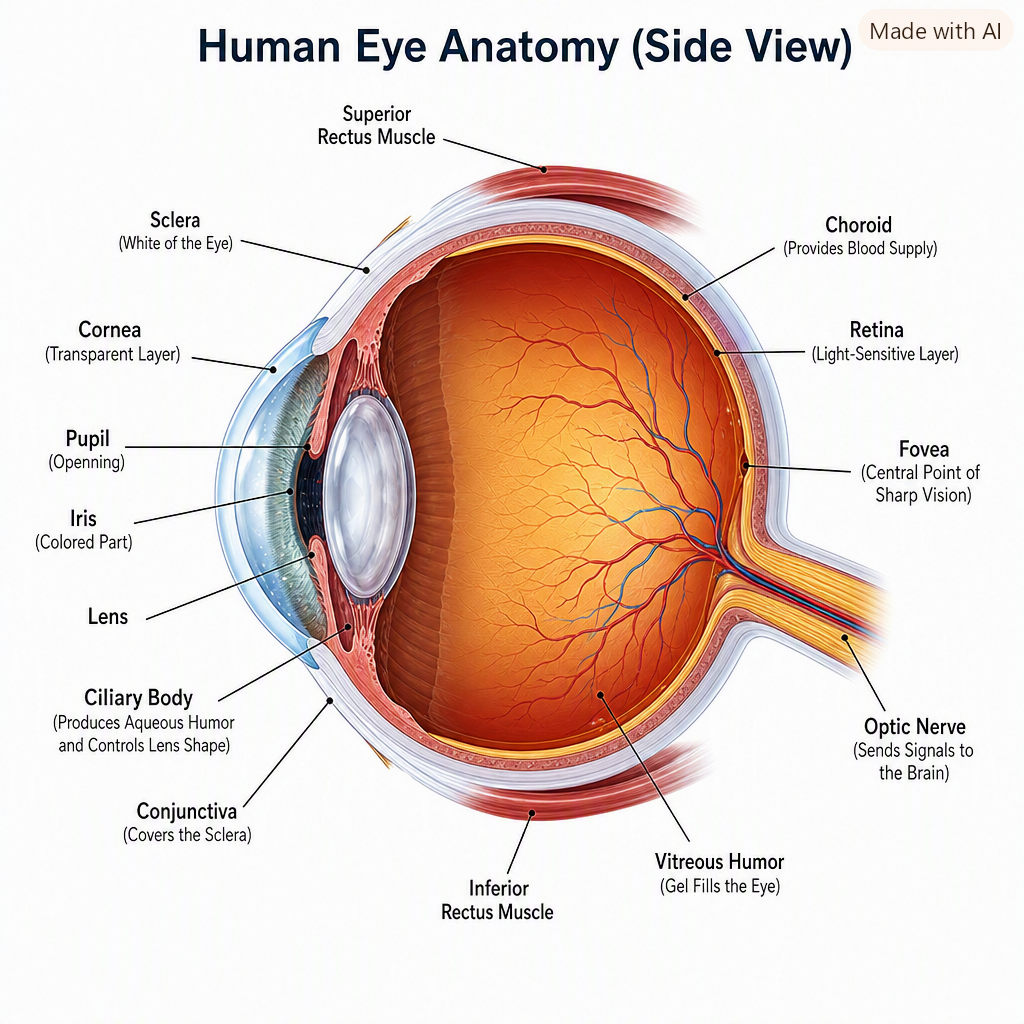
Exactly, and that’s the strange part. We treat eyesight like background magic. You wake up, open your eyes, and the world simply appears. But when you slow it down, there’s a transparent front window, a focusing system, a light-control mechanism, a chemical conversion process, and then a staggering amount of signal processing. It’s not just seeing. It’s a coordinated performance.
03 [James]
And a performance with almost no room for error. If the cornea isn’t clear, if the lens doesn’t focus, if the pupil doesn’t regulate light, if the retina can’t detect it, if the optic nerve can’t carry it, the whole experience changes dramatically. We’re talking about a system where many parts have to work together at once, and that’s what makes the eye so astonishing.
04 [Christopher]
Let’s start right at the front, because even the entry point is remarkable. Light first hits the cornea, that clear curved surface that does a huge portion of the eye’s focusing. It has to be transparent, smooth, strong, and carefully shaped. And that’s already a lot to ask from living tissue. It’s like having a perfectly polished window built into a protective shell.
05 [James]
And not just a window, a self-maintaining one. The tear film keeps that surface smooth and moist, clears away dust, and helps maintain optical quality. People think tears are only about crying, but they’re part of the visual system. If the eye dries out, vision gets blurry fast. So right away, seeing depends on lubrication, protection, and precision working together.
06 [Christopher]
That’s one of my favorite things about the eye: functions overlap. A single feature often does three jobs at once. The eyelids protect, spread tears, and help reset the surface. Blinking seems trivial until you realize it’s part of keeping the optics usable. Miss that coordination and the image quality degrades. It’s elegant, but also very demanding.
07 [James]
Then light passes through the pupil, and now you’ve got dynamic control. The iris adjusts how much light enters, and it does it constantly. In bright conditions, it tightens down. In low light, it opens wider. That sounds simple, but it means the eye has to manage extremes. It needs sensitivity in dim settings without being overwhelmed when the light suddenly floods in.
08 [Christopher]
And I’d argue that’s where the eye starts to feel engineered in a very obvious way. Because regulation matters as much as detection. Too much light can wash out detail. Too little light and you lose clarity. So the eye doesn’t merely receive input; it actively manages it. It’s not passive. It’s responsive, adaptive, and incredibly fast at changing modes.
09 [James]
I’m with you, though I’d go even further. The lens is where a lot of people underestimate the sophistication. It’s transparent tissue that changes shape so you can focus on things at different distances. Reading a page, then glancing across a room, then out a window—those shifts feel effortless. But behind that ease is a finely controlled focusing system making constant adjustments.
10 [Christopher]
Yes, and the astonishing part is that all of this has to stay aligned. Cornea, pupil, lens, retina—they can’t just exist in the same neighborhood. They have to be properly positioned relative to one another. If you had all the components of a camera but they were slightly off-center or out of sequence, the result would be poor at best. Arrangement matters.
11 [James]
That gets us into the second big wonder: the retina. Because once the light is focused, you still don’t have sight in the full sense. You have to convert light into signals the brain can use. And the retina is not just a sheet waiting to be hit. It’s layered, active, and full of specialized cells handling different aspects of visual information.
12 [Christopher]
Right, and this is where people start to realize the eye is less like a simple camera and more like an integrated sensing network. You’ve got rods for low-light sensitivity and cones for color and sharp detail. Different cells respond differently depending on conditions. So the system can function in moonlight, daylight, and everything in between. That flexibility is astonishing.
13 [James]
And the cones alone open up a world of complexity. Color vision depends on comparing responses across different kinds of cone cells. That means the eye isn’t merely registering brightness. It’s distinguishing wavelengths in a coordinated way that allows us to perceive rich, stable color. A red apple, green leaves, a blue sky—those experiences depend on highly tuned comparison systems.
14 [Christopher]
What I find especially compelling is that the eye doesn’t hand over raw chaos. There’s preprocessing. Cells in the retina are already organizing information, enhancing contrast, filtering noise, and preparing signals before they ever travel deeper into the visual pathway. In other words, the eye begins interpretation immediately. That’s extraordinary. It’s not just a detector. It’s an intelligent front-end.
15 [James]
And from an intelligent design perspective, that layered coordination really stands out. You’re not looking at one clever trick. You’re looking at multiple systems that depend on each other: optics, chemistry, electrical signaling, fluid balance, muscular control, protective mechanisms, and information handling. The more you list them, the less plausible it feels that this is just a fortunate pileup of useful features.
16 [Christopher]
I agree, though some people hear that and think it’s just an emotional reaction to complexity. But it isn’t only that the eye is complicated. It’s that the parts are functionally matched. Transparency where transparency is essential. Pigment where stray light must be controlled. Curvature where focusing is required. Sensitivity where light has to be detected. It’s not complexity alone. It’s purposeful complexity.
17 [James]
That phrase matters—purposeful complexity. Because the eye is built around an outcome: usable vision. Not random activity, not mere light awareness, but detailed, adaptable, meaningful sight. And then you add depth perception from two eyes working together, smooth tracking of moving objects, and the ability to maintain a stable visual world even while your eyes are constantly moving. It’s almost too much to take in.
18 [Christopher]
Let’s talk about movement, because that’s the third big area people forget. Your eyes are never really still. Tiny movements, tracking motions, rapid jumps from point to point—these all help build a coherent visual experience. Muscles have to move the eyes with speed and precision, and both eyes must stay coordinated. Otherwise, the world would double, drift, or feel unstable.
19 [James]
And those movements are tied to attention. You hear a sound, your eyes snap toward it. You read a sentence, your gaze lands in sequence across the line. You catch a ball, your eyes track its path smoothly. So now we’re talking about visual mechanics linked with perception, timing, and response. It’s not an isolated organ. It’s deeply integrated with the rest of the person.
20 [Christopher]
That integration becomes even more striking when you think about the optic nerve. Signals from the retina have to leave the eye and travel onward with enormous fidelity. Millions of fibers are involved in carrying visual information. The sheer data handling is incredible. And somehow this transmission is fast enough that your experience feels immediate. There’s no sense of waiting for the world to be assembled.
21 [James]
Which leads to the fourth big idea: seeing is not the eye alone. The eye captures and prepares, but vision depends on an entire chain working together. The incoming image is interpreted as edges, motion, color, depth, faces, and spatial relationships. What feels effortless to us is built on an immense collaboration between the eye and the brain. We live inside the finished product.
22 [Christopher]
And that’s where the wonder deepens for me, because the system has to deliver not just data but useful reality. We don’t want a meaningless flood of signals. We need a world we can navigate. We need recognition, orientation, judgment. The visual system gives us all of that with incredible reliability. It’s hard not to see intention in a setup so profoundly suited to human life.
23 [James]
I think that reliability is easy to overlook because it’s familiar. But imagine how many variables are constantly changing: lighting, distance, motion, focus, reflections, shadows, partial obstruction. Yet most of the time you can still identify a friend across a room, pour a drink, climb stairs, read a sign, or thread a needle. That level of practical success speaks volumes.
24 [Christopher]
And even the vulnerabilities of the eye tell you something about its precision. Small disruptions can have big consequences, which is what you’d expect in a highly refined system. A tiny scratch on the cornea hurts and alters vision. Pressure changes matter. Lens clarity matters. Retinal health matters. These aren’t signs of poor design. They’re signs that delicate precision is doing serious work.
25 [James]
That’s a good point, because delicate doesn’t mean accidental. It often means exact. The eye has to be both protected and exposed, soft yet durable, transparent yet living, responsive yet stable. Those are difficult requirements to combine in one organ. And somehow they are combined in a way that serves everyday human experience with extraordinary grace.
26 [Christopher]
So if someone asked why the human eye inspires awe, I’d say it’s because every layer of it rewards closer attention. The surface is impressive. The optics are impressive. The cellular chemistry is impressive. The signal processing is impressive. The coordination with movement and perception is impressive. And all of it seems ordered toward the gift of sight in a way that feels deeply meaningful.
27 [James]
And maybe that’s the best place to leave it: the eye is so familiar that we forget how astonishing it is. But once you pause and look closely—no pun intended—you start to see a system of breathtaking sophistication. Not just complicated, but coherent. Not just functional, but elegant. And for me, that makes opening your eyes each morning feel a little more like a wonder. Thanks for listening.

















Thanks! Share it with your friends!
Tweet
Share
Pin It
LinkedIn
Google+
Reddit
Tumblr