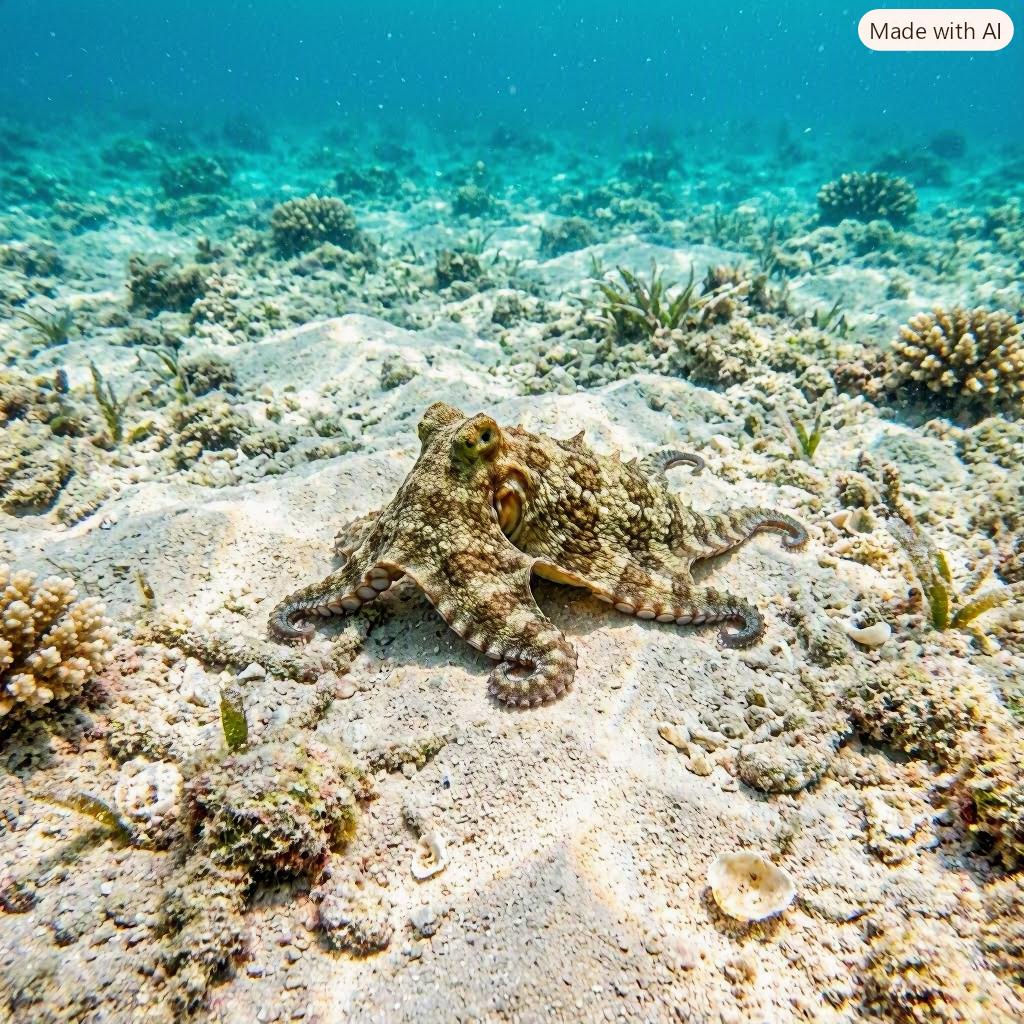
John: Nigel, have you ever just stopped and considered the sheer ingenuity present in some of the creatures that share this world with us? I mean, really considered it?
Nigel: Absolutely, John. It’s an endless source of fascination for me. There’s a particular creature I’ve been thinking about recently, one that truly embodies a level of purposeful crafting that’s just breathtaking: the mimic octopus.
John: Ah, the mimic octopus! What an incredible subject. It’s almost as if it was specifically put together with a toolkit for impersonation. It’s not just camouflage; it’s an active, deliberate act of becoming something else entirely.
Nigel: Precisely. When you watch it operate, it’s like observing a perfectly designed system at work. This isn’t just about blending in; it’s about transforming itself into other distinct organisms, sometimes with astonishing accuracy and speed. How does something acquire such a repertoire of disguises, complete with the appropriate behavioral patterns?
John: That’s the core question, isn’t it? Take, for instance, its ability to morph into a lionfish. Not only does it change its skin pattern and color to match, but it also arranges its arms to simulate the venomous spines of the lionfish. It’s a complete package – visual and behavioral – engineered to deter a potential threat.
Nigel: And the timing! It’s not just a static impression. It understands when to adopt a particular guise. If a small, quick predator approaches, it might become a flat sole fish, hugging the ocean floor, almost vanishing. If a larger, more cautious predator looms, out come the ‘lionfish spines’ or the ‘sea snake’ impression. It’s adaptive in a way that implies a guiding intelligence behind its actions.
John: The sea snake mimicry is arguably even more complex, wouldn’t you say? It tucks six of its arms into a burrow, leaving two arms trailing behind it, undulating in a way that precisely imitates a banded sea snake, a highly venomous creature. The details, the execution, the choice of what to mimic – it’s all so perfectly orchestrated.
Nigel: It implies not just the physical machinery for transformation, but also a sophisticated cognitive system that assesses the situation, accesses a ‘library’ of impersonations, and then executes the chosen one with pinpoint accuracy. This isn’t random trial and error; this is a calculated, purposeful display.
John: Indeed. Think about the underlying mechanics. It possesses specialized pigment sacs called chromatophores, but also iridophores and leucophores, allowing it to reflect and refract light. These are controlled by muscles, which in turn are controlled by its brain. The speed and precision with which it can manipulate these elements to create a dynamic, believable illusion is astounding.
Nigel: It’s like having a built-in, real-time special effects studio. Each chromatophore can be expanded or contracted in milliseconds, creating textures and patterns that are not just visual but also tactile to the touch. The ability to shift from smooth to bumpy, from dull to iridescent, from one complex pattern to another, all in a blink – it’s a testament to incredible foresight in its composition.
John: And the fact that it can combine these elements. It’s not just a single trick. It’s a suite of abilities, integrated seamlessly. It can even mimic an entire coral patch, complete with the appearance of polyps, or disappear into a sandy bottom with a ripple-like texture.
Nigel: The sheer breadth of its repertoire suggests a very sophisticated blueprint. It’s not just one or two specific mimics; it’s a versatile master of disguise. This adaptability, this profound capacity for ‘acting’ and strategic deception, points to an intelligent origin for its capabilities. How else could such complex, interconnected systems, serving such specific purposes, come into being?
John: It implies a highly integrated design, where the visual cortex, motor control, skin physiology, and behavioral programming all work in perfect harmony. If even one component of this intricate system were missing or flawed, the entire illusion would fail, and the octopus might not survive. This implies a complete, functional design from the outset.
Nigel: Exactly. Consider the information processing required. It needs to perceive its environment, identify potential threats or opportunities, recall the appropriate mimicry from its stored knowledge, and then orchestrate its entire body – down to the individual pigment cells and muscle fibers – to perform that specific impersonation. That’s a staggering amount of coordinated activity.
John: And the fact that it seems to ‘understand’ the concept of venom or danger, even though it doesn’t possess those characteristics itself. It’s borrowing the ‘reputation’ of other creatures. This isn’t just instinct; it’s a form of strategic communication using an elaborate ‘costume’ and ‘script’.
Nigel: Which begs the question: how does an organism come to be endowed with such an understanding and such an unparalleled set of tools to act on it? It speaks to a profound level of intentionality. The mimic octopus is a living testament to the concept of precision engineering.
John: It’s as if every element, from the smallest cellular mechanism to the overarching behavioral strategies, was meticulously thought out and assembled for a very clear purpose. The capacity for such rapid, complex phenotypic change is simply unparalleled in the living world.
Nigel: And it’s not just for defense. There are suggestions it uses mimicry for hunting as well, perhaps becoming a specific type of crab to lure another type of prey. So, it’s a multi-purpose design, enhancing both survival and sustenance. That level of comprehensive utility is truly remarkable.
John: This whole discussion just reinforces the idea that there’s an incredible mind at work behind these living systems. The mimic octopus isn’t just a collection of random features; it’s a cohesive, fully integrated system designed for a specific set of complex tasks.
Nigel: Indeed. When you look at the mimic octopus, you’re not just seeing an organism; you’re seeing a masterwork of design, a brilliant solution to a multifaceted set of challenges, executed with extraordinary elegance and intelligence.
John: It makes you wonder what other incredible blueprints exist, just waiting to be observed and appreciated for their ingenious construction. The mimic octopus is truly a marvel.
Nigel: A marvel indeed, John. A testament to a profound, creative intelligence that continues to inspire awe. What a privilege to even consider such things. Thanks for diving into this with me today.
John: My pleasure, Nigel. And to our listeners, we hope this conversation about the astonishing mimic octopus has given you something truly incredible to ponder. Until next time, keep exploring the wonders of purposeful design.


















Thanks! Share it with your friends!
Tweet
Share
Pin It
LinkedIn
Google+
Reddit
Tumblr