[John]
Nigel, you know how sometimes you come across something so utterly fascinating, so perfectly crafted, that it just stops you in your tracks?
[Nigel]
Absolutely, John. Like finding a perfectly engineered clock, or a beautifully composed piece of music. What’s sparked your wonder today?
[John]
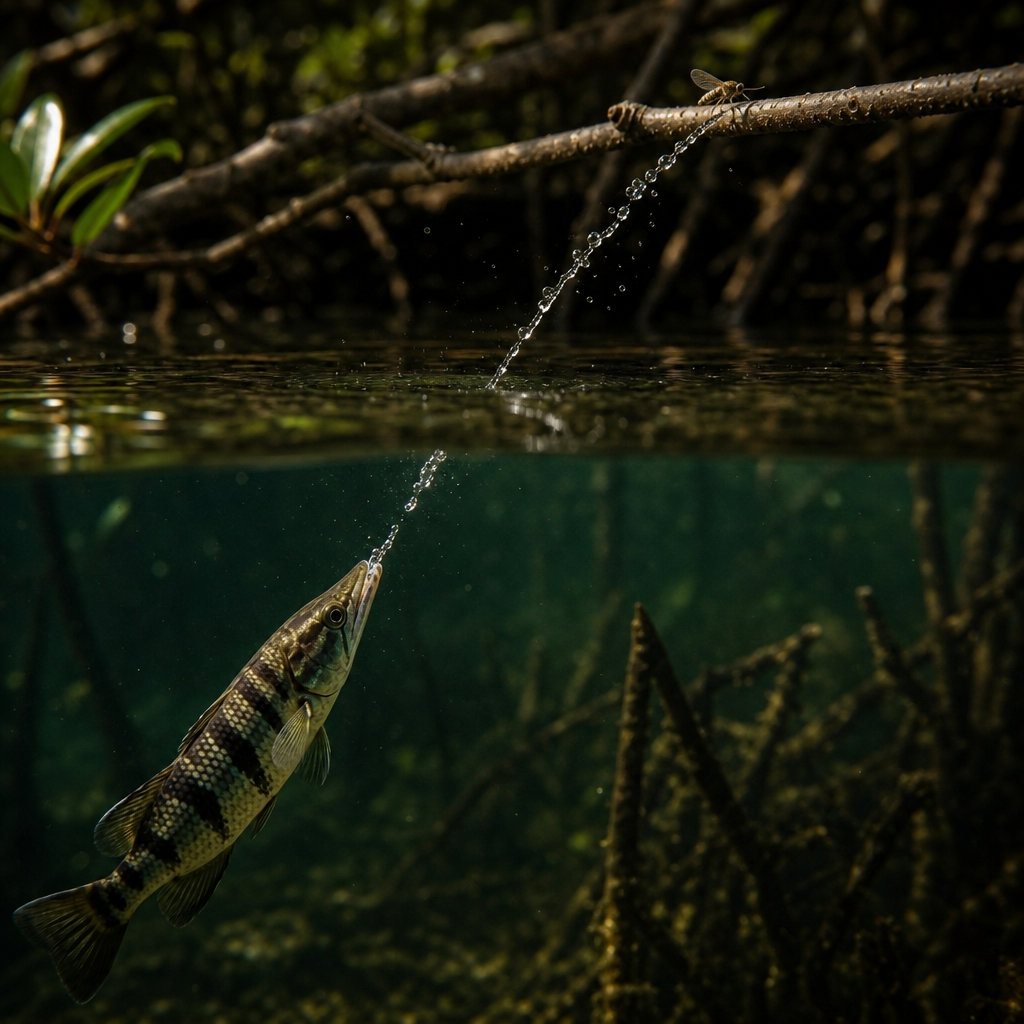
Well, I’ve been thinking a lot about the archerfish. It’s a creature that just shouts ‘design’ from every angle. Seriously, the more you learn about it, the more incredible it becomes.
[Nigel]
Ah, the archerfish! The one that shoots water, right? I’ve seen clips, it’s pretty wild. But tell me, what specifically about it makes you think ‘design’ so strongly?
[John]
It’s not just that it shoots water, Nigel, it’s how it does it, and all the incredibly precise systems that have to be perfectly coordinated for it to even work. Imagine this: a fish, submerged in water, spots an insect on a leaf or branch overhead, sometimes several feet away.
[Nigel]
Okay, so it sees the target. That’s already a challenge, given the water-air interface creating visual distortion.
[John]
Exactly! It has to instantly correct for that light refraction. Its brain needs to calculate not just the target’s position, but its true position, accounting for the way light bends as it passes from air to water. It’s an instantaneous, complex calculation every single time.
[Nigel]
So, it’s not just ‘looking up.’ It’s performing real-time physics calculations in its brain. That’s sophisticated. But that’s just the aiming part, right? What about the actual shot?
[John]
That’s where it gets even more amazing. To shoot that jet of water, it creates a ‘gun barrel’ in its mouth. Its tongue presses against a groove in the roof of its mouth, forming this incredibly precise channel.
[Nigel]
A ‘gun barrel’ with its own anatomy? That’s quite specific. So, it’s not just spitting, it’s a controlled projection.
[John]
Precisely. Then, with a sudden, powerful snap of its gill covers, it forces a concentrated stream of water through that channel. It’s not just a dribble; it’s a high-velocity, focused jet that can knock insects off branches up to six feet away, and sometimes even higher.
[Nigel]
Six feet! That requires incredible force and accuracy. And a specific mouth structure, as you said. So, we’ve got sophisticated vision, advanced neurological calculations for refraction, and a perfectly formed anatomical ‘device’ in its mouth. What else is in play?
[John]
The muscle control is phenomenal. It needs incredibly precise muscle contractions to generate just the right amount of pressure and direction for the water jet. Too little, and the shot falls short. Too much, and it might overshoot or destabilize the fish itself. It’s a ballet of muscular coordination.
[Nigel]
So, what you’re describing is an entire integrated system. The eyes, the brain, the mouth structure, the musculature – all have to be fully formed and perfectly synchronized for this hunting method to be effective at all. It’s not like you can have just one of those components and expect success.
[John]
Exactly! That’s the crux of the intelligent design perspective for me with the archerfish. Imagine trying to build this system piecemeal. What if the vision wasn’t perfectly calibrated for refraction correction? It would miss every single shot. What if the mouth wasn’t perfectly grooved? The water would just spray uselessly.
[Nigel]
Or if the muscles weren’t developed enough to provide the necessary force. Any single component, if it were incomplete or non-functional, would render the entire system useless. A half-formed ‘gun barrel’ mouth serves no purpose.
[John]
Right. You can’t have ‘half a jet.’ You either have a functional water jet that can reliably bring down prey, or you don’t. And if you don’t, then this specific hunting method, which is so central to this creature’s way of life, couldn’t exist.
[Nigel]
It implies a sort of ‘all or nothing’ scenario for the complete system. It’s hard to conceive of how each of these incredibly specific, interdependent parts could have come into being gradually, one by one.
[John]
Precisely. If you only had the specialized mouth, but no refraction correction, you’d be shooting blind. If you had the vision, but no effective water propulsion system, you’d just be seeing dinner you couldn’t reach. They all have to be there, fully operational, from the very beginning of this particular hunting strategy.
[Nigel]
It’s like a finely tuned machine. You can’t just add a gear here, and a lever there, over eons, hoping they’ll eventually connect and suddenly produce a complex output like ‘time-telling’ or ‘water-shooting.’ The blueprint for the whole mechanism must be present.
[John]
Absolutely. And it even gets better. They’re incredibly accurate. Often, they only need one shot to hit their target. But if they miss, they’ll fire again, sometimes multiple times, adjusting their aim. This indicates a learning component, too, built into their operational framework.
[Nigel]
So, the design includes not just the physical tools, but also the capacity for sophisticated real-time adjustment and skill refinement. It’s not static; it’s dynamic within its parameters. That’s another layer of complexity. Young archerfish, I understand, aren’t immediately proficient. They learn from observing older fish. This built-in learning mechanism is itself a designed feature, allowing for the skill to be acquired and perfected within the creature’s lifespan.
[John]
Right, the capacity to learn this intricate skill is inherent to its form. It’s not something it invents from scratch, but a capability that’s part of its designed toolkit. It reinforces the idea of a comprehensive, integrated system. The entire package, from the visual processing to the motor control and even the learning capacity, appears purpose-built.
[Nigel]
It’s hard to reconcile such an intricate, multi-component, interdependent system with anything other than intelligent forethought. Each part is essential, and the absence or imperfection of any one element would lead to complete failure of the overall function.
[John]
It forces you to consider the idea of an original, complete design. Because if you remove any critical piece of that archerfish’s water-shooting system, the whole thing falls apart. It stops being an archerfish in any functional sense.
[Nigel]
So, the archerfish isn’t just a fish with a unique trick. It’s a living example of extreme precision and integration, a testament to a deliberate, unified plan behind its existence.
[John]
Absolutely. It’s a tiny, powerful example of how intricate and perfectly formed certain systems are, making it incredibly difficult to imagine them coming into being without an overarching intelligence guiding their precise configuration.
[Nigel]
It truly is a marvel, John. A real eye-opener into the depth of ingenuity woven into the fabric of life.
[John]
Indeed, Nigel. A truly remarkable creature, prompting some profound questions.

















Thanks! Share it with your friends!
Tweet
Share
Pin It
LinkedIn
Google+
Reddit
Tumblr